Glorification – There Is a New You Coming
For the last several weeks, I’ve been talking to you about understanding the big words. This has been kind of a theological series, but you guys have come to me and acted like you’d like to hear a little theology every now and then. I’ve talked to you about predestination and what the Bible says about that. I told you God knew you before you knew Him. I’ve talked to you about justification, the fact that God declares those who trust Christ to be not guilty. I’ve talked to you about regeneration, the fact that God brings His Spirit inside of you at new birth and gives you a new beginning. I talked to you last week about sanctification, how Gods wants you to live in victory over the sinful nature.
Today I’m going to talk to you about another big word and that is glorification. There are three passages from the book of Romans that I want to look at today. Romans 3:23 says this:
For all have sinned and fallen short of the glory of God. Romans 5:2 says: We rejoice in the hope of the glory of God.
What that says is that in sin, we lost something, but in salvation, we are looking forward to its restoration. It says when we sinned, we lost the glory of God. But God has given us hope that there is a glory yet to come.
Then Paul said in Romans 8:30:
Those He predestined He also called; those He called He also justified; those He justified He also glorified.
Now this message today will bring to a conclusion this series on “Understanding the Big Words.” It is a good way to end
because glorification is the end of God’s fantastic plan of redemption. It’s what God had in mind from the beginning. It was the whole purpose for which Christ came–that we might be restored to that original position.
Many of you are perhaps aware of the nook by Stephen Covey entitled, The Seven Habits of Highly Effective People.
It has been on the number one bestseller list for a number of years. From that, Stephen Covey has written several other excellent books. I like this book and, in fact, I’ve been impacted by the book.
Stephen Covey said one of the habits of highly effective people is they begin with the end in mind. I want you to know something. God is infinitely effective. He always begins with the end in mind. He began knowing where He was going.
God said, “My plan is that, one day, I will stand before a group of people from every nation, kindred, tribe and tongue and I will say, ‘I am your God and you are My people.’” That was the moment for which God created all things. He would bring us to that culmination, that climactic moment of glorification.
Now let me give you the definition of this big word, glorification. 2
Glorification is the final act of God’s redemptive plan in which He will redeem the physical bodies of the righteous, restore their souls to perfection and release all of creation from the curse of sin. Let’s look at that definition in three points
Glorification means that one day our bodies are going to be redeemed. Look at some portion of your body, which are probably your hands. Look at them. One day, that flesh is going to be redeemed. One day, you’re not going to have the same body you have right now. The Bible says He is going to transform and change it.
Most of us are not pleased with our bodies. In fact, the vast majority of Americans wish they were either taller, shorter, skinner, more muscular, had a smaller nose, more hair, any hair, darker hair…you know, we would like to change something. We’re not very pleased with our bodies. Plastic surgery is a booming business in America. But I want to tell you something: one day, you are going to have a body that you are completely and totally thrilled with because that is the promise of God. God has promised that our bodies will experience His transforming grace and His transforming
power.
In Romans 8:23, Paul said: We wait anxiously for that day when God will give us our full rights as His children, including the new bodies He has promised us.
God said He would give us a new body.
Christianity is the only religion I’m aware of that promises a new body. Other religions will talk about the immortality of the soul, about your soul existing forever, or about reincarnation. Only Christianity talks about a resurrected changed body. God said He created all of you and will not allow any of you to see destruction because, when God created you, He
created you not as a dualistic creature.
Some people have this idea that human beings are like a spirit trapped in a body; that your body is like a prison, that your body is somehow bad and your spirit longs to be free from the body. Now that’s good Greek philosophy, good new age gobbledygook, but it is poor Christian theology.
Christian theology says your body is a part of who you are. Your body is not evil because, when God created your body, He looked down on what He had created and said, “It is good.” It is sin that has affected our body and God says that not only will He redeem your spirit, not only will He redeem your soul; He is going to redeem your body. God says human beings are unified beings. We are not dualistic, we’re unified beings. God says He’s going to save all of you. That’s what glorification is all about.
There’s going to come a time when Jesus Christ returns that He said, “I’m going to redeem your physical body.” You see, at Christ’s return, our bodies will be made similar to the resurrection body of Jesus. In a couple of weeks, we’re going to celebrate Easter. We are going to celebrate the resurrection of Jesus. The Bible says the body Jesus had after His resurrection, one day God will shape and form this body similar to that body.
In Philippians 3:21, Paul says:
Jesus will take these weak mortal bodies of ours and change them into glorious bodies like His own, using the same mighty power He will use to conquer everything else.
God says He’s going to change these bodies. Paul said in I Corinthians 15:51, 52: We will all be transformed in a moment, in the blinking of an eye, when the last trumpet is blown. 3
He said there’s going to come a day when we are all going to morph. God’s going to change the whole molecular structure of this body. He’s going to change the whole DNA. We will have new bodies and a new life. There’s an old song that says, “On that resurrection morning when the dead in Christ shall rise, I’ll have a new body, and I’ll have a new life.” God says He’s going to change your physical body. I am really fascinated by certain exercise equipment. Don’t you especially like the ones for the abdomen? They show a person kind of like me who turns a few times and looks like Arnold Schwartzenager. If I could do that in three turns, I’d have been turning a long time ago. I am the poster boy for the “before” pictures. Did you ever notice on the before pictures people always look sad and they stick out their stomachs as far as they can? But when it comes to the after, they are smiling and sucking it in. They are saying, “Hurry up and get the picture, I can’t hold it in much longer!”
I want you to know God has some before and after pictures. They are in I Corinthians 15: 42-44. Paul is talking about what our body is like before it is changed and what it will be like after it is changed. Here is what he says: That body that is sown is perishable, it is raised imperishable…sown in dishonor, raised in glory…sown in weakness, raised in power…sown a natural body, raised a spiritual body.
The before picture is perishable; the after picture is imperishable. The before picture is dishonor; the after picture is glory. The before picture is weakness; the after picture is power. The before picture is a natural body. The after picture is a spiritual body. That is God’s before and after shots.
Now, we are still in that before phase right now. I realize that even more now as I’m approaching 50. I can’t read anything except a large print Bible’s unless I wear these glasses. I bought these glasses 18 months ago at Sam’s. Once
you ever start using these, you’ll never be able to read again without them. About two months ago, I was walking down the steps in the office and all of a sudden, my big toe started hurting
something fierce. I thought I had a cramp on my big toe. I mean, it was hurting, and it wouldn’t go away. I was on my way to speak somewhere, and I was hobbling and telling my wife about my big toe hurting. It wouldn’t quit hurting, so I told her I must have gout. I don’t even know what gout is. I just know old people get it in their toes.
Well, I didn’t have gout, because my toe wasn’t red. They said it was supposed to be red and it wasn’t. I said, “Well, it looks normal, but it hurts.” Finally, I had to go to the doctor for some blood work, and while I was there I said, “Hey, by the way, my big toe has been hurting.” So she took off my sock and shoe and looked at my toe and asked, “Does it hurt when I do this?” I yelled, “Oh, yes!” She said, “You have arthritis.” I said, “Arthritis? You don’t get arthritis in your big toe.” She said, “You do!” I thought, “Oh. No! I’m old.” All of a sudden, you start getting applications for AARP and stuff like that. You realize this old body is getting old. I’ve got an age spot here and a bump I’ve been feeling and wonder where that bump came from.
Just because I’m in the before picture, I want you to see my after picture. I want you to see your after picture as a follower of Jesus. Jesus said your after picture is an imperishable body. Imperishable means a body that won’t wear out, that won’t grow old. No sickness, injury or death will affect this body. You will have a healthy and strong body forever – a body that is youthful and mature. God says that’s the kind of body He will make you afterwards imperishable.
Then He says that your old body is dishonorable, but your new body will be glorious, in glory. I looked that up and this is what it means: it’s going to be beautiful, attractive, radiant, visible brightness. That’s what glory means–visible brightness. Now I don’t know if that means we’re going to walk around shining, but there will be a visible radiance about this new body. Jesus Himself said in Matthew 13:43: The righteous will shine like the sun. So, the idea here is this body is going to nonperishable, beautiful, and glorious. Then He said the old body was weak, but the new one will be powerful. You know what that means? It means full of strength, as God intended us to be before we ever sinned–a body that’s like the Eveready bunny – it just keeps going and going and going. He says that’s the kind of morph body you’re going to have. It’s going to be changed. It’s not going to wear out. It’s going to be 4 perfect. It’s going to go on forever. God says it’s going to be a powerful body, a youthful, strong body. Glory to God!
That’s where we’re headed.
Then God says this: the old body is like a natural body; the new body is like a spiritual body. I looked at that and thought, “Now, what does that mean? Does that mean we’re not going to have a physical body?” No, it does not mean that, because our body is going to be like Jesus. He had a physical body. It doesn’t mean we’re going to be like ghosts, like vapor, or some kind of spirit. It literally means a body that is in complete control of the Holy Spirit. It’s a body that the Spirit is completely controlling.
Now you know what the disciples said to Jesus: the spirit is willing, but the flesh is weak. In the new body, the flesh will never be weak. It will always respond to the Spirit. It will always move in the Spirit. It will be a body that relates to the spirit world correctly and completely. That is the body that we’re headed for. The Bible says when Jesus comes, it’s going to be in a moment, in the blinking of an eye, and the change will take place. You know what that’s called? It’s called glorification. God’s going to restore to you the original glory that sin caused us to fall from.
The second thing that’s going to happen is, not only is God going to affect our bodies, but God will restore our souls to perfection. When Adam sinned, the souls of all humans became depraved. We talked about that and why we need the work of God’s sanctification to deal with our sinful natures. All of us inherited a moral defect inside of us. We’re all morally depraved. But there is going to come a time when God not only changes our body, He’s going to take away all that’s left over of that sinful nature. We will be restored in innocence and perfection. God is going to perfect our souls.
I told you last week that sanctification is victory over the sinful nature. Glorification is the absolute and final removal of the sinful nature. There will be no inclination to sin. There will be no inclination to lie, cheat, be dishonest, because God is going to perfectly and totally cleanse your soul of any of the leftover aspects of the sinful nature.
The writer of Hebrews said in chapter 13, verse 23: You have come to the spirits of the redeemed in heaven who have now been made perfect. God is going to completely perfect your soul. Some people often ask, “Do you think there will be the possibility of any sin in heaven? How do we know some idiot won’t sin and start this whole cycle all over again?” I can tell you with assurance there will never be another sin in heaven. How do I know that? Well, first of all, God will make sure there won’t be, because when God brings this thing to a conclusion, it will be brought to a conclusion.
I think there are three ways God will make sure there is no sin in heaven. First of all, there will be no one with any sinful nature. There will be no one inclined to sin, no one whose flesh is leading them to sin. You say, “Wait a minute! Adam sinned before he had a sinful nature.” I know so this is only just my first point. I have to get to the next two to build this whole picture.
The second reason there will be no sin in heaven is there will be no tempter in heaven. We used to sing the song, “Our Lord is coming back to earth again. Satan will be bound a thousand years. We’ll have no tempter then.” I want you to understand something. Adam didn’t come up with the idea to sin on his own. It was Satan who brought the idea to him.
I want you to understand something. Satan is going to be burning in hell forever, and we won’t have to worry about his tempting and his fiery darts and his whispers. He’s going to be gone. So, there will be no one tempting us to sin.
Here’s the third reason I believe there won’t be any sin in heaven. There will be no sinful options. You see, in order to sin, you have to have the availability of sin. There won’t be any available sin there. People often ask, “Do you believe we will have free will in heaven? Will we be able to choose?” I say, “Sure!” They ask, “Well if we can choose, we can sin.”
I say, “The only reason you can’t sin by choice is because all the options are good. It’s either Twinkies or Ding Dongs. There’s nothing bad about that. Vanilla or Chocolate.” In other words, there will be many options in heaven, but not one 5 of them will be a sinful options. They will all be good and righteous options. That’s part of that glorification, when Jesus comes. He says you will be glorified. He said, “I’m going to change your body. I’m going to change your soul into perfection. I’m going to put you in a place where you are removed from the power and influence of sin, and I’m going to put you like I originally wanted you to be in the beginning, before you disobeyed me. I’m going to restore you, because that’s my whole plan from the very beginning: to restore you back the way I originally created you.
The world as you see it now is not the world as God created it. Things are spinning out of control. Adam’s sin not only affected him and affected all of his descendents, which includes you and me, but it affected the entire planet and the entire created order.
Yesterday, I began the initial process of looking at my lawn and shrub bed for the spring. I would vow and declare that last fall I planted grass. You would think I planted weeds. I see weeds. I didn’t plant weeds. The grass I planted, most of it isn’t there. I look at that and think, “Look at these weeds!” You pull them up, you spray them with weed killer, you weed-whack them with the weed eater, and they still come back and you have to plead with the grass to grow. “Please grow! Please, please, please! I will water you. I will put good things on you. Just grow!
You go pick blackberries or strawberries and come back itching with chiggers. That wasn’t how it was supposed to be. There wasn’t supposed to be earthquakes, tornadoes, drought and floods. This is a world that is convulsing in travail because of being cursed by sin. Now you know the word travail is the pain of childbirth. When Shannon was born, there were two rooms we went into. One of them was called the labor room and the other was called the delivery room. I was so thrilled when we moved from one room to the other. My wife was more thrilled than I. The labor room was a time of pain, contractions and travail. The delivery room meant it was almost over – something was about to be born. That’s how Paul pictures the earth.
One of the things I know about labor from what my wife told me, I don ‘t know personally, but what I observed is that, as you get nearer the moment of birth, it gets more intense, more painful and the contractions get closer together. This is why I believe that we may be approaching the end. It could be a hundred years or tomorrow, but I think we’re getting much closer, because these travailing pains are getting more intense and closer together. I think somehow the world is about to be rolled soon into the delivery room for the revelation of the sons of God.
That’s the whole idea. The world is longing for redemption. Now this is an interesting passage, “…creation waits in eager expectation for the sons of God to be revealed.” In Jewish tradition, there were several significant times for a Jewish father in the life of his son. One was obviously the birth and there was the celebration of the birth of the son, the whole presentation at the temple, the consecration and the circumcision. There was great joy at the birth of the son.
Then there was later the bar mitzvah, when the son became looked upon as a man, no longer a boy, but a man. He began a process of being an apprentice to take over the father’s business. Remember when Jesus was in the temple when he was 12 years old? His mother had lost him and she came to Jesus and said, “Jesus, where have you been?” He replied to her, “Don’t you understand? This is my bar mitzvah. I am to be about my Father’s business.” He wasn’t talking about Joseph’s business. He was talking about his heavenly Father’s business. He said, “This is my Father’s house, isn’t it?” You see, at 12, a young Jewish boy began to apprentice in the father’s business.
There was another significant third event in the life of a son, which occurred somewhere around the age of 30. After a number of years of being an apprentice and learning the business, the father was now ready to make his son a full 6 partner in the business. It was a big pronouncement, a big revelation, “This is no longer a child, this is my son.” And he would present his son in a formal occasion. Do you remember when Jesus was presented? When he was baptized by John, the voice of the Father was heard from heaven saying, “This is my Son in Whom I well pleased.” He was about the age of 30.
Paul was saying here there is coming a moment when that is going to happen for us. Sons are going to be revealed. The Bible says when He appears, we shall appear with Him in glory. If you go to communities and cities where there is a large Jewish population, particularly if they are shop owners or store owners, you will see something like this on the front of the many building: “Goldstein and Son or Finestein and Sons.” There was a point where the founder of that business said, “It is time for my son’s name to be on that marquee with mine.” There is coming a day of glorification when God is going to change these bodies into glorious bodies and purge these souls of the last leftover visages of sin. He is going to take us to appear with Him in glory. I can just imagine what it’s going to be like a big unveiling that will say, “God and Sons and Daughters.” Because we did not deny Him, He will acknowledge us before His Father. The Bible says when earth sees this revelation, it will know deliverance has come, and it will be free from all the bondage of the curse and sin.
Here’s what this whole idea of a glorified earth is. Do you remember when Adam was in the Garden of Eden; the Bible says God would walk with him in the cool of the day. I don’t know about you, but that blows my mind! How does God just come down and walk with you? In the Garden of Eden, there was no veil between the spirit and the physical. It merged into one. But when Adam sinned a veil vent up, and that veil is still there.
Do you believe there are angels in this room? Sure there are. The Bibles says they encamp about us. There are angels in this room right now. I believe God Himself is in this room right now. I can’t see Him with my physical eyes. I can’t touch Him with my hands, but He is here. When the earth is glorified, that veil that was put up by sin that separated us from the spirit realm is going to be ripped down and the merging of the physical and the spiritual are going to come back together. That’s why the Bible says the earth will be like a new earth. Why? Because the glory of the Lord will cover the earth like waters cover the sea. Wherever the glory of the Lord is, there is life, there is liberty, there is freedom, and there is glory. The Bible says the whole earth will be filled with His glory, and on that day we will walk in glory.
That’s why the Bible says this physical body, this natural body, has to become a spiritual body, a body that can walk in the physical and spiritual realm at the same time, a body that yields to the leading of the Holy Spirit. The Bibles says when that occurs, the earth is going to rejoice and there will be no more pestilence, there will be no more sickness, there will be no more pain, and there will be no more earthquakes. There will be a new heaven and a new earth. A New Jerusalem is coming down. The Bible says when that occurs, then shall be fulfilled the saying, “Death is swallowed up in victory. Oh, Grave, where is your victory, oh, Death, where is your sting?” It will all happen and He will put all enemies under His feet.” Amen!
Now, my brothers and sisters, if you are a follower of Jesus, that’s your future. We are on the winning side. Let me read to you from Eugene Peterson’s paraphrase, The Message. II Corinthians chapter 5, here is what Eugene Peterson paraphrases what Paul said:
We know that when these bodies of ours are taken down like tents and folded away, they will be replaced by resurrection bodies in heaven. God made, not hand-made, and we’ll never have to relocate our tents again. Sometimes we can hardly wait to move, so we cry out in frustration. Compared to what is coming, living conditions around here seem like a stopover in an unfinished shack and we get tired of it. But we’ve been given a glimpse of the real thing, our true home, and our resurrected bodies. The Spirit of God whets our appetites by giving us a taste of what is ahead. He puts a little of heaven in our hearts so we will never settle for anything less. That’s why we live in such good cheer. You won’t see us drooping our heads or dragging our feet. Cramped conditions here don’t get us down. They only remind us of the spacious living conditions that lie ahead. It’s what you trust in, but don’t yet see, that keeps you going. Do you suppose a few ruts in the road or rocks in the path are going to stop us? When the time comes, we will be ready to exchange exile for homecoming. Let me read Revelation 21: 7 I saw heaven and earth newly created. Gone were the first heaven and the first earth. And I saw Holy Jerusalem new created, descending, resplendent out of heaven as ready for God as a bride is for her husband. I heard a voice of thunder from the throne saying, “Look, look, God has moved into the neighborhood.” Don’t you just love that? God is “in the hood!”
Making a home with men and women. They are His people and He is their God. He will wipe away every tear from their eyes. Death is gone for good. Tears are gone. Crying is gone. Pain is gone. All the first order of things is gone. The enthroned conqueror says, “Look, I am making everything new. Write it down. Each of these words is dependable and accurate.
If you are a follower of Jesus, there is a new you coming. There’s a new world coming. That’s why Paul said, “We may, through sin, have fallen from the glory of God, but we rejoice in the glory of God and His coming.”
Helping People Experience Gods Presence
A life-giving church is a connected community that contextualizes the message of God’s love. Why? At the core of what it means to be a life-giving church is worship. Worship in a life-giving church provides people with the opportunity to encounter and interact with God, helping them to find meaning and to connect with something bigger than themselves.
Worship is a means for incomplete and broken mankind to find completeness and wholeness in God’s presence. Worship is man’s destiny.
John 4:23, The Father is looking for anyone who will worship him… (NLT)
To understand the purpose of God in creating man, look at the beginning and at the end of the Bible.
There is a growing hunger in the hearts of people for the supernatural.
The Vision of City Church of Chattanooga
To be a Life-giving church, helping the people of Metro Chattanooga..
Ø Experience God’s presence
Ø Feel His Love
Ø Hear His Word
Ø Become Jesus’ Disciples
There is a increasing awareness that there is more to this world than we can see, feel, taste of even imagine. Worship is a journey toward a God-encounter (Psalm 100).
To experience God’s presence it to be changed.
2 Corinthians 3:16-18, Whenever anyone turns to the Lord, the veil is taken away…wherever the Spirit of the Lord is, he gives freedom. And all of us have had that veil removed so that we can be mirrors that brightly reflect the glory of God…and we become more and more like him and reflect his glory even more. (NLT).
Life-giving is both a mystical and a rational experience.
John 4:23, …Worship the Father in spirit and in truth. To truly worship is to experience something we both can and cannot
explain. Life-giving worship attracts the attention of non-believers.
Psalm 40:3, He has given me a new song to sing, a hymn of praise to our God. Many will see what he has done and be astounded. They will put their trust in the Lord. (NLT).
1 Corinthians 14:25, Their secret thoughts will be laid bare and they will fall on their knees and worship God, declaring, “God is really here among you.” (NLT)
1. Exalt God
Psalm 48:1, How great is the Lord and how much we should praise him!
2. Expound his word
2 Timothy 4:2, Preach the Word.
3. Experience God’s presence.
Psalm 27:4, One thin I ask of the Lord…that I may dwell in the house of the Lord all the days of my life, to gaze upon his beauty and to seek him in his temple.
4. Examine our lives
Psalm 139:23, Search me, O God, and know my heart…Point out anything in me that offends you and lead me along the path of life.
5. Enjoy God
Psalm 16:11, You will fill me with joy in your presence.
Helping People Become Jesus Disciples
Today, we bring this series of messages to a close. In this message, we will emphasize that the reason God gives us life is so that we can impact our world.
Life comes to us on its way to someone else.
Why Does the Church exist?
“The main thing is to keep the main thing the main thing!”
Matthew 28:19-20, God and make disciples of all nations, baptizing them in the name of the Father and of the Son and of the Holy Spirit, and teaching them to obey everything I have commanded you…
A disciple is a fully devoted follower of Christ.
Luke 14:25-27, Anyone who comes to me but refuses to let go of father, mother, spouse, children, brothers, sisters—yes even one’s own self—
The Vision of City Church of Chattanooga
To be a Life-giving church, helping the people of Metro Chattanooga..
Ø Experience God’s presence
Ø Feel His Love
Ø Hear His Word
Ø Become Jesus’ Disciples
cannot be my disciples. Anyone who won’t shoulder his own cross and follow me cannot be my disciples. (The Message) Discipleship is the processes of helping people become more like Jesus in their attitudes and actions.
Three Characteristics of a Disciple:
1. ______________ John 8:31
2. ______________ John 13:35
3. ______________ John 15:8
Charting Your Discipleship Journey:
Crowd: Casual attender who shows up for services and other programs of the church. (Come and see)
Congregation: Baptized believer whom God has added tot he church. (Come and follow me)
Committed: Believer who is active in the church and serious about God’s will performed in your life. You’re making spiritual decisions and increasing your involvement in the ministry of the church. (Come and be with me)
Core: Believer with a deep spiritual commitment who has prepared yourself to reach out to others in evangelism and ministry. (Go and Make Disciples)
Baptizing implies that a person must have a relationship with Jesus in order to be a disciple.
The inaugural act of discipleship is the new birth.
We cannot be in the discipleship business without being in the evangelism business. It is two sides of the same coin.
Baptizing also means that a person must have a relationship with God’s people to be a disciple.
1 Corinthians 12:13, For by one Spirit we have all been baptized into one body.
Instruction in God’s Word is a vital part of discipleship.
The purpose of teaching is transformation, not just information.
The end result of discipleship is a spiritually mature man or woman of God.
“A religion that gives nothing, costs nothing, and suffers nothing is worth nothing,” Martin Luther.
Helping People Feel Gods Love
John 13:34, So now I’m giving you a new commandment: Love each other. Just as I have loved you, you should love each other.
1 John 3:16-18, 23, We know what real love is because Christ gave up his life for us…If anyone sees a brother or a sister in need and refuses to help—how can God’s love be in that person…Let us stop just saying we love each other. Let us really show it by our actions…Love one another just as he commanded.
1 John 4:12, No one has ever seen God. But if we love each other, God lives in us. We cannot make a difference in our city if we do not love. Love must be what energizes us. The impact we will make will be determined by how much we love. How much we love will be seen by how much we do.
To fail to love is a sin.
The command to love is the greatest commandment.
Because love is a command, it is not about feelings.
The Vision of City Church of Chattanooga
To be a Life-giving church, helping the people of Metro Chattanooga..
Ø Experience God’s presence
Ø Feel His Love
Ø Hear His Word
Ø Become Jesus’ Disciples
We don’t have to change the way we feel, only the way we act.
Feelings without corresponding actions mean little.
It is a matter of following Jesus’ example.
How did Jesus love?
1. His love was unconditional.
2. His love was practical.
3. His love was without prejudice.
4. His love was riskly.
5. His love was sacrificial.
Jesus calls us to partner with him in make his love tangible in our city.
Selfishness bolds the door of our hearts, blinds our eyes, and paralyzes our hands.
Love is about sacrifice.
Anytime we have the opportunity to sacrifice for someone, we have the opportunity to love.
To help people feel God’s love, we must…
Open our eyes.
See your brother in need.
Open our hearts.
Does not feel pity.
Open our hands.
Let us show our love by our actions.
It is through love that the invisible God becomes visible in our world.
“No one can do great things for God. We can only do small things with love,”
Mother Teresa.
How to Write Your Theology of Ministry Paper
INSTRUCTIONS
Each candidate is asked to prepare a “mission statement,” called a Theology of Ministry, for service in the Kingdom. This assignment is meant to reveal your understanding of ministry in general, and your perception of your own personal ministry calling. The Theology of Ministry statement involves the Scriptural and spiritual motivation and methodology for performing ministry. This should be a well-thought out basis from which your ministry will flow. The writing of this paper is designed to help you think critically and analytically about your call to ministry. It is the purpose of this exercise to help you “get a handle” on your calling. Your ministry is unique, because you are different from everyone else. You cannot and should not try to copy someone else’s style, nor can you be everything to everybody. In this exercise you may identify your spiritual gifts and begin to specialize and personalize your vision for a life of ministry.
First of all, pray for guidance and examine the Biblical directions and admonitions for people in full-time service to the Lord and His Kingdom. List the key Scriptures that will become the Biblical base for direction and authority that will guide your ministry in the years ahead. Fads and feelings change with the trends and times, but the foundation of God’s Word is steadfast and unshakable. Some suggested Scripture references are Ezekiel 34:1-31; Matthew 28:19, 20; Luke 4:18, 19; Acts 1:6-8; 2:42-47; 1 Corinthians 12:1-31; 13:1-13; Ephesians 4:11-16; 1 Peter 2:1-10; 2 Peter 1:1-10; and Jude 3. However, do not limit yourselves to these references. A little study in a good reference Bible, concordance, or topical Bible will uncover many other verses that will shed light on your calling. Learn now to enjoy searching the Word and running references. This can become an exciting and rewarding portion of your study!
Secondly, relate your ministry experiences to date. What have you done? What did you do well? What did you enjoy? What are your strengths and weaknesses? What gifts of the Spirit have revealed themselves in your life and ministry? What vision and dream has God given you for your future? Interweave and blend this personal experience and reference with Scriptural base: how do the two relate? Are there glaring deficiencies and weaknesses, or does your ministry life so far, and your dreams for the future, conform with the Scriptural platform that is provided for our guidance? What should you be doing that you are not doing now, or what should you not be doing now and in the future?
Thirdly, examine the relationship between the present-day view of ministry and the Biblical concept of servant hood. Explore the difference between personal ambition for advancement/power and a desire to serve the Kingdom and the Lord. Some people enter the ministry because of a neurotic desire “to suffer,” or an angry spirit that wants to “set them all straight.” How does your vision and driving force serve the Church and the Lord? Are your motives pure? Please search your heart as you write this section. Ask the Lord to reveal and purify the hidden corners of your heart, mind, and spirit that provide the driving forces in your ministry (Psalm 19:12-14).
As you write, remember that you will be evaluated in the following five areas:
- Your understanding of the assignment’s importance
- The use of Scripture as your foundation of ministry
- Clarity in presenting your dream/vision of your future involvement in ministry
- Neatness, proper grammar, and writing skills (The assignment should be 8–10 typed, double-spaced pages.)
- Skill in communicating your calling (Having a vision is only half the battle; helping people to understand and persuading them to follow you in that vision will be a constant challenge throughout your ministry.)
Lastly, answer the following questions:
- What would you like to do in the ministry, if money and time were no object?
- What great things would you love to accomplish for the Savior?
- How would you really like to be involved in the Kingdom? (Sometimes He does make dreams come true, if they are His dreams.)
(Adapted from M. Dwain Pyeatt, “How to Write Your Theology of Ministry Paper: Instructions,” prepared for Ministerial Development for the Ministerial Internship Program.)
Harmony and Conflict in Leadership Team
INTRODUCTION
Leadership teams make sense. Whether the church is large or small, effective leadership demands that the responsibilities and authority of leadership must be shared and coordinated. The pastor cannot do it all. Actually, he can’t even do what must be done alone, but he can bring a team of people together to do what needs to be done to grow a healthy church that pursues the purposes of God. Laurie Beth Jones in Jesus CEO makes the case for the necessity of leadership teams when she states, “The truth is that good ideas, noble intentions, brilliant inventions, and miraculous discoveries go nowhere unless somebody forms a team to act on them.”
There are good teams and bad teams. Where there is harmony and teamwork, there is effective progress toward achieving God’s purposes. Where there is conflict and division there is paralysis and failure. Jim Jackson contributing to Building Teams in Ministry identifies a number of ways a church can be affected by conflict on leadership teams. The first is what he calls the domino effect, “when something goes wrong in one area of the church, it is likely to create a huge drag.” He goes on to say that church is like a family, when one child gets sick the whole church can become infected with a spirit of negativity.
Another concern he raises is the potential for division in the church body. He states, “Every staff person has spheres of influence among laypeople who get involved when they feel their staff friend is being treated unfairly.” The situation can quickly escalate into a political power struggle.
Church leadership must learn to intentionally manage the leadership team rather than wait for conflict to arise or there will be a continual running from one crisis to another.
What can be done to promote harmony
in leadership teams?
1) Establish a clear line of authority
Dale Galloway, in Building Teams In Ministry, makes this crucial point, “To build a great church, it is absolutely necessary that the senior pastor have authority to hire and fire personnel.” He goes on to say, “When the direct line of authority comes through the board to the senior pastor to the staff, everyone—including the board, staff and congregation—knows who the leader is and who is casting the vision. Then staff members know where to go for guidance. They feel secure in their relationships and fairly treated in their accountability. They know that they will be evaluated by the one who knows the most about their ministry.”
Why is this important? Galloway presents this insight, “when no one knows who has responsibility over staff, chaos easily erupts in a church. Then mass confusion reigns because everyone feels a need to build his or her own power base.”
2) Have a clearly defined church purpose statement
You cannot have an effective team unless the team members are in agreement with the leader of the team. The people on the leadership team must share the pastor’s concepts of ministry and be committed to walking them out. Purpose and vision cannot be decided by committee, it must be something that is revealed to the leader by God. Henry and Richard Blackaby state in Spiritual Leadership, “Leaders can dream up a vision, but they cannot discover God’s will. God must reveal it. The role of spiritual leaders is not to dream up dreams for God, but to be the vanguard for their people in understanding God’s revelation.”
As the team members develop purpose statements for the ministries they lead, the statements must be in harmony with the general-purpose statement. The church must not be pulled in different directions causing division and strife.
Long-term pastorates are important to establishing God’s direction for place. When pastors come and go it leaves churches without true vision and the life of the Spirit perishes.
3) Choose team players
The pastor needs to exercise due diligence when adding new staff members to the leadership team. While competency and experience are important, character issues must not be overlooked or underestimated. Emotionally unhealthy people are almost sure to cause conflict and problems.
When a senior pastor is interviewing someone, how can he be sure that he is looking at a healthy person? In an interview for Leadership Journal Bill Hybel, pastor of Willow Creek Community Church gave this council, “You can’t be 100 percent sure, but a person who has never wrestled with how his upbringing impacts his adult relationships is a sure bet for a barrel of conflict. In our interviewing process, we often ask, ‘Were you raised in a perfect family?’ Most often, of course, the answer is no. Then we probe deeper: ‘How did your parents let you down? Have you worked through that?’ People on the journey toward health generally can answer yes to two important questions: (1) Will you admit that you have baggage from your past? And (2) will you do honest work on it so it doesn’t distort your relationships and work around here.”
Questions should also be asked about how they have done in relationships in previous assignments. Did they have a problem with the senior pastor? Did they relate well with the other members of the staff? What about the people they served, did they get along well with them?
Each member of the leadership team is a leader themselves and they must have the necessary people skills to be fruitful in their ministry responsibilities.
4) Define roles and responsibilities
Each team member must understand his role on the leadership team as it relates to the team leader. They are a part of a team under the authority of a leader who has been charged with the responsibility of leading the church. Because the senior pastor is ultimately responsible for the ministries of the church he has been given the authority to lead the church forward in following the will of God. They were brought on the team by the senior pastor to assist him with his responsibilities.
The team members must also understand their role as a member of the church leadership team. If the team is to be successful they must mutually support one another. It is not about individual ministry success but team success.
The responsibilities of each team member should be clearly defined. A realistic job description for each team member should be developed and policy and procedures should be in place for the entire team.
A thorough presentation of the roles and responsibilities of team members should be made when new team members are being recruited. This should be followed up when a new team member comes on staff.
5) Give ongoing support to team members
The senior pastor should not only expect loyalty and support from the members of the leadership team, but he should also extend it. He represents the leadership team to the congregation and the church board. The overall success of the leadership team is his responsibility; after all he is the leader and it is his team.
That support should be two-fold.
(1) He should speak well of the team members. He has a responsibility to listen to concerns and be sensitive to the feed-back of individuals, but the information should be used to evaluate and make improvements and adjustments in the individual’s ministry, not to criticize the person in front of individuals or groups.
(2) He should support each team member’s spiritual, emotional and ministry growth through mentoring and coaching, either doing it himself or providing for someone else. The members of the team should feel that the senior pastor is working for their good. The purpose of his coaching is not to micro-manage the ministries of the team members but to help each individual to identify their own ministry goals, lay out their plans, and both hold them accountable and encourage them.
(3) If the team members are paid staff the pastor should work with the church board or finance committee to provide a generous compensation packages.
6) Create an atmosphere of community
The church leadership team should be more than individuals working at doing church business together. They should look at each other as family and friends, brothers and sisters in Christ living in community, supporting one another as they experience and serve Christ together.
Teams would do well to begin their community building process by building friendships. If the relationships among the group members are not strong and healthy, destructive conflict will be the result.
Let me suggest three components to building true friendships.
- Pray together. Make prayer a part of your weekly staff meetings. Share praises and prayer requests and encourage each member to share not only ministry related praises and needs, but personal victories and personal needs. The senior pastor needs to lead the way. The other members of the team will be reluctant to open up if the leader doesn’t lead.
- Have fun together. Choose sports and activities that you can do just for the fun of it, miniature golf and bowling work well. This is not a time for the jocks to shine, but an opportunity for the team members to enjoy themselves.
- Spend time together. It takes time to build friendships. Go to conferences together, plan retreats into your schedule, and celebrate birthdays by going out to lunch. Think of ways to bring the group together outside the structure of work.
Being in community does not mean demanding conformity. Unity does not demand uniformity. It is acceptable for team members to disagree but it is important they do it in an agreeable way and to respect the other person’s opinion. The members of the team need to operate in grace and be quick to forgive. The team should have a reconciling spirit.
7) Practice good communication
Good communication involves what the senior pastor tells the leadership team, what the leadership team tells him and what the leadership team tell each other.
Weekly leadership team meetings are important. This gives the senior pastor an opportunity to communicate with the leadership team, it gives the leadership team an opportunity to communicate with the senior pastor and it gives the team an opportunity to communicate with each other.
The agenda for the leadership team meetings could contain the following items: praises, prayer requests, prayer, Sunday bulletin and monthly newsletter items, up-coming ministry events, new comers update, hospital update, and ministry calendar updates. Schedule time for each team member to share what is happening in his or her ministry. Reading a book together and discussing a chapter each week or viewing a training video could provide in-service training.
Regularly scheduled planning meetings should be held to plan the fall, winter, spring and summer schedules. Care should be taken to have an orderly process of scheduling to avoid conflicts.
8) Do not play favorites
This can be a real challenge. Just the perception of favoritism, can be destructive to the harmony of the team. Socializing on a regular basis with individual team members should be avoided. Care should be given to the fair allocation of building space and office resources. Thought must be given when recognizing leadership team members before the church, exercising care that each member is treated equitably.
Conclusion
One of the most important duties of the senior pastor is to assemble his leadership team and lead them forward in unity to do God’s will. It will take preparation, perseverance and a servant’s heart to be successful, but the success of his church depends upon the success of his leadership team.
Helping People Hear Gods Word
We cannot as a nation, a church, or as a person become unhitched from the Word of God and expect to find anything but chaos and confusion. The Prophet Amos spoke of a time when there would be a famine in the land—not a famine for bread but a famine of God’s Word. Could this not be the prefect metaphor for our day?
2 Timothy 4:2, Preach the word of God. Be persistent, whether the time is favorable or not. Patiently correct, rebuke, and encourage your people with good teaching. (NLT) God has chosen the foolishness of preaching to bring salvation to men.
1 Corinthians 1:21, Since God in his wisdom saw to it that the world would never find him through human wisdom, he has used our foolish preaching to save all who believe. (NLT) A Life-giving church must have a clear message from God.
John 6:68, Where shall we go? You alone have the words of eternal life. (NLT) The Vision of City Church of Chattanooga
To be a Life-giving church, helping the people of Metro Chattanooga..
Ø Experience God’s presence
Ø Feel His Love
Ø Hear His Word
Ø Become Jesus’ Disciples
The Word of God is to be preached everywhere. (Mk. 16:35)
Hebrews 4:12, For the word of God is full of living power. It is sharper than the sharpest knife, cutting deep into our innermost thoughts and desires. It exposes us for what we really are. (NLT) There is great power in this world, but the power of God’s word is greater than them all…
It has the power to convict the heart
to convert the soul
to conquer the will
to capture the mind
The Bible is not about information. It is about transformation. What other book, 2000 years after being complete has the power to captivate the mind and transform the human heart? Tens of thousands of the smartest people who have ever lived have devoted their lives to studying it.
Tens of thousands of others have devoted their lives and careers sacrificially to going to foreign countries, learning a foreign language so that they could translate this book into their own language. Countless millions have died because they believed this book.
The Scripture does not bear witness to itself. I calls us to believe on the One whom God has sent.
John 20:31, But these are written so that you may believe that Jesus is the Messiah, the Son of God, and that by believing in him you will have life. (NLT)
John 5:39, The Scriptures point to me.(NLT) Open the Bible anywhere and it reveals Jesus.
How to Pray For a Miracle
Luke 18:35-43, As they approached Jericho, a blind beggar was sitting beside the road. When he heard the noise of a crowd going past, he asked what was happening. They told him that Jesus of Nazareth was going by. So be began shouting, ‘Jesus, Son of David, have mercy on me!’ The crowds ahead of Jesus tried to hush the man, but he only shouted louder, ‘Son of David, have mercy on me!’ When Jesus heard him, he stopped and ordered that the man be bought to him.
Then Jesus asked the man, ‘What do you want me to do for you?’ ‘Lord,’ he pleaded, ‘I want to see!’ And Jesus said, ‘All right, you can see! Your faith has healed you.’ Instantly the man could see, and he followed Jesus, praising God. And all who saw it praised God, too. (NLT) From this miracle, we find five keys of prayer that open the door to God’s extraordinary grace and power.
He began shouting, ‘Jesus, have mercy on me.’…he shouted louder When you pray, put your heart into it.
Jeremiah 29:13, When you get serous about finding me and want it more than anything else, I’ll make sure you won’t be disappointed. (Message) We need to be delivered from perfunctory prayer.
God has a tool to reach you how to pray passionately:
PAIN
…the crowds tried to hush him, but he only shouted louder.
Remember this acrostic:
P: Pray
U: Until
S: Something
H: Happens
Persistent prayer is important because…
It shows you care about what you are praying.
God can guide you as you continue to pray.
God is preparing your heart for what he wants to do.
Colossians 4:2, Don’t be weary in prayer. Keep at it.
Watch for God’s answers. (LB)
‘What do you want me to do for you?’ ‘Lord, I want to see’
Our prayers are too vague.
Vague praying is lazy praying.
Vague praying is faithless praying.
‘You can see. Your faith has healed you.’
Expect God to act.
Few of us have perfect faith, but take whatever faith you have and place it in Jesus.
Mark 9:22-24, ‘If you can do anything, do it. Help us.’ Jesus said, ‘If? There are no “ifs” among believers.
Anything can happened.’ The father cried, ‘ Then I believe. Help me with my doubts!’ (Message) Build your faith by knowing God’s Word.
He followed Jesus, praising God.
Gratitude is an essential ingredient in meaningful prayer.
Philippians 4:6, In all your prayers, ask God for what you need, always asking Him with a thankful heart. What specific miracle do you need today? Write it out in the space below:
Integrated Model for Spiritual Leadership
INTRODUCTION
Leadership is complex and often confusing. Spiritual leadership must embrace the Word of God and the characteristics of Jesus Christ. Spiritual leadership is a unique integration of essential requirements, necessary skills, and accurate thinking.
A spiritual leader should seek to integrate into his/her life each of the components represented in the model presented in this study. Leadership requires knowledge and insight into ones self and into the difficulties associated with personal growth and effectiveness.
In the secular world of leadership, integration and assimilation of all the major components of leadership are not valued as necessary. Some leaders tend to focus only on one or a few qualities/components. Limitations of balanced leadership strengths may not be a problem for some role expectations.
In spiritual leadership, balance and integration of as many qualities as possible is essential for maximum effectiveness. A spiritual leader should be a transformational leader who helps followers to embrace a vision of a preferred future.
Leaders inspire and empower followers to achieve new levels of personal performance and fulfillment. When spiritual leaders are trusted and respected, followers tend to internalize the vision and goals articulated by the leader.
The integrated model presented in this lecture will describe the major components necessary for leaders to function interdependently with others. Spiritual leaders demonstrate remarkable levels of personality accountability and credibility. They model, with great integrity, the attitudes and actions they desire from team members and the congregation.
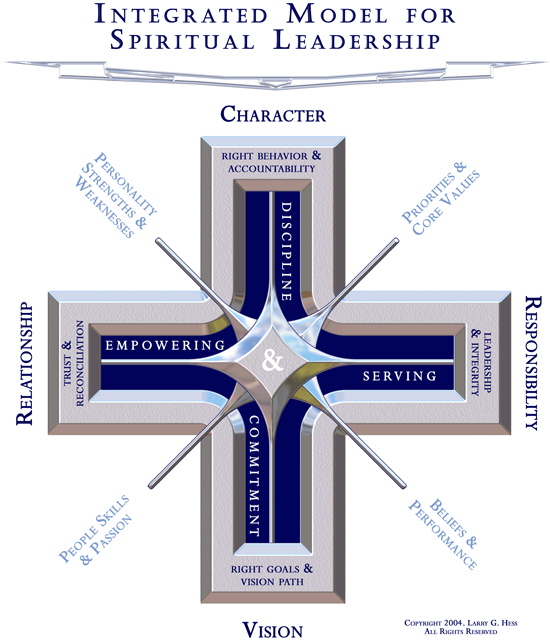
The chart below addresses the major components in an “Integrated Model for Spiritual Leadership.”
1) CHARACTER
A spiritual leader is a person who really wants to reach his/her God-given potential in every area of his/her life. An integrated model of spiritual leadership is built upon our character, which requires discipline to be faithful to God and true to who we really are inside.
Character gives a sense of dependability to our leadership and enables us to live a life that encourages others to follow. In an attempt to be a leader, some people have resorted to developing the appearance of a leader rather than developing the character of a leader.
Professional consultants are able to teach “image control” or “reputation management” for aspiring leaders who seek to create the perception that they are authentic and genuinely qualified to lead. People, with help, can generate a lot of hype, but they are really only pseudo leaders. They have image, but no character.
Influence is a key word associated today with leadership. People can seek to gain influence over others in the three following illegitimate ways:
Position:
Achieving a position does not guarantee character. People who use political or unethical means to acquire positions lack integrity. Oswald Sanders asked, “Should it not be the office that seeks the man, rather than the man the office?” Holding a leadership position in a Christian organization does not automatically assure God’s anointing or pleasure. Some leaders use their position to go further to pursue influence over people by using force and/or manipulation.
Power:
Leaders invite rebellion when they use force to achieve their goals. The my-way-or-the-highway does not work in the church or in the business world. Pastors have used many strong-arm tactics to get their way. Some have volatile tempers. They are charming and cordial as long as church members submit to their leadership. But when challenged, they become angry and lambaste anyone who dares to oppose them. Some have used the pulpit as a platform or soapbox to castigate those who disagree with them. Some pastors lobby support from influential members as if they were seeking to get a bill passed through Congress. Some ostracize their detractors or bully people into submission.
Spiritual dictatorships can be the most oppressive form of tyranny. Such leaders are intolerant of those who would challenge them.
Personality:
People often follow leaders because of their charm and winsome personality. Popular pastors have used their confident, impressive, persuasive personality to control or dominate people for selfish reasons. Often pastor-search-committees erroneously look for a striking and charismatic personality whose allure can attract new members. Charisma is never more important than character.
Spiritual leaders, of all people, ought to be known for their honesty, their integrity, and their character. Character is manifested in right behavior and in accountability. Our true purpose in life is a reflection of our character.
Our sense of purpose is derived from the deepest part of our souls. It is based on ethics, morals, and values that are spiritual principles. Our purpose shapes our vision and goals. Our purpose is our highest force that gives us a sense of divine direction.
Our purpose and character shape our relationships. We can either use people or love them. If our purpose is holy and unselfish, we will be givers, not takers. Godly character insures that our actions will be consistent with our words, and we willingly accept the need for accountability to God and those we serve.
2) VISION
Character and vision interact to make the leader disciplined and accountable in order to model commitment to God’s vision. Leadership is about moving people on to God’s agenda. Vision flows out of a commitment to the mission. The mission can be achieved through a process of implementing the vision path as we move toward the right goals with commitment and unity.
Visions are exhilarating and must be clear, shared, and compelling. Visions are about a preferred future that can mobilize people to enthusiastically follow spiritual leadership.
People look to visionary leaders who possess the skills necessary to perform in their role and achieve results. Churches tend to measure success by focusing on attendance, seats filled in the auditorium, and amount of money in the offerings. Peter Drucker says that the ultimate measure of leadership is “results.”
According to the expectations of many, successful leaders must be people who get things done. Leadership should focus on building great teams, building unity, and building healthy churches.
The pastor does not do all of the thinking for the church. Pastors must involve the right people in leadership and build consensus and commitment to God’s vision and agenda. Leaders fail when they pursue their goals for achievement but leave people by the wayside, uninvolved and uncommitted to the vision.
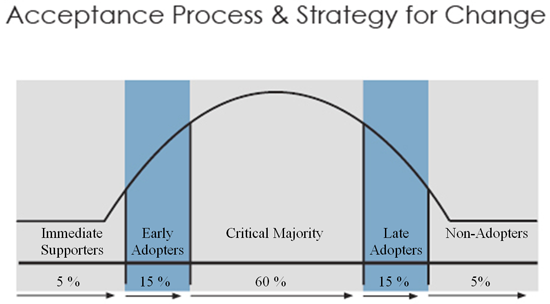
Spiritual leaders seek to achieve acceptance for and commitment to the vision as people align themselves to move forward on a transformational journey. The journey usually involves change; leaders experience some degree of resistance to change. A strategy for overcoming resistance and aligning for unity requires the building blocks of unity on the vision path to success.

Managing resistance to change requires an understanding of how people tend to come to a position of acceptance of the vision and to unity of purpose. In building unity, a spiritual leader looks for more than mere compliance. They look to achieve acceptance and alignment with the necessary change and transformational process. The following chart illustrates the path a congregation follows in taking ownership of a projected change or a new vision.

This process is impacted by the personality traits of the group. Some people are naturally more trusting (immediate supporters and early adopters), while other types tend to be distrusting (late adopters and some are distrustful. Trusting personality traits are:
- Accommodating
- Spontaneous
- Warm and altruistic
- Trusting and unsuspecting
- Adaptive
- Accepting
- Mature
- Genuine
- Emotionally stable
- Self-assured
- Cooperative
- Open to change
- Deferential
- Affiliative
- Restrained and careful
- Tolerant and flexible
- Sensitive
- Patient
Distrusting Personality traits are:
- Controlling
- Vigilant and suspicious
- Directive
- Skeptical and wary
- Methodical
- Private
- Reserved and impersonal
- Apprehensive and self-doubting
- Reactive
- Self-reliant
- Emotionally changeable
- Perfectionist
- Bold
- Tense and impatient
3) RELATIONSHIPS
A spiritual leader uses his/her skills in the relationship component to empower and to serve others. As a leader’s character is expressed in relationships, he/she will be able to earn trust and bring about reconciliation. Positive relationships and trust are necessary if the vision is to be realized.
A spiritual leader usually works with volunteers and lacks the command authority of a CEO or a general. The greatest asset of a spiritual leader is the relationships built with people. No matter how gifted the leaders are or how exciting the vision, leaders will not lead for long if they are not able to build and maintain strong relationships and partnerships.
Trust busters are present in every church and on every ministry team, especially at the higher levels of leadership.
COMMON TRUST BUSTERS
- Personality factor: character flaws and extreme temperament traits/weaknesses
- Expansive ambitions: always concerned about looking good and being in control
- Bigger egos and higher stakes: can cause leaders to play on the natural fears and insecurities of people
- Insincere: not completely honest, withholding information
- Controlling nature: want to control all the decisions
- Defensive: defends own opinions and does not listen to others; moves ahead without adequate facts
- Distrustful: tends not to show consideration for teammates; leaves them out if they think that they might disagree, even when it is obvious they have a stake in the decision/action
KEY TRUST BUILDERS
- Honesty and openness: exhibits integrity and authenticity; share their true feelings without deceit
- Transparency: does not have private, hidden agenda covered with hypocrisy
- Genuinely caring: is concerned about the needs of others as evidenced by actions, not just words
- Listen: listens to people carefully; is not judgmental or overly critical
- Value other people’s opinions: seeks input from key advisors and trusted partners before making decisions
- Show empathy: demonstrates compassion by reaching out to give support and help to others
Trust can be built in relationships instead of suspicion and conflict. Trust is slow to build, yet can come crashing down quickly. Trust can take years of persistence and character to construct. Trust is fragile. It must be handled with care.
A leader must have trust; it is the air that he/she breathes. There are no perfect models, no flawless characters, or purely selfless leaders. However, we must remain intensely focused to keep trust and integrity.
4) Responsibility
Integrity is the foundation of leadership responsibility. Integrity and honesty are essential for sound decisions, mutual trust, and credibility. Leaders are responsible for truthfulness, fairness, loyalty, good judgment, accountability, clear priorities, and strong values.
Responsible leadership demands that we have the courage and self-confidence to live out integrity in the pressure cooker test of leadership.
Responsibility in spiritual leadership requires emotional stability and maturity.
Characteristics of stable, mature, and responsible leaders:
- Have ego strength sufficient to overcome frustration or loss with the power of a resilient mindset
- Are not intimidated by problems and are not overwhelmed
- Have a good sense of timing and know how to manage priorities
- Avoid tendency to procrastinate
- Do not set unreachable goals
- Do not engage in self-blame and criticism but maintain a positive self-image
- Are able to anticipate unpleasant events and face them with reinforcing self-talk
Characteristics of leaders who are less emotional stable and mature:
- Are reactive and emotionally changeable under stress
- Are impulsive and inconsistent in conflict
- Excessively criticizes and seek to control people
- Are angry and tend to reject people, threaten abandonment, or excessively punish people with an emphasis on perfectionism
- Neglect congruent thinking about realistic consequences of their negative reactions
- Promote to followers an excessive dependence of their approval as the leader
- Subject people to double binds or no win situations when in conflict
- Are apprehensive, guilt prone, self-reproaching, insecure, and worried
- Are overly driven, tense, and frustrated
- Are undisciplined, lax, follow their urges, and are careless of social rules
Spiritual leaders should be responsible and remember that people are watching them to see if they walk the talk, if they are consistent and emotionally stable. Integrity and emotional stability form the bedrock that supports any leadership effort.
The components of responsibility and relationships are linked and essential in achieving the goals of leadership.
Leaders are responsible for their beliefs and for their performance. Leaders need to be both relationship oriented (possess good people skills) and results oriented (task driven.)
A person’s leadership performance hinges on results and requires that leaders know where they are going and are capable of and committed to take others with them. A few characteristics of high performance leaders are:
- Straightforward and direct with clear communications about expectations
- Have a strong work ethic
- See the big picture and are visionary and strategic
- A decisive yet sensitive person who is firm but flexible
- A good problem solver
- High expectations of self and of others
- Focused on the mission, the goals, and necessary tasks
- Balanced and emotionally adaptable
- Is proactive to initiate positive actions that are consistent with beliefs
- Are committed to excellence, pays attention to details, and motivates others to achieve within their capabilities
A leader’s role is to ensure success by communicating the vision, defining the goals, ensuring high standards, resolve problems, make key decisions, hold people accountable, and model integrity.
Often results-oriented leaders place upon themselves or on others unrealistic expectations.
Without a good balance between relationships and responsibility, the frantic pace of a driven workaholic can cause the leader’s emotional engine to shut down and bring him/her to a grinding halt.
The character of Jesus Christ and the grace of God can liberate us from failure in relationships, from self-defeating behaviors, unresolved conflicts, and from the poison of unrealistic expectations. We should again be comforted by the words of Jesus to those oppressed:
“Come to Me, all you who labor and are heavy laden, and I will give you rest. Take My yoke upon you and learn from Me, for I am gently and lowly in heart, and you will find rest for your souls. For My yoke is easy and My burden is light: (Matthew 11:28-30 NKJV).
Successful spiritual leaders work at balancing relationship skills with responsibility skills. They seek to be competent in skills where they tend to be the weakest. People will not follow weak, tyrannical, or incompetent leaders.
Integrating all of the major components of spiritual leadership is never easy. However, leaders must:
- Walk the talk
- Be accountable and withstand scrutiny
- Make difficult choices
- Continue to grow and develop skills and personal strengths
- Remain flexible and respond appropriately
- Keep a balance in this integrated model of leadership
- Interact with peers and mentors who can help leaders stay on the right path
Spiritual leaders need to hear the message that God spoke to Joshua when He said, “Be strong and courageous. Do not be terrified; do not be discouraged, for the Lord your God will be with you wherever you go” (Joshua 1:9).

CONCLUSION
An integrated model for spiritual leadership looks at four major components of leadership and how they need to balance and compliment each other.
Character requires discipline and accountable behavior to achieve our priorities in keeping with our core values. Priorities and core values can only be maintained through responsibility based on integrity, which reflect our commitment to beliefs and performance.
Our vision must come from God and must be carefully discerned and articulated to bring about positive change that is clear, shared, and compelling – a vision that is matched with the right goals and vision path.
Commitment is most critical for achieving the right goals and maintaining the vision path necessary to fulfill our true mission. Commitment recognizes that following God’s path is a never-ending process.
A spiritual leader who has character will seek to build relationships of trust and reconciliation, which empowers people to be part of God’s vision. Leaders seek to overcome personality weaknesses that can be their dark side. They build on their personality strength to serve people with integrity and responsibility.
Spiritual leaders seek to be used by God to transform people and the church through disciplined character, visionary commitment, empowering relationships, and serving responsibility. Through the skills of accountability, integrity, vision, and trust people can come together in unity to achieve the impossible for the glory of God.