Life Related Expository Preaching

INTRODUCTION

Biblical preaching takes on many different methods of presentation, just as the Biblical authors used stories, parables, psalms, and letters.  There are many acceptable forms of sermon delivery, just as there are many different ways to communicate God’s truth.

In the past, preachers were considered as credible authorities with the right to tell people what to think and how to live.  That level of authority has been lost in most of the world.  Preaching today must be life related and authenticated by the power of the Word of God.

1) Pentecostal Expository Preaching

Pentecostal preaching is powerful, anointed, passionate, divinely driven communication based on the truths of God’s Holy Word.  Pentecostal preaching comes from the heart of the preacher and goes straight to the heart of the listener.  It is preaching that provides wholesome spiritual nourishment for God’s people from His Word.

Pentecostal preaching both evangelizes the non-believers and equips the believers to do the work of the ministry.  This is an awesome responsibility.  Preachers are the purveyors of God’s truth, the physicians of the soul.  We shall be held accountable to God for any perversion of truth and for our negligence and lack of skill.

The Pentecostal preacher’s knowledge of the power of the Holy Spirit and of the healing/delivering power of God, reminds us that we will be judged by God on the truthfulness, accuracy, and integrity of our preaching.  Any failure as a spokesman of God brings not only shame (2 Timothy 2:15) but also judgment (James 3:1).

A small amount of skill, ability, and anointing will never enable a preacher to teach the deep things of God, convince stubborn minds, capture affections and will, or spread light on darkness.  But above all, if a preacher is to be used of God to free men from their strongholds of ignorance, convince their consciences, stop their mouths, and fulfill the responsibility to proclaim all the counsel of God, the preacher must not only be skilled in the Word of God but also anointed of the Holy Spirit.

A) Definition and Mandate

In the expository preaching, the message is derived from a text of Scripture.  The sermon confronts people with Biblical truth, which has present meaning for their lives.

Paul gave this mandate to Timothy:  “I solemnly charge you in the presence of God and of Christ Jesus, who is to judge the living and the dead, and by His appearing and His kingdom:  preach the word, be ready in season and out of season; reprove, rebuke, exhort, with great patience and instruction” (2 Timothy 4:1-2 NAS).

We must be faithful to the Word by presenting the meaning of the Bible passage(s) entirely and exactly as it was intended by God.  People are spiritually hungry for the Word of God presented in truth and in power!

B) Responsibility

A Pentecostal preacher realizes his/her responsibility to the Word of God.  The Word must be our source for preaching (Colossians 1:25; 1 Thessalonians 2:13).  Thus, our preaching is God’s Word, not the preacher’s word.  But rather the preacher is:

  • a messenger, not an originator
  • a sower, not the source
  • a herald, not the authority
  • a steward, not the owner
  • a guide, not the author
  • a server of spiritual food, not the chef

Preaching is a most exacting discipline and an awesome responsibility.  We who are called must follow the example of the apostles and say, “It is not right that we should give up preaching the Word of God to serve tables…we will devote ourselves to prayer and to the ministry of the Word” (Acts 6:2,4).

2) First Person Expository Preaching

A first-person sermon is preached from the viewpoint of an eyewitness to a Biblical event.  It recounts a story from the perspective of one of the characters in the story.

First-person expository preaching helps to apply Scripture to the meaning of everyday life.  This method communicates its message through the power of story and the power of drama.  A first-person sermon tells a story from the perspective of an insider to the story.

People tend to remember good stories.  Television is full of stories, even the news and sports.  In sermons, stories promote life-related learning, enabling people to experience the truth of God in their lives. Stories create word pictures that influence the way people look at life, reflect life, and communicate ideas.

A good expository first-person sermon is built upon solid exegesis.  Preparation involves researching the character so that we get into the mind and personality of the him/her. Next we research the setting, the culture, and the geographical details.

Presentation requires a healthy imagination guided by extreme care for the integrity of the Scriptural text. Presentation transports the contemporary audience back into ancient time and transports the character into the modern world.

Stages of Constructing the First-Person Sermon

Stage 1) Identify the Substance and Direction of the Sermon

The first stage of sermon construction identifies the substance or main idea and the direction of purpose. This sermon should focus on communicating timeless Biblical truth to modern listeners in a way that relates to our contemporary audience. Some suggestions are as follows:

  • Simply and memorably state the main idea of the sermon.
  • Use specific and familiar words to state the main ideas.
  • Focus on the kind of response we want to get in response to the sermon.
  • Decide if we are bringing the character into the twenty-first century or if we will take the audience back in time.
Stage 2) Clarify the Purpose of the Sermon

We must determine not only the preaching idea but also clarify the purpose. The homiletical idea is the substance of what we want the sermon to say. The purpose describes what we want the sermon to do. The purpose answers why we are preaching this message and how we want people to respond.

Stage 3) Determine the Structure and Flow of the Sermon

In this stage, we build a structure for the story that will be told by our character. In order to prepare for this, we should outline the events of the story and decide how we will tell these events to clearly develop the central idea.

Organizing the narrative of the passage/story is like dividing the scenes of a movie or a play. When we tell the Biblical story we must use imagination in order to avoid redundancy and to add creativity. However, the chronology of our story must parallel the actual events in Scripture.

Stage 4) Complete the Exegetical and Historical Details of the Sermon as We Write the Sermon Manuscript

Our sermon will need enough historical and cultural information so that the sermon is appealing and interesting. The manuscript should be written in conversational language with short sentences. Use active verbs and concrete nouns.

Since stories are inductive, the idea of our sermon should usually emerge toward the end rather than at the beginning of our message. The introduction should raise a question or create some sort of tension that will have to be answered in the sermon. This tension gives energy to a first-person sermon.

In conclusion, we step out of the character or we allow the character to conclude. When we step out of the character at the end, we can make a direct application of the sermon with a quick closing.

3) Examples of First-Person Sermons

A) An Ordinary Hero – The book of Ruth
  • Structural Stance: During the days of the judges, one of the elders from the town of Bethlehem steps forward in time to speak to the congregation
  • Purpose: To enable ordinary people, especially mothers, to see how God can make a difference in them and through them.
  • Idea: God makes a difference in mothers who are faithful.
B) The Profile of a Leader – 1 Samuel 16-17
  • Structural Stance: Eliab travels forward in time to speak to the audience.
  • Purpose: To help potential leaders to recognize how courageous they can be when they entrust themselves to God
  • Idea: It takes faith and courage to be a leader of God’s people.
C) Setting the Record Straight

Matthew 2: 1-18

  • Structural Stance: King Herod the Great is released from his torment in hell to tell his story to the pastor and congregation.
  • Purpose: To help people understand the crucial issues surrounding the Christmas Holiday.
  • Idea: Worship Jesus as Lord or reject Him, but do not ignore God reaching out to our life through Christ.
D) Simon Said

Luke 12: 15-21

  • Structural Stance: The contemporary audience is transported back to the first century to hear the testimony of Joanna, the rich fool’s wife.
  • Purpose: To help listeners understand how important it is to build our lives and our plans around God while at the same time, showing how dangerous it is to leave God out of our lives.
  • Idea: Only fools leave God out of their lives.
E) No Reason to Cry

 John 20: 1-8

  • Structural Stance: The contemporary audience is transported back to the first century, a few weeks after the Resurrection. They become the ancient audience – followers of Jesus with whom Mary Magdalene share her testimony concerning Christ’s Resurrection.
  • Purpose: To present the Gospel to non-believers to share their story and the Gospel.
  • Idea: Jesus is alive, so go spread the Good News of the Gospel to a lost world.

These and other first-person expository messages with complete manuscripts are found in the book, It’s All in How You Tell It by Haddon W. Robinson and Torrey W. Robinson, Baker Books, 2003.

4) Expository Preaching in General

God speaks through the Bible and expository preaching may be the best way to communicate the truths and divine authority of Scripture.

Haddon W. Robinson defines expository preaching as “the communication of a Biblical concept, derived from and transmitted through a historical, grammatical, and literary study of a passage in its context, which the Holy Spirit first applies to the personality and experience of the preacher, then through him/her to the hearers.”

Some key facts about expository preaching:

  • The passage governs the sermon.
  • The expositor communicates a concept.
  • The concept comes from the text.
  • The concept is applied first to the preacher as God deals with him/her concerning the message.
  • The concept is applied to the hearers.
  • The sermon should have a central, unifying idea at the heart of the message.
  • The idea should be defined and formed so that the idea answers the question, “What exactly am I saying about the subject?”

5) The Stages in the Development of Expository Messages

There are many approaches to sermon construction, however, two facts emerge in the way expositions go about preparing sermons. First, mental preparation is a dynamic process. Secondly, detailed instructions about how to think in preparation might actually hinder the process.

Dynamic and effective preaching must flow out of our imagination, our insight, and our spiritual passion. These do not come simply out of following a set of how-to instructions. As we look at the following stages, keep in mind that sometimes they follow other orders of sequence.

Stage 1) Choose the passage to be preached

  • The sermon will be based on some unit of Biblical thought.
  • Consider the amount of material that can be covered in the time allotted for the sermon.
  • Make sure the topic fits the passage.
  • In selecting the best passage for the sermon, take advantage of resources such as lexicons, concordances, Bible dictionaries, word-study books, commentaries, etc.

Stage 2) Study the passage and gather notes

  • The message must also relate to the immediate context of the passage.

Stage 3) Determine the exegetical idea from the passage

  • Narrow the subject.
  • Expand the subject into the main idea (called the complement).
  • From the passage identify the characters, episodes, and main ideas behind the story.

Stage 4) Analyze the main exegetical idea

  • Remember that expository sermons consist of ideas drawn from Scripture and related to life.
  • Ask, “What does this mean?”
  • Ask, “What is the deepest truth of this passage?”
  • Ask, “What difference does it make?” This focuses on the author’s theological purpose.

Stage 5) State the main idea in the most exact and memorable sentence possible

  • The central idea should be stated in a way that connects the Bible and the audience.
  • Restate the idea in different words to clarify or impress it upon the audience.

Stage 6) Determining the purpose of the sermon

  • The purpose defines what the truth of the message should accomplish.
  • The purpose behind the passage of Scripture should correspond with the purpose of the sermon.
  • An expository sermon finds it’s purpose in line with the Biblical purposes.
  • Purpose is what one expects to happen in the lives of those who hear the sermon.

Stage 7) Decide how to accomplish this purpose

  • Think about the ideas of the sermon and determine how one should seek to accomplish the purpose.
  • Sometimes the idea needs to be explained, proved, or applied.

Stage 8) Outline the sermon

  • An outline clarifies the relationship between the parts of a sermon.
  • An outline crystallizes the order of ideas into an appropriate sequence.
  • Outlining the sermon helps to recognize the areas requiring additional support material to fully develop the points.
  • Outlines consist of an introduction, body, and conclusion.
  • With the expansion of the outline, the substance of the sermon becomes more obvious.
  • A complicated outline with many subdivisions looks good but can overwhelm or lose the audience.
  • Use transitional statements to move from one point in the outline to the next.

Stage 9) Filling in the sermon outline in order to explain, expand, or amplify the major points.

  • Restate points for clarity and emphasis.
  • Explain and define.
  • Compare and contrast.
  • Expository preaching uses the facts of Scripture and not just opinions.
  • Quotations can be used to support or expand a point or idea.
  • Use narration to fill in history, the setting, personalities involved, etc.
  • Use illustrations; they make points clearer, more believable, and more interesting.
  • Personal illustrations add warmth and vitality to a sermon
  • Illustrations restate, explain, prove, or apply ideas by relating them to tangible experiences.

Stage 10) Writing the introduction and the conclusion

  • Introductions command attention.
  • People tend to sit up and listen to hear a story.
  • The opening must grab people’s attention.
  • Introductions orient people to what is coming in the sermon.
  • Keep the introduction short.
  • Do not promise more than you will deliver.
  • During the introduction, people make a mental decision about the speaking ability of the preacher before you get to the body of the message.
  • The purpose of a conclusion is to conclude.
  • Conclusions might restate or review the major points presented.
  • A conclusions summarizes and ties loose ends together.
  • Conclusion might contain illustrations, quotations, a question, a prayer, or might give directions.

CONCLUSION

The effectiveness of a life-related expository sermon depends on what we say and how we say it. Sermons are made up of thoughts, language, voice, gestures, and content. Effective delivery begins with passion and anointing as we are directed by God to make His word both life-related and life-changing.

We want to preach so that people will listen. This requires that we develop our skills of communication and our ability to prepare and present life-related sermons, which can be used by God to accomplish His divine purposes.

Matthew Simpson in his Lectures on Preaching  put the preacher in his place: “His throne is the pulpit; he stands in Christ’s stead; his message is the word of God; around him are immortal souls; the Savior, unseen, is beside him; the Holy Spirit broods over the congregation; angels gaze upon the scene, and heaven and hell await the issue. What associations, and what a vast responsibility!”

Leadership Communication and Connection

INTRODUCTION

Communication is the oil that enables people to work together smoothly. It is the basis of all relationships. Without communication, there is no connection and no significant relationships.

Communication is a complex process that depends upon reaching a common understanding. Leadership training has not placed enough emphasis on the development of strong communication skills. The proper use of communication and problem solving skills will enable leaders to communicate and connect with people in a way that provides the greatest chance for positive interactions.

Ineffective communication can be destructive and cause serious emotional consequences. Clinical studies show that most people have difficulty managing situations that are emotionally volatile, particularly when the emotions aroused are anger and anxiety. When this difficulty is combined with poor communications skills, the results can be disastrous.

The inability to manage emotions under stress and the inability to communicate effectively often produces unresolved and repetitive conflicts in local churches. Strong communication skills are instrumental in resolving sticky problems with difficult people, in managing church bosses, in building unity, and communicating the vision.

We will look at five (5) steps for leaders in communicating and connecting effectively.

1) STEP ONE – Develop a High Level of Self-Awareness

Self-awareness allows us to tune into vast information about our feelings, senses, appraisals, values, weaknesses, and intentions. This information helps us understand how we respond, behave, communicate, and function in various situations.

Self-awareness reveals:

  • How we see ourselves
  • What is most important to us
  • How we react in distress
  • Our “hot buttons”
  • Our levels of emotional stability and spiritual maturity by exposing what we do under stress and at our worst
  • How others really see us
  • How good we are at making the right choices

Self-awareness combined with spiritual discipline helps us stay focused and centered on a Biblical, spiritual, and purpose centered course. Without a true and accurate self-awareness, we lack sufficient knowledge and wisdom to make good decisions. How can we increase our levels of self-awareness?

Self -Awareness Requires Examining How We Make Appraisals

Appraisals are all the different impressions, interpretations, evaluations, assessments, and expectations we have about ourself, others, and situations. They are influenced by our personality traits, life experiences, and core values. They are manifested in our deepest thoughts and feelings.

Self-awareness increases when we understand how our thoughts and beliefs influence our feelings, actions, and reactions.

A) Suggestions on identifying how we make appraisals
  • Put thoughts and feelings in a clear statement which begins with “I think…,” “I believe…,” “I feel…”
  • Engage both inner dialogue and specific prayer concerning true inner feelings. Notice how negative inner thoughts work against us and produce self-fulfilling prophesies of failure.
  • Learn to make evaluations and self-assessments when we are calm and rational. Prayer and spiritual worship are powerful ways to achieve a calm and rational state of being where we can more accurately become aware of what is true.
  • “Finally, brethren, whatever things are true, whatever things are noble, whatever things are just, whatever things are pure, whatever things are lovely, whatever things are of good report, if there is any virtue and if there is anything praiseworthy–meditate on these things” (Philippians 4:8, NKJ).
  • Seek advice and input from trustworthy sources whose perspective might add to the appraisal of the situation.

It is important to clearly understand our own process of making appraisals so that we can increase our chance of being fair-minded, accurate, and objective.

B) Tips for making accurate appraisals
  • Remember that appraisal of an event or a person determines our reactions, not someone else’s behavior or the event itself.
  • Acknowledge that opinions/appraisals are our own.
  • Accept that appraisals are subject to change based on new information or new thoughts and beliefs.
  • Use all senses to gauge what is taking place around us and identify what we see and hear.  When we use all of our senses, we can more accurately appraise what has taken place.
  • Get in touch with feelings or spontaneous emotional responses to interpretations and expectations.  Remember that feelings have outward manifestations and often drive certain behaviors.  We need to learn to identify the true emotions we feel in order to determine if our reactions are valid.

High quality self-awareness includes how we make appraisals, use our senses, manage our feelings, identify our intentions, and monitor our actions.  Developing high self-awareness requires practice and courage in order to step back and observe ourselves in action and evaluate the course we are navigating.

2) STEP TWO – Manage Emotions

Managing emotions requires self-discipline and control over our thoughts, actions, and behavioral tendencies (weaknesses).  We are emotional beings because we are made in the image of God.  God is emotional.  He loves; He grieves; He is capable of anger; He is jealous; and so forth.  Each of God’s emotions is positive and healthy.  Because of His nature, He is incapable of guilt and fear.

However, we as sinful human beings, experience negative emotions.  Jeremiah 17:9 says, “The heart is the most deceitful of all things, desperately wicked.”

In order to manage our emotions and to move toward maturity in Christ, we must be renewed in our spirit, made alive in Christ, and have our minds renovated.  God told Jeremiah that, “I will put my law in their minds, and write it on their hearts, and I will be their God, and they shall be my people” (Jeremiah 31:33).

A) Range of Emotions – From Love to Hate

Psalm 97:10 – “Those who love the Lord hate evil.”

The extent of our hatred of evil should be determined by our love of good.  Solomon links righteous hatred with another emotion – fear or awe of God.  “The fear of the Lord is to hate evil; Pride and arrogance and the evil way and the perverse mouth I hate” (Proverbs 8:13).  A disciplined heart does not feel terror toward the heavenly Father.  “There is no fear in love.  But perfect love casts out fear…” (1 John 4:18).

Disciplined love is the kind that is genuine, sincere, without hypocrisy (Romans 12:9).  Genuine love motivates us for good, to be patient, kind, not proud, not rude, not easily angered, keeps no score of wrongs, delights in truth, practices holiness, hopes, trusts, and perseveres (I Corinthians 4:13).

Even the sorrow of believers is a hopeful sorrow (I Thessalonians 4:13).  Guilt is also positive when it serves its purpose of bringing us to repentance.  However, a morbid grief or guilt can rob us of our joy and hinder our service for Christ.

Just as there is a holy jealousy (James 4:5), so there is a sinless anger (Ephesians 4:26).  Sinless anger is a restrained and spiritual hatred of evil.  Solomon listed seven things God hates:  “A proud look, a lying tongue, hands that shed innocent blood, a heart that devises wicked plans, feet that are swift in running to evil, a false witness who speaks lies, and one who sows discord among brethren” (Proverbs 6:16-19).

B) Self-control or Self-discipline

Self-discipline is the crowning fruit of the Spirit that must be cultivated and nurtured by believers.  Self-control or self-discipline is reproduced in the child of God by the power of the indwelling Holy Spirit.  “For to me to live is Christ…” (Philippians 1:21).

In order to live the Christ-life, we must be totally committed to managing our emotions in the power of the Holy Spirit.  Self-control achieved through the fruit of the Holy Spirit is basic to managing our emotions.

“But also for this very reason, giving all diligence, add to your faith virtue, to virtue knowledge, to knowledge self-control, to self-control perseverance, to perseverance godliness, to godliness brotherly kindness, and to brotherly kindness love.  For if these things are yours and abound, you will be neither barren nor unfruitful in the knowledge of our Lord Jesus Christ” (2 Peter 1:5-8).

3) STEP THREE – Motivate Yourself

Self-motivation is the key to starting and completing a task.  It is also vital to effective communication and relationship building. Without positive motivation, we might feel isolated, frustrated, afraid, depressed, or anxious.  “The joy of the Lord is our strength” (Nehemiah 8:10).

A) The New Motivations

Psychologists and researchers have made some significant new observations about what motivates people today in North America.  The old incentives or motivations were money, status, reward, and fringe benefits.  These no longer dominate people’s thinking.  People are turning inward and have a new philosophy focused on self-actualization incentives.

The new motivations are personal growth, a sense of being worthwhile, and a sense of accomplishment.  Therefore, psychological fulfillment seems to be the new motivation.  When the old type of motivations such as money and status have been achieved, we tend to look deeper toward the new motivations.

B) Motivated by Inner Passion

“But we have renounced the hidden things of shame, not walking in craftiness nor handling the word of God deceitfully, but by manifestation of the truth commending ourselves to every man’s conscience in the sight of God. But even if our gospel is veiled, it is veiled to those who are perishing” (2 Corinthians 4:2-3).

The apostle Paul was motivated by inner passion, not by great oratory or empty promises of fame.  Paul’s method of motivating people can be explained in identifying three (3) simple steps:

  1. Set forth the truth plainly.  Paul wanted people to wrestle with clear facts not with guilt, fear, shame, or even possible reward.
  2. Be direct and honest with people but do not manipulate.  We want people to be God-directed from deep inner commitment.
  3. See personal relationships as the basis of ministry. Personal relationships spawn effective ministry because God-motivated people get excited about people, not programs.
C) Self-Motivation Strategy
  • Create a positive and friendly atmosphere.
  • Enjoy the fact that people are uniquely different.
  • Stay focused on who you are, not what somebody else is.
  • Keep looking to the future; not just the present or the past.
  • Do not attempt to go beyond your capabilities or your responsibilities.
  • Take an honest look at your goals and primary motivations.
  • Guard against saying the negative things to yourself when frustrated, disappointed, or distressed.

4) STEP Four – Develop Effective Communication Skills

The foundation of any relationship is communication. Without communication, there is no connection and no relationship.  For leadership, effective communication is crucial and its value is incalculable.

Thus far, we have emphasized the need to develop high self-awareness.  This involves examining how we make appraisals, how we identify your feelings and intentions, and how we analyze our behavior.

When communicating with people, wise leaders pay close attention to how we impact other’s feelings, thoughts, and behaviors.  Wise leaders have learned the skill of being sensitive and capable of quickly adjusting their communication style.

Some important communication skills are:

A) Self-Disclosure

Communication is a back-and-forth process of exchange with the goal of accurately understanding each other. Self-disclosure in communication is the process of revealing what we are thinking, feeling, and believing.

Self-disclosure statements often begin with “I think,” “I feel,” or “I believe.”  Sharing your thoughts, ideas, feelings, or beliefs can sometimes be dangerous.  We fear that our idea might be disparaged, our thought might reveal our lack of knowledge, or that our feeling might suggest a weakness in character.

Self-disclosure always involves some risk.  Therefore, our self-disclosures should be strategically executed.  Carefully choose what to reveal and how to reveal it so that the risks are minimized and the benefits are maximized.

Suggestions for using self-disclosure:

1) Acknowledge ownership of statements

Recognize that certain experiences in life led to your opinions and/or feelings.  Therefore, they belong to us and may not be quickly or clearly understood by everyone.

Acknowledging ownership of our statements helps in expressing them with confidence and conviction from a position of strength.

2) Make Sense Statements

Sense statements are these communications that are based on information derived from our senses (seeing, hearing, touching, smelling, tasting), not from absolute positions of truth.  Remember that effective, intelligent communication acknowledges the right of others to their interpretations, as well as our rights to our interpretations.

We must always keep the doors of communication open to clarify any misconceptions.

3) Use Interpretive Statements

Interpretive statements reveal what we think or believe at a given time.  They imply that we took specific information into account before we made our statement.  Examples of interpretive statements are:

  • “I think it is…,”
  • “I didn’t think you…,”
  • “In the past we…,”
  • “I wasn’t aware of…,”
  • “I guess we don’t need…”

By making interpretive statements, we suggest that our interpretation is subject to revision.  The opposite and dangerous types of statement reflect opinions that are locked in (but might be totally wrong).  For example:

  • “You’re not interested…,”
  • “Yes I am…,”
  • “No you’re not…”

Effective communication requires that we stay open and gracious about receiving new information.

4) Make feeling statements

When we are really in touch with our feelings, we can better understand our reactions.  Feeling statements reveal information about the reasons behind our reactions or opinions.

In order to disclose feeling statements in a wise way, we need to tune in to our feelings, convey them accurately, and be sensitive to the respondent.

5) Use intention statements

In an appropriate way, be clear in revealing what you want from a situation with respect for what the other person(s) want or wish.

Intention statements generally begin with I want, I would like, or I wish. While being clear about your intentions you must also be judicious in the desires that you reveal. Generally, we would not reveal our hidden agenda(s). We should not use our intentions to control or manipulate others

B) Assertiveness

Assertiveness and aggressiveness are not the same. Assertiveness is the ability to protect your own beliefs, opinions, rights, and desires along with demonstrating respect for the rights of others.

Aggressiveness disregards the needs of others and uses power or persuasion combined with some degree of hostility to achieve the desired goal.

Assertiveness is a positive and necessary way to respect your own thoughts, beliefs, emotions, and needs in a mutually benefiting style. Transactional Analysis (TA) would encourage a healthy approach that we say, “I am OK and you are OK.”

Suggestions for Assertiveness

  • Clarify your position with important facts
  • Seek to understand and acknowledge the other person’s position
  • Repeat your position with consistency
  • Defend your position with logic
  • Strive for a compromise that brings resolution in a mutually satisfying way
C) Dynamic Listening

Dynamic listening brings a high degree of self-awareness into the process of communication, as we address our own personal filters. Filters can often screen out or even transform the information we are receiving.

Personal filters need to be eliminated as much as possible or we will end up hearing only what we want to hear because of preconceived beliefs.

Dynamic listening helps you get underneath the surface of what someone says to hear the feelings that are really being expressed.

D) Criticism

Criticism is hard to receive and usually hard for people to give. Criticism reveals how others view your behavior or work. People can benefit from criticism but it can also be extremely destructive to a person’s self-esteem and to relationships.

Criticism makes us feel vulnerable and usually makes us defensive. The effective use of criticism requires the skillful use of every component of good communication.

In giving criticism:

  • Check your motive – is it to help?
  • Choose the right time and place
  • Protect the person’s self-esteem
  • Emphasize improvement
  • Show concern
  • Manage your own emotions
  • Clearly identify problems with examples
  • List desired changes
  • Always give some positive feedback
  • Discuss acceptable solutions and positive benefits of change then end on a positive note

In receiving criticism

  • Acknowledge that you can learn from criticism
  • Listen carefully before saying anything
  • Avoid immediate defensive responses by tuning in to your emotions
  • Take a deep breath and go slow
  • Accept responsibility for your actions
  • Turn off listening filters
  • Use self-disclosure statements
  • Use assertiveness but remain positive and avoid defensiveness
  • Watch how the giver of criticism is reacting to your responses
  • Summarize the other person’s statements and show a willingness to change
Conclusion

The purpose of communication is to connect in a meaningful way. We use our self-awareness, self-control, listening skills, openness, attention, and willingness to handle criticism to achieve spiritual and emotional maturity in communicating, understanding, and connecting at the deepest levels of feeling and emotion.

Successful leadership communication means keeping our emotional perspective clear, anticipating peoples responses, remaining calm and controlled while calming an out of control person, and always demonstrating the love of God.

Leadership Personalities – Part 2

INTRODUCTION

LIFESTYLES OF LEADERSHIP (LSLI) INVENTORY

Looking at Your Profile

The LSLI is designed to heighten your self-awareness and to direct you in your efforts for self-improvement and leadership development. Your profile reflects only what you think about yourself. Don’t criticize or blame yourself if you feel your scores are too low. Look at this process as an opportunity to strengthen yourself as a leader.

Understanding Your Scores

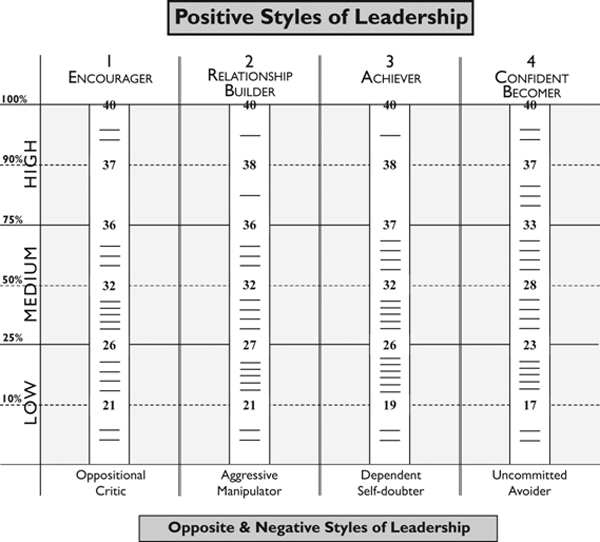
The four styles looked at in this inventory are all constructive styles that reflect self-enhancing thinking and behavior. They contribute to one’s level of satisfaction and ability to develop healthy relationships and work with people, to be proficient at accomplishing tasks, and to function at a high level of stability and fulfillment. Therefore, it is desirable to have a high score in all four styles.

A high score in these four styles of leadership reflect self-enhancing thinking and behavior that contribute to one’s level of satisfaction, ability to develop healthy relationships, work effectively with people, and to be proficient at accomplishing tasks.

Low scores in these styles could represent strong tendencies or styles of behavior in the opposite styles. These opposite styles represent behaviors that tend to be more defensive, aggressive, avoidant, or oppositional.

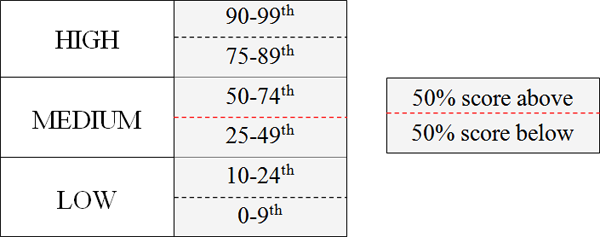
In order to determine what is a high, medium, or low score, your raw score is compared to those of almost 10,000 other individuals. Thus, your score in each style is converted to a percentile score.

The percentile breakdown for each area is as follows:

PERCENTILE SCALE

What Your Scores Measure

As a leader, it is important that you understand yourself and your behavior. Our behavior is motivated by several things. Different psychological inventories measure different motivators such as needs, values, and attitudes. In leadership development, a variety of inventories can be used to assess personality strengths and weaknesses. LSLI looks at four (4) constructive styles or attitudes that influence behavior and affect the success of leadership.

The bottom of the profile chart identifies opposite and negative styles of leadership. These styles are defensive, aggressive, avoidant, and oppositional in nature. They are the opposites of the positive styles measured by this inventory. The opposite and negative styles reflect attitudes that are destructive to leadership effectiveness. Low scores can indicate tendencies toward these self-defeating styles.

Profile

Overview

The LSLI looks at four positive styles of thinking and behaving, which are all important for leadership success. The “descriptions” section provides a detailed view of each of the four positive styles and a summary description of the negative styles that are negative or problematic in leadership. A low score in the positive styles could indicate a tendency toward the opposite styles.

Encourager

This style of behavior enables a person to establish warm, open, trusting relationships with people. Their altruistic nature makes them good at helping, encouraging, motivating, and supporting others. They like to work with people, especially in groups.

Opposite Style — Oppositional Critic

Relationship Builder

This style represents people who are also warm, caring, accepting of others, and strongly motivated to build close relationships with people. They are more people-oriented than task-oriented. They enjoy building long-term relationships and bonds of trust with people.

Opposite Style — Aggressive Manipulator

Achiever

Achievers are highly motivated, goal oriented, organized people who tend to take responsibility for their own actions and choices. They work to achieve their own satisfaction and accomplishment. They believe that their personal effort counts and is essential in reaching their goals. Achievers tend to be critical thinkers who put their energy where it is most beneficial. They consider a broad number of alternatives when making decisions. They are good problem-solvers and decision-makers.

Opposite Style — Dependant Self-Doubter

Confident Becomers

The confident becomer is characterized by a positive self-esteem, a concern for growth, and a desire for personal fulfillment. They are highly motivated, spontaneous, committed, and decisive people who make decisions quickly. They are optimistic, self-confident, and enthusiastic. They are able to tolerate ambiguity and seek adequate information before making decisions or reaching conclusions. Confident becomers are self-empowered people who take control of their own life by setting objectives that are achievable in spite of difficulties or conflicts. They also seek to and demonstrate respect for other people’s opinions.

Opposite Style — Uncommitted Avoider

Descriptions

Style 1 – Encourager

This scale measures our interest in people, our tendency to care about others, and our ability to encourage them to improve. Encourager people are accepting of themselves and accept who they are – without question or criticism. They wish to help others and provide a supportive climate that will inspire self-improvement. Encouragers are sensitive to other’s needs and devote energy to counseling or coaching others. They seem to have a refined knowledge of people and demonstrate maturity and consideration when dealing with them.

Encouragers gain satisfaction through seeing others grow, and they typically form meaningful relationships. Their willingness to take time with people makes them excellent leaders, managers, and teachers.

Characteristics of a high score in this style:

  • a concern for the growth and development of others
  • an appreciation for the strengths of others
  • a belief in other’s potential for improvement
  • optimism regarding what people can accomplish
  • a nurturing approach to relationships
  • a willingness to develop others
  • the ability to inspire and motivate others
  • a potential to be taken advantage of by people who are highly competitive or power crazy
  • a potential not to be aggressive enough with some people or in making some decisions – due to a desire to be cautious or sensitive
  • these people are often sought out to form relationships

Characteristics of a low score in this style:

  • have difficulty encouraging others
  • may be uncomfortable relating to others
  • can become detached and isolated
  • are preoccupied with their own problems
  • do not show concern for others
  • could be too skeptical of others
  • could reflect (in some people) a negative, hostile, or suspicious attitude
  • could be a person with whom it is hard to relate
  • have potential for defensiveness and habit of blaming others for their own mistakes
  • could be cynical or resentful of other people

Opposite Style – Oppositional Critic

Many younger people, such as adolescents, tend to exhibit this style but with age and experience they often develop more positive styles. Many healthy effective people tend to be oppositional in style, which annoys others more than it bothers them.

In this style we often see a negative, hostile, and suspicious attitude. These people can be very hard to relate to because they do not trust easily, they oppose indirectly, they are hard to impress, and they resist new ideas.

When in distress they become defensive, do not accept criticism, and may blame others for their mistakes. They are often cynical and resentful of other people and are very argumentative.

They focus on what is wrong instead of what is right. This intimidates and frustrates other people and hinders the building of relationships, the opportunity to achieve goals, and acquiring a deep sense of fulfillment or satisfaction.

Style 2 – Relationship Builder

This scale measures our degree of commitment to forming and sustaining satisfying relationships. This style represents a need for social interaction and interpersonal contact. People who are high in this style tend to seek out, establish, value, and maintain close associations with others. These people tend to be most comfortable when among those with whom they have established strong emotional and social ties. Others tend to see them as warm, trusting, and socially skilled. They share their thoughts and feelings easily and help others to feel important and worthwhile.

Characteristics of a high score in this style:

  • a tendency to value relationships above all else
  • a need to build relationships that are meaningful and reciprocal
  • have strong, well-developed interpersonal skills
  • a tendency to motivate others using genuine praise and friendliness
  • an appreciation for teamwork, cooperation, and mutually rewarding relationships
  • a tendency to be considerate of other people’s feelings and to be tactful
  • one basic weakness is that there can be a tendency to be so concerned about friendship that one can sacrifice getting results and making hard decisions

Characteristics of a low score in this style:

  • a tendency to be reserved and detached
  • others may find them difficult to approach
  • difficulty in initiating and building satisfying relationships
  • a tendency to avoid relationships due to fear of being hurt
  • uncomfortable sharing feelings and thoughts and even suspicious of those who do
  • others may find it hard to get to know them
  • a lack of a strong network of friends
  • could represent a primary concern with dominating and controlling others
  • could be a highly defensive person

Opposite Style – Aggressive Manipulator

These are dominating, tough, and controlling people. They have an excessive need for power, recognition, or status. They become angry easily, have little confidence in people, resist new ideas, and seldom admit mistakes.

Power becomes the end, not a means to an end. This style often correlates with high stress and stress related medical symptoms.

Because they manifest little confidence in people, aggressive manipulators are not good at delegating. They are easily offended and can be exceedingly vengeful when wronged or challenged.

They tend to use manipulation to get what they want. Often their surface personality is that of a charming and highly persuasive extrovert.

People high in this style are proud, self-sufficient, and competitive. For them life and relationships are a game to be won. Relationships always suffer because these people are seen as conceited, arrogant, and egotistical.

Style 3 – Achiever

This scale measures a way of thinking that is highly associated with personal effectiveness. High scores in this style usually indicate an interest in attaining high-quality results on challenging projects. Achievers are highly motivated to succeed by their own values and beliefs. They believe they can improve things and usually do not hesitate to act.

Achievers tend to find their work highly rewarding. They are most interested in getting the job done and doing it well. These individuals often possess the skills necessary for effective planning and problem solving. They make excellent leaders because they tend to share responsibility, inspire others, and build confidence—especially when they are high in encourager style (Style 1) and relationship builder (Style 2).

Characteristics of a high score in this style:

  • a focus on achieving  a standard of excellence
  • the belief that things have specific and definable causes; a lack of belief in luck or chance
  • the knowledge that individual effort counts
  • a commitment to making things better
  • a preference for seeing and accomplishing realistic and attainable goals, rather than goals imposed by others
  • a belief in the benefit of asking for and giving honest feedback
  • encourage others to give their very best
  • value and respect people who are innovative self-starters
  • think for themselves
  • a tendency to plan and look ahead
  • good team leaders
  • seek to live out their dreams
  • usually know what they want
  • like a challenge for the fun of it
  • persist in the face of difficulty but are not rigid or compulsive
  • fact-oriented and problem-solvers

Characteristics of a low score in this style:

  • a lack of self-confidence
  • under motivated
  • under estimate potential to achieve
  • may tend to feel helpless and lack control over their life
  • could represent a dependant behavior style
  • may be too compliant or passive
  • insecure in confronting people
  • follow but seldom lead
  • a fear of rocking the boat
  • could be a worrier, self-doubter, overly-cautious, excessively meek, and predictable person in relationships

Opposite Style – Dependant Self-Doubter

People with this style may be very compliant and very considerate because of a deep need for acceptance and attention. This style reflects fear and insecurity, which makes them easy targets for manipulators.

Major descriptions of this style are overly-cautious, self-doubting, eager to please, easily fooled, worried, poor leader, meek, and dependant on others.

People high in this style are better followers than they are leaders. They are usually nice people and easy to relate to because of their kindness and modesty. However, they tend to be worriers, self-doubters, overly-cautious, and predictable. Achievement goals are often a real threat to them because there are risks involved in establishing and following through on goals.

Style 4 – Confident Becomer

This scale measures a way of thinking that results in the highest form of personal fulfillment. It represents the process often called becoming self-actualized. This process is one of a high level of growth and maturity. This style is characterized by a high acceptance of self, others, and situations. These people are creative and imaginative. They are individualistic by nature and have a strong interest in becoming everything they are capable of being. They have a healthy self-worth and are good at understanding their own feelings and needs, as well as the needs of others. They are insightful and tend to be direct.

Confident becomers tend to enjoy life and are content. They do not normally need the approval or recognition of others in order to feel good about themselves. They are motivated by their own values and beliefs. They lead satisfying lives and handle stress well. They are open-minded and flexible when faced with logical, sound evidence. They are good judges of people and show respect to others.

Characteristics of a high score in this style:

  • a concern for self-development
  • a strong instinct and intuition
  • a relative freedom of guilt or worry
  • an energetic, exciting approach to life
  • a strong desire to know about and experience things directly
  • a high level of contentment
  • are optimistic and enthusiastic
  • a high self-confidence
  • a healthy outlook
  • respond, not just react, to life
  • avoid involvement in the non-important
  • put first things first
  • are seen by others as successful and a happy/joyful person

Characteristics of a low score in this style:

  • are under-achievers; not living up to their potential
  • a low level of self-motivation
  • a lack of contentment
  • low self-esteem
  • are insecure about their future
  • a failure to take advantage of opportunities for personal growth
  • lack curiosity
  • are envious of those who seem content
  • have limited interests
  • lack spontaneity
  • can be preoccupied with the past
  • probably have low scores in Styles 1, 2, and 3
  • sometimes feel overwhelmed by life’s problems
  • experience negative health-related problems due to stress
  • do not usually follow values and beliefs or their values and beliefs are not clear
  • avoid making decisions
  • behavior appears self-centered very often or most of the time
  • carry unresolved guilt over past mistakes
  • procrastinate and abdicate rather than delegate

Opposite Style – Uncommitted Avoider

This style represents a strong tendency to avoid threatening or challenging situations. These people fear life, avoid people, and put off doing tasks out of a fear of failure or insecurities.

These people often experience guilt and self-blame over past mistakes. Major descriptions of this style are tense and uneasy, avoid decisions and are evasive, shy and self-depreciating, easily upset and often manipulated, lack confidence, have poor people skills, have difficulty being accepted, and demonstrate little interest in reaching goals.

These people have poor relationships and seem to have strong inner conflicts that keep them focused on their own problems and fears. A lack of commitment and avoidance behavior makes it impossible to satisfy basic needs, build strong relationships, to be optimistic, or enjoy true personal fulfillment.

CONCLUSION

It is all too easy for spiritual leaders to use their positions and the people they serve in ways intended primarily to meet our own neurotic needs. The success and credibility of the church is threatened by leaders who follow the negative and destructive style of thinking and behaving. These failures of Christian leaders have created great cynicism within our culture toward the church.

The ability to overcome the negative styles and to be transformed by the power of the Holy Spirit is vital to effective ministry.

May God find all of us faithful in overcoming the dark side of negative and self-destructive styles of living.

Leadership Personalities – Part 1

INTRODUCTION

The significant task of this presentation is to identify the most important personality traits and tendencies impacting effective leadership in a spiritual/ministerial context.

The traits and personality qualities associated with a sense of well-being are essentially unrelated to socio-economic status, income, level of education, gender, or race.  Even though clinical depression has been rated as more prevalent in women than men, women score at least as high as men on scales of happiness or subjective well-being.

Some studies show that religious conversions or special spiritual experiences will greatly increase the sense of well-being for a period of time, and then even very religious people tend to drift back to their normal set-point level of well-being.  This finding supports the importance of spiritual disciples, spiritual renewal, and a true commitment to self-evaluation and accountability.

Leaders can be found in all of the major descriptions of personality types.  Leadership styles vary because each personality type has unique strengths and weaknesses. There are many excellent models of personality types, such as Myers/Briggs, Process Communications, and the DiSC personality profile.  All of these models are harmonious and uniquely valuable.  DiSC is the more basic, foundational profile to understanding the structure of personality.  A more in-depth study could link all of the models in a unified picture, which would be especially valuable for all who are very involved in counseling and chaplaincy ministries.  For our purposes we will begin with a review of the major personality types using the DiSC model.

PERSONALITY TYPES – DiSC

1) DiSC PERSONALITY PROFILE

Using the DiSC behavioral model, we will look at the four major styles of behavior and describe the personality profile of a spiritual person. The DiSC personality profile is a behavioral model developed by William Marston in the early 1990s and centers on four basic styles:

D   =   Dominant

i   =     Influence/Interacting

S  =    Steadiness

C =    Cautious/Compliance

The DiSC model has been well researched and tested for validity and is considered one of the best human resource tools available anywhere.

A clear understanding of Christian theology shows that Jesus Christ was fully man and, in his humanity, manifested behavioral or temperament styles, yet always modeled balance and order.

Research shows that the most effective people are those who know themselves, know the demands of each situation, and adapt strategies to meet those needs. No human being is able to always be versatile, consistent, and pure in his/her actions and attitudes.

As we look at human behavior, even that of many Bible characters, we see the imbalance of actions and behavior that could be out of control.

The DiSC model is based on a “trait theory”, which classifies or characterizes people. According to this theory, one can describe a personality by its position on a number of scales, each of which represents that trait. The DiSC profile lists a series of twenty-eight traits on four scales, from high intensity to low intensity.

Graph I on the profile measures behavior in a given situation. Graph II measures a person’s instinctive core behavior and response to pressure. Graph III is a summary of the first two.

The profile of Jesus would show that He possesses all of the positive elements of all of the scales. His behavior would be perfect without imbalance, in complete control, and instantly able to take on whatever style is necessary to meet the need of the situation.

2) THE LEADERSHIP PERSONALITY PROFILE

A) High D

A high D individual imposes powerful control over the environment and the people with whom he/she comes in contact. They often produce in others fear and respect. They often intimidate people and seem detached or confrontational. They are action oriented, self-confident, and high achievers who focus on the task or on their goals.

Description of a High D

Someone with a high D style wants:

  1. Prestige
  2. Challenge
  3. Opportunity for advancement
  4. Accomplishments; results
  5. “The bottom-line”
  6. Wide scope of operation
  7. Direct answers
  8. Freedom from controls, supervision, and detail
  9. Efficiency of operation
  10. New and varied activities

Strengths to be used:

  1. Getting immediate results
  2. Making quick decisions
  3. Persistence
  4. Solving problems
  5. Taking charge
  6. Self-reliance
  7. Accepting challenges

Weaknesses to be avoided:

  1. Insensitivity toward others
  2. Impatience
  3. Overlooks risks and cautions
  4. Inflexibility and unyielding
  5. Taking on too much
  6. Being inattentive to detail
  7. Resenting restrictions
  8. Being too demanding of others
B) High i

High i’s are characterized by a desire for involvement with people. Typically, they are excellent communicators, using picturesque verbal imagery to express their ideas and feelings. In others, they produce reassurance and feelings of acceptance. They encourage others and demonstrate a caring attitude.

Description of a High i:

Someone with a high i style wants:

  1. Popularity; social recognition
  2. Noteworthy rewards
  3. Public recognition of their abilities
  4. People to talk to
  5. Favorable working conditios
  6. Group activities outside of job
  7. Casual warm relationships
  8. Freedom from control and detail
  9. Approval and friendliness
  10. Identification with others

Strengths to be used:

  1. Optimism
  2. Enthusiasm
  3. Being personable
  4. Making a good impression
  5. Being verbally articulate
  6. A desire to help others
  7. Creating an entertaining climate

Weaknesses to be avoided:

  1. Lack of follow-through
  2. Over-estimating anticipated results
  3. Misjudging capabilities
  4. Talking too much
  5. Acting impulsively
  6. Jumping to conclusions
  7. Over-committing
C) High S

The high S is characteristic of an individual possessing incredible patience and constancy. Even in adversity, the high S has the tendency to be extremely loyal to friends or team members. The high S produces harmony and security in relationships. They are the people you can count on to be a true friend.

Description of a High S:

Someone with a high S style wants:

  1. Status Quo
  2. Security of situation
  3. Covering references
  4. Happy relationships
  5. Simple, repeated procedures
  6. Sincerity
  7. Limited territory
  8. Longer time to adjust to change
  9. Genuine appreciation
  10. Identification with others
  11. Recognition for service
  12. Opportunity to specialize

Strengths to be used:

  1. Being supportive
  2. Being agreeable
  3. Loyalty
  4. Self-Control
  5. Consistency
  6. Being a good listener
  7. Performing established work patterns

Weaknesses to be avoided:

  1. Resisting change
  2. Trouble meeting deadlines
  3. Being overly lenient
  4. Procrastinating
  5. Being indecisive
  6. Holding a grudge
  7. Lack of initiative
D) HIGH C

High C tendencies are characteristic of an individual who is committed to accuracy and quality control. High C’s pay close attention to details and procedures. They are committed to excellence and conscientiousness.

Description of a High C:

Someone with a high C style wants:

  1. Known operating procedures
  2. Limited exposure
  3. Controlled environment
  4. References, verification
  5. Reassurance
  6. No sudden or abrupt changes
  7. Personal autonomy
  8. Personal attention to their objectives
  9. Selective involvement

Strengths to be used:

  1. Orderliness
  2. Conscientiousness
  3. Discipline
  4. Preciseness
  5. Thoroughness
  6. Being diplomatic with people
  7. Being analytical

Weaknesses to be avoided:

  1. Indecisiveness
  2. Getting bogged down in detail
  3. Rigidness on the how-to’s
  4. Avoiding controversy
  5. Low self-esteem
  6. Being hesitant to try new things
  7. Sensitivity to criticism
  8. Pessimism

True spirituality in the child of God manifests itself in Christ-like character, behavior, and thinking. What made Jesus unique was that whatever style He expressed, it was the right one for the specific situation. As we look at the behavior of Jesus during the three and one-half years of His public ministry, we have observed something that can be said of no other person in history. Jesus was able to be both flexible in the temperament He projected and to always select the behavioral style that was exactly right for the situation.

SPIRITUAL PERSONALITY

As children of God, we must grow spiritually and emotionally so that our responses in life are consistent with the character of Jesus Christ. We need to transcend our natural tendencies. When old ways of responding/coping are inadequate, we need to shift from our usual responses into something highly unusual. This process is called transformation.

Paul said: “Do not conform any longer to the pattern of this world, but be transformed by the renewing of your mind. Then you will be able to test and approve what God’s will is – his good, pleasing and perfect will” (Romans 12:2, NIV).

Before we began a spiritual and personal relationship with Christ, the only resource for behavior modification available to us was sheer willpower. Some people have had a measure of success in changing unpleasant personality traits on their own, but in Christ, we have the divine source for experiencing change within us. Transformation ceases to be our responsibility alone and becomes our response to His divine ability to work in us. An example of each major personality type is as follows:

D –  The apostle Paul, who was a fiery high D learned that “My grace is sufficient for you, My power is made perfect in weakness” (2 Corinthians 19:9a). Paul wrote, “To keep me from becoming conceited because of these surpassing great revelations, there was given me a thorn in my flesh, a messenger of Satan, to torment me. “ (2 Corinthians 12:7).

Paul made what has become one of the more incredible statements of a high D: “Therefore I will boast all the more gladly about my weaknesses, so that Christ’s power may rest on me. That is why, for Christ’s sake, I delight in weakness, in insults, in hardships, in persecutions, in difficulties. For when I am weak, then I am strong” (2 Corinthians 12:9b-10).

i  –    Simon Peter also went through a transformation that allowed him to rise above some natural tendencies of his personality style. When under pressure, Peter (the high i), would often say things he would later regret, or make commitments that he did not follow through. Peter became the diligent proclaimer of Christ who would not back down or deny Christ (Acts 4:8-12).

S  –   Abraham, a high S, manifested a spiritual transformation when God gave him the ultimate test, to sacrifice his son Isaac (Genesis 22:2). The natural action for a high S in Abraham’s situation would be to avoid the situation or ignore the request. Instead of Abraham becoming distressed and pleading with God out of loyalty, Abraham did the following:

“So Abraham rose early in the morning and saddled his donkey, and took two of his young men with him, and Isaac his son; and he split the wood for the burnt offering, and arose and went to the place of which God had told him. Then they came to the place of which God had told him. And Abraham built an altar there and placed the wood in order; and he bound Isaac his son and laid him on the altar, upon the wood. And Abraham stretched out his hand and took the knife to slay his son. (Genesis 22:3, 9-10).

Abraham went against his “S” tendencies and risked obeying God. Abraham’s actions demonstrated that his faith was stronger than his fears.

C  –  Moses, the high C, who needed an environment that was controlled and safe, also experienced a transformation. Moses’ style was to closely follow the directions of the Lord and proceed cautiously. God revealed His glory to Moses and gave him the faith and courage to obey God.

God loves us as we are, but He also loves us too much to keep us that way. Spiritual growth, development, and transformation are truly God’s plan for us all.

CONCLUSION

In Part II of this presentation we will continue our study on Leadership Personalities by focusing on four primary position styles of leadership along with the opposite negative styles. This information will be based on the Life-Styles of Leadership Inventory (LSLI).

Making Good Decisions

City Church of Chattanooga, Chattanooga, TN

Every day, we make multiple decisions – some big, some small…some of little consequence and some of lifechanging impact. Someone has said, our life can be measured by the decisions we make.
Decisions are important because…
Decisions determine Destiny!!
Good decisions come from the right process—  not intellect and not luck.
In today’s message, I want to share with you a framework for good decision making. I have identified them as the “four pillars of good decision making.” They are principles that are clearly articulated in God’s Word.
PILLAR #1: God

What has God said about the matter?
Proverbs 2:6-11, God gives out wisdom free, is plainspoken in knowledge and wisdom. He is a rich mine of common sense…He keeps his eye on all who live honestly, and pays special attention to his loyally committed ones. So now you can pick out what’s true and fair…They will keep you from making wrong turns or following bad directions…(Message)
James 1:5, If any of you lacks wisdom, he should ask God, who gives generously to all without finding fault, and it will be given to him. (NIV)
When God has spoken on an issue, that should be the end of the discussion.
Look for the commands, the principles and the freedom.

PILLAR #2: Facts

Is this decision based on assumption or facts?
Proverbs 19:2-3, Zeal without knowledge is not good; a person who moves too quickly may go in the wrong direction. People ruin their lives by their own foolishness, and then are angry at the Lord. (NLT)
Proverbs 13:16, Wise people think before they act; fools don’t and even brag about it. (NLT)

PILLAR #3: Advice

Seek the advice of wise and spiritual people.
Avoid the temptation to only listen to friends or the famous.
Proverbs 19:20, Get all the advice and instruction you can, and be wise the rest of your life.
Proverbs 12:15, Fools think they need no advice, but the wise listen to others.
Proverbs 15:22, Plans go wrong for lack of advice; many counselors bring success.

PILLAR #4: Impact.

Every decision has an impact—some immediate and some in the future. A wise man considers the long-term effect of his choices.
Proverbs 22:2, A prudent person sees trouble coming and ducks; a simpleton walks blindly and is clobbered.
Proverbs 14:12, There is a way that seems right to a man, but in the end it leads to death.
Proverbs 3:5,6, Trust in the Lord with all your heart and do not lean on your own understanding. In all your ways acknowledge him and he will make your paths straight.

Morally Pure

Series: Where Do You Go From Here? – City Church of Chattanooga, Chattanooga, TN 

Hebrews 6:1, Let us go on to maturity. Today, we continue our look at the characteristics of a spiritually mature follower of Christ. We are moving to characteristic number three— moral purity. A spiritually mature Christian is one who pursues a life of holiness that honors Christ. God calls us to a life of holiness:
1 Peter 1:15-16, Just as he who called you is holy, so be holy in all you do; for it is written: “Be holy, because I am holy.” (NIV)
Hebrews 12:14, Make every effort to live in peace with all men and to be holy; without holiness no one will see the Lord. (NIV)
The spirit of the age says to pursue anything but holiness. Yet, it is God’s call to every believer.

THE DELICATE TASK OF MORAL PURITY

To be in the world but not of the world.
John 17:15-17, I’m not asking you to take them out of the world, but to keep them safe from the evil one. They are not part of this world any more than I am. Make them pure and holy by teaching them your words of truth. (NLT)
We are not to conform to the world, but be lights in the world.
Philippians 2:15, Go out into the world uncorrupted, a breath of fresh air in this squalid and polluted society. Provide people with a glimpse of good living and of the living God. Carry the life-giving Message into the night. (Message) Our challenge is to abandon the security of worldly attitudes and lifestyles and to be free from the gravitational pull of the world.

THE DYNAMIC MOTIVATION OF MORAL PURITY

There can be only one motivation for holiness:
The desire to honor Christ
Ephesians 4:1, I, a prisoner for serving the Lord, beg you to lead a life worthy of your calling, for you have been called by God. (NLT)
Colossians 1:10, And we pray this in order that you may live a life worthy of the Lord and may please him in every way: bearing fruit in every good work, growing in the knowledge of God. (NIV)
1 Thessalonians 2:12, We urged you to live lives worthy of God, who calls you into his kingdom and glory. (NLT) Moral purity is about glorifying God with our bodies.
1 Corinthians 6:19-20, Don’t you know that your body is the temple of the Holy Spirit, who lives in you and was given to you by God? You do not belong to yourself, for God bought you with a high price. So you must honor God with your body.

THE DETERMINING FACTOR OF MORAL PURITY

Moral purity begins in the heart.
Mathew 5:8, Blessed are the pure in heart for they shall see God. (NIV) Moral Purity is not primarily about avoiding sin. It is getting your heart right with God.
1 Samuel 16:7, Man sees the outside, but God looks into the heart.
Proverbs 21:2, God weighs your heart. A pure heart is an un-divided heart.
Matthew 6:24, No man can serve two masters…
James 1:8, A double minded man is unstable in all his ways.
A pure heart brings the reward of seeing God. Heart purity turns our “receivers” to the frequency of God’s transmission.

Passionately Committed to Christ (Part 2)

Series: Where Do You Go From Here? – City Church of Chattanooga, Chattanooga, TN

This is the third message on spiritual maturity and our second look at the first characteristic of spiritual maturity—a passionate commitment to Christ. In the previous message, we looked at two enemies of spiritual passion:
#1. A Distracted Devotion: Our love of “the world” has isolated us from God.
#2. A Drained Condition: Our “outflow” is exceeding our “intake” and we are running on empty.
Before we look at other enemies of spiritual passion, let’s briefly look at several scriptures on this topic:
God is passionate about his relationship with us.
Exodus 34:14, You must worship no other Gods but only the Lord, for he is a God who is passionate about his relationship with you.  (NLT) Spiritual passion is like a fire within us:
Psalm 69:9, Passion for your house burns within me. Those who insult you are insulting me. (NLT) Idolatry is misdirected spiritual passion.
Isaiah 57:5, You worship your idols with great passion. (NLT) Our passion is visible to others.
2 Kings 10:16, Jehu said to Jehonadab, ‘Come ride with me and see my passion for the Lord.’ (NLT)

ENEMY #3: A DEFEATED CONDITON

Everyone has known the agony of spiritual failure. It is a terrible moment of embarrassment and humiliation. Peter is a Biblical example of this condition. He had said, “I’m ready to go to prison with you and to die with you.”
(Luke 22:33He was sincere, but within hours, he had failed.
Luke 22:61, The Lord turned and looked at Peter…and he went outside and wept bitterly.”
Spiritual passion does not dwell in the heart of the defeated. Guilt…humiliation…self-doubt…self-loathing have replaced passion.

ENEMY #4: A DEMORALIZED SPIRIT

This occurs when intimidation and fear produces an overwhelming sense of inadequacy. We begin to see people, events, and problems as far more powerful than the God of our faith. Moses is a Biblical example of this.
In Exodus 2:12, Moses, in his misdirected passion, kills an Egyptian who was fighting with an Israelite. He flees when things did not work out has he had hoped.
Exodus 2:14-15, ‘Who made you ruler and judge over us? Are you thinking of killing me as you killed the Egyptian?’ Then Moses was afraid…and fled and went to live in Midian…” It would take 40 years for Moses to regain his confidence and his courage.

Passionately Committed to Christ (Part 3)

Series: Where Do You Go From Here? – City Church of Chattanooga, Chattanooga, TN

Once again, we will look at passionate spirituality. It is the first of seven characteristics of spiritual maturity. These seven are:
Passionately Committed Family Centered
Biblically Measured Socially Responsible
Morally Pure Evangelistically Bold
Financially Generous
We have defined passion as a “deep emotion that focuses our attention and energizes our actions.” We have addressed four of the enemies of our spiritual passion as:
A Distracted Devotion A Defeated Condition
A Drained Condition A Demoralized Spirit
Today, we will look at the final enemy:
A Distorted Faith. There is a very subtle enemy that is attacking the spiritual life of the church. It is a self-centered message masquerading as the Gospel. It seems that its primary message is how to coax God into giving us what we want. Such a distorted view of our faith robs us of spiritual passion and turns us into spiritual gluttons.

PASSION IS SEEN IN WHAT I AM WILLING TO SACRIFICE

Question: Am I willing to act like a Christian as long as it doesn’t cost me anything?
2 Samuel 24:24, I cannot present an offering to the Lord that has cost me nothing. Abraham defined sacrifice as worship.
Genesis 22:5, We will worship and then come back…

A DISTORTED FAITH WILL CAUSE US TO RUN FROM THE INNER CONFLICT

Matthew 16:24, If any of you wants to be my follower, you must put aside your selfish ambition, shoulder your cross, and follow me. When we accept the idea of taking up the cross, prayer becomes a battleground. We engage in the struggle to die to our will so that God’s will might reign supreme and go uncontested. It is a life-long battle waged on newer and deeper levels. Remember: We do not get to choose our crosses.
In order for us to mature, God will have to break us and humble us to teach us the joy of obedience and surrender.

TWO PICTURES OF PASSIONATE COMMITMENT

Paul
Philippians 3:7-11, All the things I once thought were so important are gone from my life. Compared to the high privilege of knowing Christ as my Master, everything I once thought I had going for me is insignificant—dog dung. I’ve dumped it all in the trash so that I could embrace Christ and be embraced by him…I gave up all that inferior stuff so that I could know Christ personally, experience his resurrection power, be a partner in his suffering and go all the way with him to death itself…

Mary
Mark 14:3-9, During supper, a woman came in with a beautiful jar of expensive perfume. She broke it and poured the perfume over Jesus’ head. Some of those at the table were indignant. ‘Why was this expensive perfume wasted? She could have sold it for a small fortune and given the money to the poor!’ And they scolder her harshly. Jesus replied, ‘Leave her alone. Why berate her for doing such a good thing to me?’ When we develop a heart of sacrifice, everything else in our life falls into place.

Passionately Committed to Christ (Part 1)

Series: Where Do You Go From Here? – City Church of Chattanooga, Chattanooga, TN

Hebrews 6:1,   Let us go on to maturity.
At the very core of spiritual maturity is spiritual passion—a passionate commitment to Christ. It is the driving force of our spiritual growth. Spiritual passion is a driving force within us that… motivates our actions and focuses our attention. When passion goes out, we begin to practice religion rather than pursue a relationship. Today, I want to begin to explore the “Five Enemies of Spiritual Passion.” This will be our topic for the next three messages.

ENEMY NUMBER ONE: DISTRACTED DEVOTION

The lure of the world is strong, and it is present everywhere. There is a battle going on for your affection—your heart. Without warning, we can find ourselves…. conforming to its values courting its favor seeking its approval enticed by its trinkets fascinated by its rewards Let us hear the warning of the Bible:
1 John 2:15-16, Don’t love the world’s ways. Don’t love the world’s goods. Love of the world squeezes out love for the Father. Practically everything that goes on in the world—wanting your own way, wanting everything for yourself, wanting to appear important—has nothing to do with the Father. It just isolates you from him. (The Message)
James 4:4, Don’t you know that friendship with the world makes you an enemy of God…If it is your aim to enjoy the world, you can’t be a friend of God. (NLT)
1 Peter 2:11, Friends, this world is not your home, so don’t make yourselves cozy in it. Don’t indulge your ego at the expense of your soul. (The Message) Hear the passion of Paul…
Galatians 6:14, Because of the cross, my interest in this world died long ago, and the world’s interest in me is also long dead. (NLT)

ENEMY NUMBER TWO: DRAINED CONDITION

Many are running on empty. Busyness has sapped their spiritual passion. This is the state of Elijah after the victory at Mt. Carmel.
1 Kings 19:34, Elijah was afraid and fled for his life…He went alone into the desert…and prayed that he might die. “I have had enough, Lord. Take my life…” Passion is depleted by the increasing fatigue, exhaustion and
weariness caused by an unbalanced life. The exhaustion is not just of the body. It is of the spirit as well. Many of us need to stop and let our soul catch up with our body.

Principles of Ministry for Leaders

INTRODUCTION

The principles of God’s Word are essential and eternal.  We should stand like a rock and anchor our ministries to the principles designed for the ages.  It has been said that, “Methods are many, principles are few, methods always change, principles never do” (anonymous).

I am constantly realizing that as I arrive at the various stages of my life, I arrive as a novice.  Life is a great learning adventure and we never stop learning and needing to grow.

If we desire to be a success in our education or our ministry, first we need to define success.  The success syndrome of the world today has enabled some small men to reach some large places, and remain small.  It has also caused the church to overlook some giants simply because they refused to jump on the bandwagon and join the parade.  Walter Landor said it perfectly: “When little men cast long shadows, it is a sign that the sun is setting.”

We may be clearly in God’s will and at first not see success in our ministry.  Success may not always mean glowing reports.  Strong leaders are not accepted well by everyone.  There are often power struggles that will entrap you.  Therefore, prospective leaders need to be taught well the dangers and diseases which plague God’s work.  Lay leaders must prepare themselves in every way possible to minister to the spiritual body just as medical students prepare to minister to the physical body.

1) THE FOUNDATION OF MINISTRY IS CHARACTER

God has called you to a leadership ministry and He will use many tools to build your character.  As Phillip Brooks stated it, preparation for ministry is “nothing less than the making of a man.”  After all, the work that we do flows out of the life that we live.  “Watch over your heart with all diligence, for from it flows the springs of life” (Proverbs 4:23).  Remember, ministry/leadership is what we are as much as what we do.

Leadership without character is only religious activity or religious business.  Our goal is building character and spiritual strength.  We must avoid anything that would tear down what God is trying to build up.  “There is no honest way to cheat.  There is no successful way to steal.  Achieving a good end by a bad means is exactly what Satan wants” (Warren Wiersbe, Making Sense of the Ministry).  Without personal Christian character, everything we have is worthless.

2) THE NATURE OF MINISTRY IS SERVICE

No other organization/movement in the world can do what God has called the church to do.  The church is Christ’s answer to putting His principles into action.  The Church is a servant of humanity.  The leader needs the attitude of a servant, but he/she must always remembers that he/she serves Christ by serving the church.  If he/she does not serve Christ, he/she will only hurt the church.  If we don’t want to serve, then we don’t want to be involved in local church ministry.  We serve God by serving His people.  The church today has too many celebrities and not enough servants.  If we lack a conscience easily touched, and if we are not concerned about having to give an account of our life to God, then we need to get out of the ministry.  We can become a self-centered people who use the church to create a comfortable place for ourselves and forget about serving others.

3) THE MOTIVE FOR MINISTRY IS LOVE

A leader must cultivate a ministry of love.  Anyone who goes into a leadership ministry with any motive other than love is destined for disappointment and defeat.  Some might go into the ministry to have authority and prestige, or to win the praise of men.  It is possible, like Jonah, to minister simply out of a sense of duty, and not really love either the God who sent us or the people who hear us.  That kind of ministry is only drudgery, and it eventually wears a man down.

Jacob is a role model for ministry of love.  “So Jacob served seven years for Rachel and they seemed to him but a few days because of his love for her” (Genesis 29:20).  Love and love alone can transform sacrifice into joy and suffering into glory.  Love motivates us to do our best for Christ and for people.  Love helps us build people up and not exploit them for our own selfish purposes.  Love enables us to build up and not tear down.  Love helps us handle criticism and not fight back, or to receive praise and not get a big head.

We not only need a love for God and His people, but also love for a lost world.  A spiritual leader/minister is to be a soul winner.  He/she should always be sharing with the lost the truth of God’s love and grace.  We must not become a tongue-tied witness for Christ.  Andrew Bonar once confronted another preacher by asking, “You love to preach, but do you love the people you preach to?”  Some ministers get a big head and a cold heart.  Ours is to be a burning heart and humble spirit.  For love, not knowledge, makes us stand tall.  Knowledge without love is a weapon or a means of manipulation.  We need a lot of knowledge but a whole lot more of love.

4) THE MEASURE OF MINISTRY IS SACRIFICE

A ministry that costs us little will be of little value and accomplish little.  If we have the heart and attitude of Christ, we will be a servant who makes sacrifices for God and His sheep (people).  The hireling hastens to easier pastures.  A true child of God is willing to pay a great price that others might be blessed.  Only those motivated by love will sacrifice for others.  In today’s “show business” approach to ministry, some ministers use their people to build their own personal kingdoms and their own security.  The only thing they know about sacrifice is how to spell the word.

The sacrifices we make today are investments in our future.  There are many joys in ministry but they are not joys purchased by the sacrifices of others.  They are heaven-sent joys that are the fruit of our own private Gethsemanes and Calvaries.

5) THE AUTHORITY OF MINISTRY IS SUBMISSION

Some people live by the philosophy, “Take care of number one and walk on others if you have to.”  Some others live by the philosophy that we are to “submit to God’s authority and expect to be walked on by others on occasion.”

It seems that God always wants a person to be a servant before he/she becomes a ruler.  If a person is going to give orders, he/she must first learn how to take orders.  Nobody should exercise authority who has not first learned how to submit to authority.  We can find ministers who criticize and disobey church leaders, but then wonder why they have so many problems and get such little respect from those they serve.  If people see in us a critical spirit and a lack of respect for authority, they will criticize us and show disrespect to us.  Some ministers talk like nobody is good, honest, or smart but them.  Unless we humble ourselves and submit to God, we will never know His will or accomplish our potential.

Faithfulness has always been God’s key to success.  First faithfulness in a few things, and then enjoyment of many things.  First toil, then the joy of our Lord.  There is no shortcut to ministry, so don’t try to bypass submission.

It is important how we handle responsibility and it is also important how we handle privileges.  Some people never mature as they should and they use privileges for personal gain.  If we have not learned responsibility and accountability, we may abuse privileges.

Another evidence of submission is a holy unconcern over who is the greatest, over who gets the credit or the glory.  Ministers/leaders are to be submitted servants.

There are some very important principles of Christian leadership that must not be ignored.

  • A servant attitude must be demonstrated.
  • Traditional concepts are not to be blindly followed.
  • Emphasis is placed as much on “being and doing” as on “knowing.”
  • Manipulation and control of others is rejected.
  • Those who lead are to lead in humility.
  • Authoritarian attitudes are condemned.

The minister’s responsibility is to train, develop, and lead other people toward realizing their full potential in Christ.  Role models are important to people and people will look to us for an example, a model.  Therefore, leaders must possess and live by the proper motives.

God’s plan calls for everyone to be under the oversight of someone else.  There must be accountability.  There is a high attrition rate in the ministry because there is a lack of accountability, submission, and a lack of care, support, and training.  Every minister must find and take advantage of opportunities for growth and development in order to stay sharp and on-track with the vision God has for his/her future.

6) THE PURPOSE OF MINISTRY IS THE GLORY OF GOD

We are part of an eternal plan that climaxes with glory, and then continues gloriously forever.  Do not be short-sighted and forget that the purpose of salvation is the glory of God, not just our deliverance.

We are to be in the ministry for the glory of God, not for ourselves.  We are to do our best and leave the results up to God.  We are to examine ourselves and leave others in the hands of God.  We are to examine our motives and methods and give God the glory for all of our success.

7) THE TOOLS OF MINISTRY ARE THE WORD OF GOD AND PRAYER

“But we will devote ourselves to prayer, and to the ministry of the word” (Acts 6:4).  The answer to every church problem is prayer and the Word of God.  There are probably many keys to success in ministry but none greater than prayer and the Word of God.

Many churches today are living on substitutes — or are dying on substitutes.  Study God’s Word, hear His Word, and know His Word.  We must back up our life with prayer.  We must use the two spiritual tools of His Word and prayer the rest of our life, so we need to learn to handle them now!

8) THE PRIVILEGE OF MINISTRY IS GROWTH

We need the right perception about ministry and about ourselves.  See ourselves ever growing and learning.  Be a winner!  Be a man or woman who knows where we are going and how to get there.  Focus and concentrate on the goal.  Believe God for miracles and answers to prayer.  Look for solutions and never give up on ourselves, God’s people, or the vision God has given us.

9) THE POWER OF MINISTRY IS THE HOLY SPIRIT

The Pentecostal movement is stronger than ever!  The Church of God is moving forward and making a difference in this world.  Why?  Because the anointing of the Holy Spirit is on her.  Because we are going forth in the power of the Holy Spirit.

A Spirit-filled life is God’s plan for His people.  We must get our eyes off of the carnality around us and get right in the center of what God is doing and in the flow of His power.

10) THE MODEL FOR MINISTRY IS JESUS CHRIST

Thank God for role models and mentors who guide us, challenge us, and motivate us.  We need people who will mentor us and set a good example before us.

We are supremely to be an imitator of Jesus Christ—to follow His example and model.  In doing so, we will become our own Christ-like person.  Not a copy of someone else but the wonderful product of models, mentors, and the touch of God on our lives and ministries.

CONCLUSION

“The difference between principles and rules is radical.  Rules can be made, and therefore broken.  Principles cannot be made and cannot be broken.  Rules are things of time.  Principles are matters of eternity.  Rules are accidental.  Principles are essential” (G. Campbell Morgan).

Thomas Jefferson said, “In matters of principle, stand like a rock; in matters of taste, swim with the current.”

We have looked at a number of key principles of ministry and leadership in the body of Christ.  Learning to live and guide our ministry by these principles will chisel off the rough edges of our faith and character.  Also, living by these principles will allow Christ to mold us and motivate us to grow.  Living by the right principles gives us a spiritual perspective to see earth’s trials and challenges from God’s point of view.  Principle-centered living makes our problem seem smaller as our conception of God becomes greater.  Principle-centered ministry builds our service upon the Rock.  A rock is formed by sand that is under pressure and heat.  Our ministries are to be founded upon the Rock, Jesus Christ, who will change us from instability to stability; from weakness to strength; from temporary to permanent.

If we build our ministry on Biblical principles, we will stand firm through all the storms of life.