
Powerful Leadership Communication and Difficult People

INTRODUCTION

What makes a great leader? There is no simple formula, but it must have something to do with the ways an individual handles adversity, conflict and difficult people. Great leaders have probably overcome traumatic experience and have endured intense conflicts, confrontations, and challenges. These extreme experiences and life changing interactions are what are called “crucible experiences.”

One of the most reliable indications and predictors of true leadership is an individual’s ability to find meaning in negative events, trying circumstances, and conflicts with difficult and sometimes dangerous people.

A recent study on forty top leaders in business between 2000 and 2003 found that all of them were able to point to intense, often traumatic, always unplanned experiences that had transformed them and had become the sources of their distinctive leadership abilities.

Early “crucible experience” becomes part of our life story because they are often powerful enough to somehow transform or alter our own attitude and sense of identity.

“Crucible experiences” can include our most significant encounter with difficult people because everyday life is likely to bring us into contact with people, who for whatever reason are angry, hurt, frustrated, selfish, stubborn, etc.

The ability to maintain perspective, calm, and to communicate clearly during these encounters is difficult, especially when it involves a close friend or family member.  You may normally be guided by a clear vision and set of core values but you can forget all of that quickly when you are engaged in conflict.  Communicating effectively in these moments is easier said than done. Learning how to be both objective and a participant is key to successful communication.

Leaders must learn how to get off the dance floor and go on the balcony in order to clearly observe what happened, to observe your own actions, to see yourself objectively, and to begin to understand what was really going on during the encounter.

In this lesson for leaders on how to deal with difficult people you will be encouraged to learn how to both be an observer and a participant at the same time.

At times we are all “difficult.”  We occasionally irritate, annoy, or confuse one another.  There are different kinds of difficult people:

  • Normal Person who is in a moderate or severe level of distress manifesting negative failure behaviors with flawed thinking.
  • Dysfunctional people who tend to stay in distress because of reactive behavior or aggressive behavior.
  • Nasty, almost impossible people who hurt others by invalidation, victimation, and fail to accept responsibility through denial and avoidance.  They usually have low self-esteem but big egos.  They are usually unconscious or only semiconscious of what they do.
  • Troublesome, flawed in character, or personality disordered.

1) Identify Difficult People

Let’s take a deeper look into these four categories of difficult people in order to better understand ourselves and care for or cope with difficult people.  We will use the DiSC model to identify some types of difficult people.
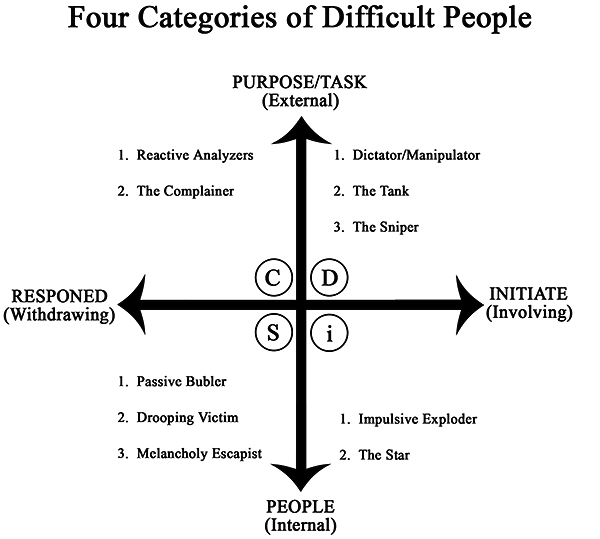
Identifying / Understanding Negative and Distressed Behavior

A) High D in distress

The Dictator / Manipulator

  • obsessed with power and control
  • calculating and tenacious
  • can appear charming in order to trick
  • plays “the blame game”
  • tells half truths and conceal facts
  • seeks to gain the advantage
  • are provocative or quarrelsome
  • sets up arguments
  • creates negative drama
  • ignores or breaks the rules
  • blames and finally abandons
  • wants to be the star, grabs the credit, takes all the bows
  • uses anger as a club
  • uses intimidation or patronizes
  • are threatened by talented people
  • glosses over some problems and magnifies other problems

The Tank

  • abusive, abrupt, and intimidating
  • leave their victims on the defensive
  • seek to overpower people by being persuasive, crude, or subtle
  • disrespect people who seem weak
  • determined to remove anyone or anything that does not serve their purposes
  • seeks to invalidate others in order to intimidate and control
  • hurts people but justifies their actions
  • suppresses guilt and avoids atonement
  • loves to embarrass victims in front of a group and is good at it
  • have low self-esteem but hide this by displaying over inflated egos
  • uses self-importance to make up for feelings of inferiority
  • the way to make an invalidator lose his grip is to invalidate him/her
  • if you invalidate your boss, who is an invalidating tank, you may feel very satisfied as you stand in the unemployment line.

The sniper

  • expert at taking pot shots and making sneak attacks in subtle ways
  • uses humorous put-downs, sarcastic tones, and disapproving looks or innuendoes
  • covert hostility
  • are bushwhackers who love to trap and make others look bad.
B) High i in distress

Impulsive Exploders

  • Fun-loving, joyous people who are lively, enthusiastic and friendly when not in distress or negative behavior
  • In negative, distressed behavior:
  • acts out impulses instead of dealing with anxiety or frustration
  • becomes obsessive or compulsive
  • erratic mood swings
  • gets depressed and feels despair
  • rejects criticism
  • blames other, “If it weren’t for . . . “
  • gets greedy
  • demands attention
  • seeks hard to please
  • allows other to think for them
  • gets negative and complains
  • says yes but means no
  • gets bored easily; feels hurt; jealous
  • delegates inappropriately and without direction
  • fears rejection—so in great distress feels censured and chooses to “get even”

The Star Performer

  • seeks attention and accolades
  • excessive need for acceptance and love
  • wants to win and is a poor loser
  • aims for center stage
  • turns slightest remark into an insult
  • interrupts and dominates conversations
  • makes sweeping statements
  • values position and status symbols
  • boasts and brags about accomplishments
  • asks aggressively challenging questions
  • makes fun of some serious things
C) High S in distress

Passive Bumbler

  • fears being unloved, unwanted, and unworthy
  • avoids decisions because of past mistakes
  • shuns responsibility and confrontation
  • keeps deepest thoughts and feelings private
  • accepts bad treatment but fumes inwardly, sulks, or puts
  • seeks sympathy and instills guilt
  • can become domineering and manipulative when angry where normally they would be more compliant and passive
  • makes excuses for playing it safe or for being selfish
  • holds grudges; becomes obstinate
  • dissociating self from all conflicts
  • over adapts to others
  • lacks assertiveness
  • invites criticism with passive behavior and low self-esteem

Drooping Victim

  • get taken for granted
  • feel ignored and unappreciated
  • try too hard to please everybody
  • turn anger inward
  • Play the role of victim
  • Violent behavior can take place after repeated victimization, even suicide

Melancholy Escapist

  • self-inhibited  and emotionally blocked
  • depressed and alienated
  • easily fatigued and has a low motivation
  • tormented by delusional or negative self-concept
  • blames others and drives people away
  • often feels hopeless
  • can be self-destructive
  • prone to abuse drugs or alcohol in order to escape negative feelings
  • struggle for significance
  • will often attack a rescuer
  • creates codependent relationships
  • withdraws and prefers to be alone or only with one significant person
  • feels no one cares or understands
  • gets engrossed in fantasy rather than reality
  • wears a drooper or victim mask
  • thinks “I am not ok but you are ok”
  • Passively waits rather than acts
  • needs a lot of solitude and external direction
D) High C in Distress

Reactive Analyzers

  • becomes preoccupied with their thoughts and interpretations rather than with reality
  • detaches from the practical world
  • becomes provocative and abrasive
  • cynical and argumentative
  • expects perfection and has difficulty delegating
  • Is very frustrated with people who do not think clearly
  • over controls with criticism
  • emotionally reactive and extreme when criticized or angered
  • over thinks for others
  • seeks to control
  • easily frustrated
  • verbally attacks from a “you” position
  • jumps to conclusions
  • can turn nasty or caustic
  • in conflict they tend to burn their bridges and ultimately reject others
  • demands and expects perfection
  • wears an attacker mask
  • thinks “I am ok, you are not ok”
  • strives to be perfect and over controls
  • can be obsessive, avoidant, or compulsive

The Complainer

  • idealists who crusaders, advocates, or critics
  • demand conformity
  • picky, judgmental, and perfectionist
  • very opinionated and expressive
  • impatient with criticism
  • moralizing and scolding
  • can become abrasive or indignantly angry
  • dogmatic and self-righteous
  • intolerant and inflexible
  • sees others as wrong
  • severs in judgments while rationalizing own actions
  • obsessive about overcoming the imperfections and wrong-doings of others
  • tries to correct, fix or police others
  • may be hypocritical and do the opposite of what they preach
  • condemning and punitive toward those they see as “wrong-doers”
  • fear being wrong defective, or incompetent
  • focus on what is wrong not what is right
  • wears attacker mask
  • thinks “I am ok, you are not ok:
  • expects you to be perfect for them
  • pushes beliefs
  • needs recognition and success
  • final distress behavior will be to forsake others

2) Dealing with these types of difficult people

A) Dealing with a high D in distress – three types:
  • Dictator / Manipulator
  • The Tank
  • The Sniper

These describe people in distress who tend to be overly aggressive and seek to exercise authority over others for their own purposes.

Great distress or anxiety in these personality types often produces a high level of hostility along with dominance.

Suggestions for dealing with high D’s who are in distress:

  • Avoid conflict with overly dominant and hostile people
  • Don’t argue
  • Avoid being manipulated by either their charm or force
  • Expect that they will become hostile id challenged and allow them to knock you off balance emotionally
  • Be assertive or they will not respect you but only see you as weak and easy to control/manipulate
  • Back off before you become unduly aggressive in response to their anger
  • Use truth and tack in confronting distressed controllers
  • Expect their wounds to be excessive and stubborn
  • Slow down and think carefully before you speak
  • Keep a check on your facial expressions and gestures
  • Answer them calmly and courteously if possible
  • Look for the traps they will set to create conflict to project blame
B) Dealing with a high i in distress – two types:
  • Impulsive exploders
  • The star

These personality types are very spontaneous, creative, responsive, and excitable people who can be very materialistic and greedy.  They never feeling they have enough and can be demanding and pushy yet unsatisfied. They can be too talkative, irritating, immature, and narcissistic.

Some of them may be gossips who are in-discrete, competitive, sharp-tongued, sneaky, imposing, critical, disloyal, and angry.

Then there are the two-faced backstabbers. They can be clandestine, sneaky, seductive, sabotaging, phony, evasive, superficial, and untrustworthy.

Suggestions for dealing with high i’s who are in distress:

  • Ignore aggressively challenging questions or statements
  • Affirm them for their accomplishment
  • Be sympathetic and personable
  • Be playful, positive, and upbeat
  • Be direct and attack the problem, not the person
  • Avoid the need to reach consensus at all costs
  • Try not to be defensive
  • Involve people in appropriate responsible action to resolve the issue
  • Share your own feelings and try to connect
  • Be a good listener
  • Assure the person you can respect him/her
  • Don’t push, criticize, or try to intimidate
C) Dealing with a high S in distress – three types:
  • Passive Bumbler
  • Drooping Victim
  • Melancholy Escapist

In a healthy emotional state of mind these people are usually caring, unselfish, altruistic, people who give unconditional love to others. They need security, solitude, and positive recognition. They fear being unwanted and abandoned. They are non assertive, often manipulated, or used, and see themselves as victims who are unworthy and must try to please others.

Suggestions for dealing with High S’s who are in distress:

  • Understand that these are normally caring, compassionate, warm-hearted people who are hurt, angry, and in distress
  • Seek to build a positive relationship with them.
  • Watch out for their possessiveness and codependent tendencies
  • Avoid allowing them to project on to your unfair guilt
  • Affirm them but reject any coercive or selfish behavior
  • Try to calm their fears and tendency to become victimized
  • Do not reject them if at all possible
  • Understand their need for security, peace, and calm
  • Respect their need for privacy at times
  • Expect that they will be unassertive but hostile when deeply hurt
  • Help them direct their repressed anger in positive ways
  • Encourage them to make positive decisions
  • Don’t say, “I don’t understand you”, and do not attack their self-esteem
  • Do not leave them alone and allow them to withdraw from important relationships
  • Recognize their need for motivation and encouragement even when they are being difficult.
D) Dealing with a high C in distress – two types:
  • Reactive Analyzers
  • The Complainer

When not in distress these people are responsible, logical, organized, conscientious, dedicated, purposeful, and perfectionistic.

In distress they become reclusive, isolated, dogmatic, self-righteous, and over-controlling. They fear being wrong or incompetent. A hot button for them is when someone criticizes or challenges them. They need to achieve their dreams and make sense of their environment. In distress they will attack and seek to be in control.

Suggestions for dealing with high C’s who are in distress:

  • Understand their need for perfection, organization, and caution
  • Expect them to be cynical and argumentative when provoked or challenged
  • Confront their verbal attacks
  • Do not let them think for you
  • Criticizing them will only intensify their attacks
  • Look beyond their attacker mask and see a person driven to be right whose self-esteem is linked to analytical thinking
  • Respect their need for space
  • Affirm their attention to detail
  • If arguing with them be prepared to use logic and facts
  • Keep an open mind when interacting with them
  • Remember they are very opinionated about most things and impatient with incompetence
  • Expect them to be moralizing, scolding, abrasive, and indignantly angry
  • Confront their dogmatic intolerance and severe judgementalism
  • Since they fear being wrong or defective expect the attacker mask to be used to cover these fears
  • If possible, affirm their need for recognition of their work and opinions
CONCLUSION

Difficult people manifest character and personality disorders which negatively impact their thinking, feeling, and relating. Difficult people are not always difficult in every relationship unless they are mentally ill. Their character disorder and difficult behavior may seem normal to them and is usually very hard to change.

The Bible identifies the primary character disorders in the seven (7) deadly sins: Pride, Envy, Anger, Greed, Apathy, Lust, and Gluttony.

In looking at difficult people we have seen behavior that is paranoid, obsessive, hysterical, aggressive, passive, temperamental, compulsive, impulsive, dependant, and manipulative.

These negative styles of character disordered behavior becomes masks people wear to hide their deepest spiritual and emotional needs.

“Flee also youthful lusts: but pursue righteousness, faith, love, peace with those who call on the lord out of a pure heart. But avoid foolish ignorant disputes, knowing that they generate strife. And a servant of the Lord must not quarrel but be gentle to all, able to teach, patient, in humility correcting those who are in opposition, if God perhaps will grant them repentance, so that they may know the truth, and that they may come to their senses and escape the snare of the devil, having been taken captive by him to do his will” (2 Timothy 2:22-26 NKJ)

Studies in Tithing

Church Of God General Offices Cleveland, Tennessee 

TITHING UNDER THE COVENANT OF PROMISE

Abraham Tithed

Returning from the slaughter of the kings, Abraham offered a tenth of his spoils to Melchizedek, the King of Salem. This incident occurred approximately 1900 years before the birth of Christ and is usually regarded as the earliest instance of tithing recorded in the Bible.

Melchizedek Blessed

Attention is given to this incident of tithe paying in Hebrews, chapter seven. The writer, discussing the incident, states that Melchizedek was greater than Abraham because Abraham paid tithes to him. The fact that Abraham paid tithes to Melchizedek denotes that Abraham was blessed of Melchizedek.

Tithing the Spoils

With regard to the spoils of battle, Abraham, although he was requested to do so by the king of Sodom, would not take any of the goods for himself. he seemed, nevertheless, to realize that he had no jurisdiction over God’s tenth. Even though he refused to accept the spoils for himself, he felt his obligation to God. For this reason, it appears that, with Abraham, tithing was not something optional but an actual obligation.

Jacob's Pledge

The fact that tithing was a custom among the ancient Israelites is reflected in the vow of Jacob 153 years before the giving of the Law: “If God will be with me, and will keep me in this way that I go, and will give me bread to eat, and raiment to put on, So that I come again to my father’s house in peace; then shall the Lord be my God: And this stone, which I have set for a pillar, shall be God’s house: and of all that thou shalt give me I will surely give the tenth unto thee” (Genesis 28:20-22).

Practicing His Grandfather's Religion

Jacob was Abraham’s grandson, and it was most fitting that Jacob should practice the religious observances of his grandfather. Since he took the God of Abraham as his God too, it is only reasonable that he would follow the worship practices of Abraham as well.

Abraham's Children Do His Works

If we are Abraham’s children, we will do the works of Abraham (John 8:39). And although we have only one record of Abraham’s paying tithes, in Jacob’s vow we see tithing as a continuous act. His vow was not made for his one single journey but for the rest of his life. For this reason, it is only right and logical to believe that Abraham was a faithful tither.

Divine Origin

Offerings are divine institutions of God; and, if God requires the, is it not logical that He would signify the amount? The very fact that so many peoples of the earth pay a tenth unto God as the stipulated amount lends credence to its divine origin.

MOSAICAL TITHING

We have already learned that tithing was not practiced merely under the Law. Neither was it an institution that began with Moses, the Lawgiver. But we have a biblical record that Abraham paid tithes under the covenant of promise 430 years before the giving of the Law.

Moses Adapted It

Moses does not deal with tithing as a new institution but seems only to have adapted it to the Jewish situation. A tenth of the produce of the land, whether it was the seed or the fruit, was to be set apart and regarded as wholly for God. Every tenth calf and lamb of the increase of the flock or herd was to be set apart for God (Leviticus 27:30-33). This tithe, though claimed by God himself, was given to the Levites as an inheritance: “And, behold, I have given the children of Levi all the tenth in Israel for an inheritance, for their service which they serve….But the tithes of the children of Israel, which they offer as an heave offering unto the Lord, I have given to the Levites to inherit” (Numbers 18:2124).

The Levites Tithed

It may be noticed that in this tithing, according to Leviticus 27:32, the giver had no voice in its disposal. No part of it was to be received back. To withhold such tithe was regarded as dishonesty (Malachi 3:8). A tenth of this tithe was to be paid by the Levites to Aaron, the priest (Numbers 18:26-28).

Two Other Tithes

Under the Jewish order, there were a second and a third tithe which were given. We learn, concerning this second tithe, in Deuteronomy 14:22-27, that, first, it was to be eaten by the offerer, his household, and the Levite. There was one restriction, and that was that it was to be eaten at the appointed place of worship. The tithe-payer was to eat and praise God for his increase.

Festival Tithe

If the tithe payer lived some distance away from that appointed place, he could convert his produce into money and spend it for sacrifices and feasting when he arrived at the appointed place of worship. This second tithe is often called a festival tithe and was paid three times a year. All of the men of Israel were to assemble at the sanctuary at least three times a year to worship God: “And thither ye shall bring your burnt offerings, and your sacrifices, and your tithes, and heave offerings of your hand, and your vows, and your freewill offerings, and the firstlings of your herds and of your flocks: And there ye shall eat before the Lord your God, and ye shall rejoice in all that ye put your hand unto, ye and your households, wherein the Lord thy God hath blessed thee” (Deuteronomy 12:67).

The purpose, then, of this festival tithe was to foster religious principles and to furnish a time for social observances. Some people do not understand the proper use of tithe because they do not understand the different divisions of tithing in the Old Testament. Most people conclude that there is only one tithe; and, for that reason, every scripture in the Old Testament concerning tithing is, in their opinion, brought under one heading. Unless we recognize the various tithes of the Old Testament, we cannot reconcile the Scriptures.

Third Tithe

The Scripture suggests that a third tithe was offered by the Israelites: “At the end of three years thou shalt bring forth all the tithe of thine increase the same year, and shalt lay it up within thy gates: And the Levite, (Because he hath no part nor inheritance with thee,) and the stranger, and the fatherless, and the widow, which are within thy gates, shall come, and shall eat and be satisfied; that the Lord thy God may bless thee in all the work of thine hand which thou doest” (Deuteronomy 14:28, 29). We know that this is not the tithe given to the Levites, because that tithe was for his inheritance. We understand that it is not the second tithe, because such a tithe was to be taken to an appointed place of worship. This tithe, which is called the third tithe, was to be laid up at home. This tenth was to be shared with the Levites, strangers, fatherless, and widows.

According to the Scripture, the Israelite was to set apart from one-fourth to one third of his income for tithe and offerings. A sincere Israelite would possibly set apart a tenth of his income for the Levite. The firstborn and firstlings of his cattle would be given to God. For three years the fruit of the young trees was not to be eaten, and in the fourth year the fruit was to be for God. Every seventh year he would not claim any money from his debtors. He would leave the corners of his field, the fallen fruit, his gleanings, and the overlooked olives and grapes for the poor. He would give a second tenth for a festival tithe to be spent at the appointed place of worship. He would possibly give a freewill offering for the Feast of Weeks, animals for the payment of vows, or thank offerings. He would also bring a basket of firstfruits to present unto the priest.

THE LAW AND THE PROPHETS

Tithing in the Days of Joshua

Having discovered the laws of the first five books of the Bible which govern tithes, let us find out if the remainder of the Old Testament adds any new light on these laws. When the children of Israel entered into the land of Canaan, Joshua read to them a copy of the law of Moses: “There was not a word of all that Moses commanded, which Joshua read not before all the congregation of Israel, with the women, and the little ones, and the strangers that were conversant among the: (Joshua 8:35). Therefore, Joshua read all that was commanded concerning tithes. Since the tithe was the only means of support for the Levites and their families, it is quite certain that this law did not go unnoticed. We read of the Levites coming to Joshua at Shiloh making the following request: “The Lord commanded by the hand of Moses to give us cities to dwell in, with the suburbs thereof for our cattle” (Joshua 21:2).

We do not read anywhere in the Word of God that tithing was regarded as burdensome by those who practiced it. Without exception, every time that tithes were given and the more closely this precept was followed, the more prosperous the people became and the greater the blessings they received.

Tithing in the Days of Elijah and Elisha

In the days of Elijah and Elisha devout men and women respected those in the ministry and gave them the portion that belonged to them and, in many cases, even beyond that portion. This spirit is exemplified in the action of the widow of Zarephath who had but a handful of meal in a barrel and a little oil in her cruse, but who made the first cake for the Lord’s prophet. It is also exemplified in the action of the Shunammite woman who prepared a room in her house for the itinerant preacher, Elisha, again showing kind hospitality toward the ministry.

The first time that the actual word “tithe” is mentioned after we leave the book of Deuteronomy is in the ironical words of Amos when he rebuked the people for not paying their tithes.

Under Hezekiah

Under the reform of Hezekiah, “he commanded the people that dwelt in Jerusalem to give the portion of the priests and the Levites, that they might be encouraged in the law of the Lord” (2 Chronicles 31:4). The Levites could have worked in the field and could have done other work, but it was their specific work to minister. Ministers to today are not too good to work with their hands, but they cannot do justice to the ministry of the Word of God when they have to work at secular labor.

Ministers are not to be regarded as objects of charity. When the people brought in their tithe, the reply of the priest was, “Since the people began to bring the offerings into the house of the Lord, we have had enough to eat, and have left plenty: for the Lord hath blessed his people; and that which is left is this great sore” (2 Chronicles 31:10).

When Hezekiah came to his throne, he opened the house of God and restored the priests and Levites to their services. They had suffered because the people had not shared God’s portion. Ministers suffer today through the laxity of non-tithers. This is God’s financial system, and we must recognize it.

Under Nehemiah

In the days of Nehemiah, the Levites and singers were driven to the fields to work because the portion had not been given them: “And I perceived that the portions of the Levites had not been given them: for the Levites and the singers, that did the work, were fled every one to his field. Then contended I with the rulers, and said, Why is the house of God forsaken? And I gathered them together, and set them in their place” (Nehemiah 13:1011).

Under Malachi

Even the last prophet of the Old Testament, Malachi, sharply rebukes the people and eve calls them robbers for withholding their tithe from God. “Will a man rob God? Yet ye have robbed me. But ye say, Wherein have we robbed thee? In tithes and offerings. Ye are cursed with a curse: for ye have robbed me, even this whole nation. Bring ye all the tithes into the storehouse, that there may be meat in mine house, and prove me now herewith, saith the Lord of hosts, if I will not open you the windows of heaven, and pour you out a blessing, that there shall not be room enough to receive it” (Malachi 3:8-10). Malachi passed a severe sentence upon those who failed to keep the ordinance of tithing. When the people lapsed into a state of spiritual declension, they always failed to pay their tithe; but, when revival came to Israel, or in times of humiliation, they would always return to the paying of tithe as recorded in the law of Moses.

CHRIST’S ATTITUDE TOWARD TITHING

Christ Endorsed It

I reiterate that Jesus Christ did not repeal the law concerning tithing, but rather He endorsed tithing. If tithing was not burdensome to those in Old Testament times, although they were required to give much more than is asked today of Christians, they surely we can give that portion of our income which belongs to God cheerfully and willingly.

Did Christ Tithe?

Tithe-paying was a general practice in the days of our Lord. The sect which was strictest concerning tithing was the Pharisees. In order to be admitted into the fellowship of the Pharisees, one was obligated to pay his tithe. He was obligated to tithe what he bought, what he sold, and what he ate. But what was the attitude of our Lord concerning the paying of tithes? Our Lord could not ignore the matter of paying tithes because He was brought face to face with it every day of His life. Even to buy a pennyworth involved the consideration of whether the penny had been tithed. If a woman set before her husband untithed food, it was an offense grave enough to permit divorce. Jesus had to face the question of tithing day after day. He taught the people as one having authority, and we can be sure that they were not silent in their questions on this point. If Jesus Christ had not been a tither, this would have been one of the first complaints of the Pharisees; for, even when our Master dined with sinners, they murmured, “Why eateth your Master with publicans and sinners?” (Matthew 9:11). But not once is Christ questioned concerning His obligation to tithe. The Pharisees were continually watching every word and action, seeking to find fault with Him; but they never found it on this point. The very fact that Jesus Christ was admitted into the homes of the Pharisees for meals is evidence that He was a tither: “And as he spake, a certain Pharisee besought him to dine with him: and he went in, and sat down to meat” (Luke 11:37). This was definitely against the vow of a Pharisee to be the host of an outsider–that is, one who did not adhere to the Pharisaical vow.

Jesus Fulfilled the Law

Jesus Christ did not come to destroy the Law but to fulfill it. If one examines closely the teaching of Christ in the gospels, he will discover that Christ enjoined an almost lavish system of giving. He said to one man, “Sell all that thou hast, and distribute unto the poor, and thou shalt have treasure in heaven” (Luke 18:22). When Jesus urged men to follow Him, He expected them to surrender all. Man must deny self, take up the cross, and follow Jesus Christ. He must hate father and mother, wife and children, brothers and sisters, and his own life also, or he cannot be Christ’s disciple (Luke 14:26).

If Jesus Christ required such a rigid surrender on the part of His followers of some of the things that are most valued by all men–family relationships and their very lives–it is conclusive that man’s money was not excepted.

There are those who feel that Christ denounced the Pharisees for their tithe paying. Christ did not offer disapproval to the Pharisee who said, “I give tithes of all that I possess” (Luke 18:12). His fault was not in his tithe paying but in his self-righteousness and egotism. Neither is there disapproval in Matthew 23:23: “Woe unto you scribes and Pharisees, hypocrites! for ye pay tithe of mint and anise and cummin…these ought ye to have done, and not to leave the other undone.” The Lord id not disapprove of tithing but, on the contrary, expressed His approval by saying, “These ought ye to have done.” This scripture most certainly expressed the attitude of the Lord concerning tithe paying.

Since tithing was generally accepted among religionists in the day of Jesus Christ, it was not necessary for Christ to issue a new commandment concerning tithing. He merely summed up the matter of giving with these words: “It is more blessed to give than to receive” (Acts 20:35).

THE TEACHING OF PAUL CONCERNING TITHING

To the Corinthians

The Scripture, in 1 Corinthians 16:2, “Upon the first day of the week let every one of you lay by him in store, as God hath prospered him” does not have reference particularly to tithing. It is rather, the collection of monies for a charitable fund to take care of the poor of the church at Jerusalem. The churches of Corinth and Galatia were called upon for this special service.

To the Galatians

The Apostle Paul also encouraged the Galatian converts to support the ministry: “Let him that is taught in the word communicate unto him that teacheth in all good things. Be not deceived; God is not mocked: for whatsoever a man soweth, that shall he also reap” (Galatians 6:67). Seldom do individuals think of this scripture as having a monetary connotation; however, Paul is giving instruction concerning support of the ministry.

To the Romans

In Paul’s letter to the Romans, He sets a policy for the support of the ministry. He contended: “For if the Gentiles have been made partakers of their spiritual things, their duty is also to minister unto them in carnal things” (Romans 15:27). Here the Apostle Paul stresses that it is the duty of those who are ministered to to give of their carnal or material things for the support of the ministry. A similar statement is made in his instruction to the Corinthian church: “If we have sown unto you spiritual things, is it a great thing if we shall reap your carnal things? (1 Corinthians 9:11).

It is contended by some that the Apostle Paul worked with his own hands and refused personal remuneration for his labors. It is true that, lest he should be classified with those false ministers who were transforming themselves into angles of light and making merchandise of the gospel, he did forego personal remuneration at times; but he did not give up his right to receive remuneration, for he writes of the liberality of the Philippian church in these words: “In the beginning of the gospel, when I departed from Macedonia, no church communicated with me concerning giving and receiving, but ye only…ye sent once and again unto my necessity. Not because I desire a gift: but I desire fruit that may abound to your account” (Philippians 4:15-17).

The support of the ministry, Paul claimed, was an ordination of God. For he declared, “Even so hath the Lord ordained that they which preach the gospel should live of the gospel” (1 Corinthians 9:14). If Jesus Christ ordained that they that preach the gospel live of the gospel, is it likely that He would ordain any other plan than the plan that He himself followed, which was the plan of tithing? The Apostle Paul makes a comparison of the support of the ministry under the Old Testament and the support of the New Testament ministry. “Have we not power to eat and to drink?…Who goeth a warfare any time at his own charges?…If we have sown unto you spiritual things, is it a great thing if we shall reap your carnal things?…Do ye not know that they which minister about holy things live of the things of the temple? and they which wait at the altar are partakers with the altar?” (1 Corinthians 9:4, 7, 11, 13). Then, following this, He says, “Even so hath the Lord ordained” (v. 14), which leads us to believe that God would have His people to set apart a certain portion for the ministry. Those that ministered about the sacred things of the Temple were given a certain portion, which the Levites were also given a tithe. Those who claim that all of the Law was aborted under the gospel must remember that tithing was not instituted under the Law. It was instituted before the Law was given. However, I am of the persuasion that the portion of the Law that concerns tithing was not annulled, but was fulfilled in the fact that Jesus Christ gave His distinct approval and endorsement of this method of support for the ministry.

Jesus confirmed tithing by approving the tithe payments of the Pharisees and ordaining that they that preach the gospel should live of the gospel. For those who would contend that the ministry is to be supported by mere freewill offerings, I refer them to Paul’s comparison of those who ministered about sacred things in the Temple. It is well to note that while there were freewill offerings for the ministry, there was also a tithe given. If this is not the system for us today, then Paul’s comparison is out of order. The very fact that the Lord ordained that ministers should “live of the gospel” should sweep away the thought that every man was left perfectly at his own liberty to give what he pleased; for, if this were so, there would be no ordinance or Law at all, and what Christ ordained would amount to little or nothing.

There are two major principles concerning giving that the Apostle Paul laid down in the New Testament. One is that tithes and offerings are to be given for the support of the ministry. The second is that each church should have a fund from which the poor can be supported when necessary.

Concept of tithing throughout the Bible.

Strategy for Developing a Multi-Cultural Church

INTRODUCTION

The task of evangelizing the lost and building growing churches has become extremely challenging in the twenty-first century. Old traditional practices that pastors have used effectively in the past do not seem to work as effectively as before.  What must a pastor and a church planter know about church planting and church growth in the twenty-first century?

This study will briefly discuss three paradigm shifts in ministry that affect twenty-first century church planting and growth.  These are:

  1. The effects of philosophical changes in urban America.
  2. The effects of the disorientation of life in urban America.
  3. The effects of demographic changes in urban America.

Church planters and pastors must face these realities affecting ministry in the twenty-first century in order to effectively minister to those needing Christ in the midst of the pressures of the world today.  An understanding of these realities would help church leaders effectively apply the following strategies for church planting and growth that are discussed in this study.

These strategies are as follows:

  • Urban strategy #1:  Integration versus Independence
  • Urban strategy #2:  Mega church versus small group church
  • Urban strategy #3:  Focusing on key age groups versus the “shotgun approach”
1) THE EFFECTS OF PHILOSOPHICAL CHANGES IN URBAN AMERICA

We live in an experience-saturated culture.  Many youths and young adults experiment with alcohol, drugs, “rave parties” etc., because they want to experience “thrills,” which actually prove to be empty and temporary.

Pentecostals, like us, who focus on “experiencing God” have the opportunity to reach postmodern men and women who are on a quest for their true selves.  People nowadays come to church, prayer meetings, and Bible studies expecting an experience.

George Gallop Jr. said in his book, The Next American Spirituality: “The idea that one path is as meaningful as the next has shaped American religious experience profoundly.  Certainly the rise of pluralism, the sheer expansion of options, has aided this.”  He said, “People are less likely to turn to a church or religious institution, more apt to depend on self-help books or tips from talk shows to arrive at their beliefs.”  Gallop likewise mentioned that “well over twenty-three percent of Americans believe in astrology and over twenty-five percent believe in the Eastern religious concept of reincarnation despite the fact that a large majority identify themselves as Christians.” [1]

Dr. Mike Chapman, senior pastor of City Church in Chattanooga, TN, said in a taped interview, “There have been two major philosophical changes over the past 50 years in America – i.e., the death of Christendom as a major influence and the death of modernism.”  Dr. Chapman said that Christendom formerly exerted a great influence on culture and society, but it has been “dead” in the United States since the 1960s.  He observed that there are churches that are doing ministry with the presumption that the American culture is still “defacto Christianized.”  He warned that, “These churches have become irrelevant and are looked upon with scorn.” [2]

Dr. Chapman also said that modernism has been “dead” in America and in other nations since the 1980s.  “There are no more absolutes today – no one knows what the truth is.  Postmodern people think that there are different paths to spirituality and each one is as good as the others.  Reasoning and the scientific method have given way to experience.” [3]

Gallop says that “One third of Americans claim to have had a spiritual experience that touches them deeply, but much contemporary spirituality stops with experience and dispenses with reflection.  There is an elevation of experience over belief. [4] The escape Pentecostals offer is “not an escape from the real world but rather, into the ultimate reality” found only in Christ. [5] Our experiences must continue to be biblically based and led by the Holy Spirit.

Doctors Jackie and Cheryl Johns said that the Holy Spirit would teach us by “bringing experiential knowledge of God.” They explained that the Hebrew word that is transliterated as “Yada” focuses on knowledge that comes through experience. They said, “One learns about God by encountering God and responding appropriately out of that encounter.”  The authors quoted Thomas Groome who said that “knowing” was to be “more by the heart than by the mind.” [6]

Another avenue that Pentecostals can use to reach postmodern people would be their seeming lack of hope.  The modernist worldview was that “science would sooner or later find a solution to problems of ill health, poverty, suffering and war, yet, as the twentieth century progressed, the modernist’s hopes were shattered.  The myth of scientific progress is dead.  The Postmodern worldview is based on the failure of modernism.” [7]

Pentecostals can therefore share hope to the hopeless!   We have the message of hope in Christ and the reality of the Holy Spirit’s power as evidenced by signs and wonders.  This message of hope can become an anchor where the postmodern person can cling on amidst the chaos of his or her personal life.  Science may have failed us but Christ will never fail!

In order to effectively communicate the Gospel in this postmodern world, ministers today must seek to understand the philosophical parameters that affect the mindset of their hearers. The Scriptures warn us, however, in Matthew 9:17 not to put new wine into old wineskins or else the wineskins will break.  We must thus be willing to radically follow the Holy Spirit’s leading in having a seeker-sensitive ministry without the trap of institutionalism – i.e. the use of old and antiquated religious practices that may no longer be relevant to un-reached, twenty-first century people.

2) THE EFFECTS OF THE DISORIENTATION OF LIFE IN URBAN AMERICA

A recent article in the National Geographic (dated November 2002) reported that “by the year 2030, sixty percent of the world’s people will be living in cities.”  These cities will be very large ones.  A “mega-city” is defined as an urban area that has more than ten million inhabitants.  According to information from the United Nations, there were fourteen mega-cities in 1995 but in 2015 there will be twenty-one.  This article said, “The number of urban areas with populations between five and ten million will shoot from seven to thirty-seven.  This growth will occur mainly in developing countries, those least equipped to provide transportation, housing, water, and sewers.” [8]

The United States Census Bureau reports that 80.3 percent of Americans or 226 million people lived in metropolitan areas.  It also said 54 percent of the 281.4 million people counted in the United States (in Census 2000) live in the top ten most populous states.  New York was the most populous metropolitan area with 21.2 million people while Los Angeles metropolitan area was second largest with a population of 16.4 million.” [9]

Bill Easum estimates that eighty percent of United States churches are located in sparsely populated areas instead of in the urban areas where the vast majority of people live today.

Easum emphasized that instead of building churches we must focus on penetrating the city.  “We must focus on penetrating urban life and reaching city dwellers.  We must …plant churches in the urban areas of dense population.”  Easum said some think that there are too many churches.  On the contrary, Easum said, “…at the turn of the century, there was a church for every 500 people whereas today there is one church for every 2,000 people.” [10]

One of the best ways to reach the people in our cities is to know their felt needs. John Dawson, in his book Taking Our Cities for God, listed these twelve factors that contribute to the disorientation of modern city dwellers: [11]

  1. They feel powerless – Authority is distant and impersonal.
  2. They feel alone – The great majority of people are total strangers to the individual.
  3. They feel vulnerable – Culture, race, and language are not bases for security.
  4. They feel lost – Nationwide urban uniformity dwarfs regional culture.
  5. They feel controlled – Urban people have their senses bombarded by media.
  6. They feel rejected – Family proximity only comes as a result of conscious effort.
  7. They feel bewildered – Decision making over many options leads to anxiety.
  8. They feel foolish – Information overload has dulled appetite for true understanding.
  9. They feel insecure – Nearly all friendships are short-term.
  10. They feel used – They are only valued for their labor, and can be rejected if they fail.
  11. They feel anxiety & stress – They are surrounded by restless activity for success.
  12. They feel void of meaning – Public values are based on consumption/production.

Floyd McClung Jr., said, “Ministry and life in the city is a learning process. We learn about cultures, people, life, pain, ourselves, failure, . . . And, if we learn all these lessons along the way, we will learn to be God’s answer to others. An entrance strategy to urban missions is to have “genuine love for people, faith in God in spite of great need and giving up our rights” [12]  “The heart of urban strategy is bringing people to Christ.” [13]

This agrees with what Roger Greenway wrote about how to succeed in the city.  Greenway said that we must spend time ministering to people outside the church’s membership.  He said that those who want to succeed in urban ministry…[14]

  • Must learn to love the city and its people
  • Must get to know the city
  • Must learn to appreciate the body of Christ that exists in the city
  • Must hurt for the city
  • Must possess a deep and genuine passion for evangelism
  • Must build genuine credibility

Ministry to urbanites in America (and in other world cities) must start with the compassion poured into the minister’s heart from the heart of Christ.  It must be undergirded by discernment that comes from the Holy Spirit with regard to the spiritual dynamics that are working within the city.  Floyd McClung, Jr. says that “Each city has its spiritual dynamics, but the spiritual life of some cities…reach beyond their geographic location.” [15]  McClung also said in another book that “Exercising the gift of discernment of spirits is crucial.  We must know if we are battling demonic powers or dealing just with sin and its consequences in the culture.”  He says further that, “I have found that a relationship usually exists between demonic bondage in a city or nation and the sins that have been committed there on a large scale in the past.”  He suggested that we must research the issues that weaken the influence of the Gospel in the city by carefully listening to what God has on His heart for our cities. [16]

Urban church planters must therefore be empowered by the Holy Spirit to discern the needs of the residents of that city and identify the spiritual dynamics affecting the spread of the Gospel of Christ there.  There is a need to identify with the residents of the city.

This calls for a holistic ministry that empathizes with their struggles and pains; one that does not ignore the marginalized such as the poor, the immigrants, the single parents etc.  It must somehow reach relationally to those whose lives are broken by alcohol, drugs, lust, fear, etc. Easum says that many twentieth century conversions were dramatic, “Damascus-road” experiences, though the gradual, Emmaus experience best describes conversion today.  Effective evangelism relies on long-term relationships and growth processes not rallies or programs. [17]

3) EFFECTS OF DEMOGRAPHIC CHANGES IN URBAN AMERICA

The United States Census Bureau reported that there were a total of 281.4 million people who were counted in the United States of America as of the year 2000. [18]

The chart in Table 1 shows the major ethnic groups in the United States in the year 2000.

The United States population is still predominantly “white” (i.e. of Anglo Saxon heritage) although the Hispanic population has grown to 35.3 million making them the largest single “minority” racial group in the United States (as compared to 34.6 million African Americans).  Missions’ consultant, Arturo Lucero says that new immigrants are coming into America (legally or illegally) at the rate of 125,000 a month.  He says that about sixty percent of the nation’s thirty-three million immigrants live in the ten largest United States metropolitan areas such as New York, Miami, Chicago, or Los Angeles. [19]

Reverend Dan Sandoval, assistant pastor of Cooper City Church of God (Florida) said:  “The spectrum of (the) territory is widening every month.  Hispanics, Jamaicans, Brazilians are making their presence known in the community.  We need to take note of these (demographic) changes, wake up to it and recognize that they are part of the harvest.” [20]  Reverend Dwight Allen, the senior pastor of Cooper City Church of God for the past eighteen years reported that, at present, there are fourty-four different nationalities in their congregation. [21]

Table 1)
United States POPULATION (2000) based on Ethnicity [22]

Racial Grouping                          Number of People           %     
White                                            211,460,626                    75.1
African American                        34,658,190                      12.3
Asian                                            10,242,998                      3.6
American Indian/Alaskan           2,475,956                        0.9
Hawaiian/Pacific Islander          398,835                            0.1
Some other race                        15,359,073                       5.5
Two or more races                     6,826,228                         2.4
TOTALS                                      281,421,906                    100.0

Hispanics/Latinos                      35,305,818                      12.5
Non-Hispanic                             246,116,088                    87.5
TOTALS                                     281,421,906                    100.0

4) ADAPTING TO DEMOGRAPHIC CHANGES:THE NEED FOR STRATEGIC CHURCH MISSIOLOGY

How then should churches respond to these demographic changes in North America?  What church planting strategies are needed in addressing the challenges and opportunities that have come as a result of these demographic changes?

The Lausanne Covenant states “…the whole church must take the whole Gospel to the whole world. [23]  Christ commissions all believers in Matthew 28:18-20 to go and make disciples of all nations.”

The Greek word “εθνος” (i.e. “ethnos”) refers to race, tribe, people, family of people, and clan or sub-clan. [24]  Christ mandates us to bring His Gospel to every people group in the world.  Oftentimes, believers interpret the Great Commission merely as a call to go overseas to some unreached tribal group.  That aspect of world missions is important; however, we must realize that there are great multitudes of people who are flocking to the major urban centers of the world.  The crowded cities of the world are the mission fields of today.  The great masses of people in the cities provide us with the greatest opportunity for reaching every εθνος for Christ.

Dr. Donnie W. Smith (state overseer of Florida-Tampa) said, “God has brought the world to our church doorsteps.” [25]  Missions consultant Arturo Lucero told Christianity Today that “American cities and towns are undergoing an explosion of immigrants, refugees, and changed lives.”  He said,  “Jesus gave the church two mandates:  evangelize all peoples and love all peoples.  We need to follow Jesus even if we have to move beyond our ethnic comfort zones.” [26]

The United States Census Bureau reports that most of the major cities of the United States have become greatly diversified ethnically.  Major metropolitan areas in the United States have gone through significant demographic changes through the influx of immigrants from various nations (see Table 1).  Dr. Donnie Smith said, “In today’s America, whites remain the majority but by the middle of the twenty-first century, they will enter the arena of minority status.  In America, tomorrow’s ministry will be multicultural.” [27]

How are pastors of evangelical churches responding to this new challenge and opportunity?  Will churches embrace these changes and grow numerically or will they resist these changes thus becoming stale and isolated from the realities around them?

Pastor Dwight Allen said, “The church leadership must be envisioned with passion from the harvest.  It is as simple as caring about people no matter what their culture.  A burden to reach different people groups must begin with the pastor.  It must be a passion driven by the Holy Spirit.” [28]

What church planting strategies would address this growth in ethnically diverse urban centers within the United States?  Let us examine the following strategies:

URBAN STRATEGY #1: Integration vs. Independence

Cooper City Church of God has succeeded in integrating different ethnically diverse people into their worship services. This is different from the concept that Donnie Smith advocates in his book, The Undiscovered Harvest. Dr. Smith cited the example of Mountain West Church of God in Stone Mountain, Georgia as a unique model for the establishment of a (multicultural) church within a church, one wherein a host church willingly shares its facilities with another cultural group.  He said its success relies upon the host congregation’s deep appreciation for the diversity of cultures. [29]

Dr. Grant McClung quoted Dr. Peter Wagner who called this approach the “Multi-congregational church planting model” where equally independent congregations share the same facilities of a church.  “Each congregation has its own pastor and staff, different council, and a separate budget yet it shares the same building with the other(s).” [30]

What strategy will work in urban church planting here in twenty-first century America?  What would be better: integration or independence?

Would the integration of ethnically diverse people groups into one congregation be better than allowing for the establishment of independent ethnic churches using common church facilities?

The integrated multi-cultural church structure of the Cooper City Church of God in Florida is a good example of the Biblical model found in the New Testament, particularly as we study the early church in the book of Acts.

Reverend Sandoval said this model of integration starts with the philosophy that “we are one church of many nations working and worshipping as one body and serving one God.” Reverend Allen said that having separate services for each ethnic group causes growth only up to a certain point.  Usually there is little leadership training in these ethnic churches because the ethnic pastor gets too busy.  With little leadership training, the congregation members are not able to break free from the hold of secular culture wherein they think that “they are the boss.”  They “eat” their pastors (figuratively speaking) instead of getting involved in ministry. [31]

Reverend Allen shared his strategy of deliberately integrating the different ethnic groups within Cooper City Church of God: [32]

  • Integration within the service of songs, Scriptures, and prayers in different languages
  • Integration of church leaders from different ethnic backgrounds in the church council
  • Integration of pastors with varied ethnic backgrounds within the pastoral staff
  • Integration of singers from varied ethnic backgrounds into an international choir
  • Integration of church members through shared meals and joint activities

Doing ministry cross-culturally requires intentional planning.  Reverend Allen says that he intentionally includes a few praise and worship songs in different languages (such as Spanish) during the worship services of Cooper City Church of God.

Reverend Allen also involves his ethnically diverse pastoral staff in reading Scriptures or praying in languages other than English during the worship service. 

As of 2003, the ethnically diverse Cooper City Church of God pastors were as follows: [33]

  • Pastor Sandoval, Assistant Pastor (Filipino)
  • Pastor Moreira, Minister of Music (Brazilian)
  • Pastor Morerro, Spanish services (Hispanic)
  • Pastor Crick, CE & Administration (British-born in India)
  • Pastor Vallotton, Italian services (Italian)

Aside from modeling this openness to cultural diversity, Reverend Allen intentionally involves his congregation in various activities that allows for different cultures to mingle.  He says that he has learned from Filipinos how to use fellowship dinners to enhance fellowship.

Reverend Allen also incorporates what he calls “non-spiritual stuff” such as games, etc. into these once-a-month dinners.  He encourages one group of ethnic people to mingle with another group with a different ethnic background (such as the Jamaicans sponsoring the Hispanics, etc).

Another key strategy that is being used in Cooper City Church of God is the incorporation of church leaders from different ethnic backgrounds in the church leadership board.  The chairman of the church council is a Spirit-filled medical doctor from Trinidad and Tobago.  Reverend Sandoval said that there are strengths in coming together as one church including having bigger resources and more opportunities for individuals to grow.  The pastors tailor ministry around the strengths of these ethnic groups.  They then reach out to their own people. [34]

Dwight Allen said, “Cross-cultural evangelism will not occur unless you build a spiritual mandate based on the Word of God.  The leader must teach his/her congregation to look at people through the eyes of God.  He sees no color, no cultural diversity, and hears no accent.”

Reverend Allen added that the church leader “simply sees a soul in need.  No matter what their culture is, people have to be loved for who they are and the way they are.” [35]

URBAN STRATEGY #2: Mega church vs. small group church

Is the size of the congregation an essential component for success in planting a cross-cultural church in twenty-first  century urban America?  Are large mega churches or medium sized churches more effective in evangelizing and discipling postmodern urban dwellers in America?

An article in Christianity Today reported that in 1999, forty-three percent of Americans claimed to have attended church in the past week.  This article cited statistics from the Yellow Pages that said that there were 350,000 listings for churches in the United States compared to about 300,000 twenty years ago.  It also quoted Lyle Schaller who said that the average church size has tripled in the past century.  Schaller said: “Many people are attending larger, mega-churches.” [36]

Ralph Neighbour, Jr. said that “Mega-churches” are the most popular form of traditional church life today.”  He observed, however, that “These city-wide congregations have bled the life out of neighborhood churches. Plush, ornate auditoriums, and subsidized ski trips for Yuppies appeal to the social side of Americans, but do little to touch the broken lives of the unchurched.  These churches attract some who desire to ‘get lost’ in the largeness…” He added that “Since their activities are extremely building-centered, they choke off growth by growing large enough that they can no longer afford to add further space to their facilities.” [37]

“A five-year study of the Hartford Institute for Religious Research examined 14,301 churches from 41 Christian denominations.  This study reported that fifty percent of the congregations in the United States have fewer than 100 regularly participating adults.  Fifty-two percent were located in small towns and rural settings. It also pointed out that only six percent of these churches have more than 1,000 active members.” [38]

An article in the Asian Journal of Pentecostal Studies reported that in 1999, there were nearly 400 large churches and 15 mega-churches in Korea (i.e. those with at least 12,000 adults in attendance).

The Yoido Full Gospel Church of Pastor Cho Yong-gi led this list of mega-churches with 230,000 adult attendees. [39]  The Korean model of church growth through cell groups has elicited a lot of academic interests.  The Asian cultural mindset is different from that of North Americans and thus, we must see if this model for church growth applies in the United States.

Pastor Gabor, Senior Pastor of Filipino Christian Center, noted however that “Small groups don’t fit to the American culture.” [40] Joel Comiskey’s case study of eight cell churches worldwide (with adult memberships of 7,000 or more) included Bethany World Prayer Center in Baker, Louisiana which Comiskey called the premier United States cell church. [41]

Ralph Neighbour Jr., indentified Portland’s New Hope Community Church, under Pastor Gale Galloway as an example of a successful cell group church here in the United States. [42] Cell based churches can thus thrive here in the United States in spite of most Americans’ desire for privacy and individualistic pursuits.

Bill Easum said that, “The further we move into the twenty-first century, the more important the relational, affirmational, contextual, and group evangelism will become.” [43]

It is said that 75 million Americans regularly find strength in a small group source. [44]  Urban church planting in twenty-first century America will thus be best achieved through the use of small groups.

URBAN STRATEGY #3: Focusing on key age groups vs. the “shotgun approach”

George Barna shared these United States Census statistics for five generations of Americans.  The Data appears in Table 2.

Table 2)
Population Data for 5 Generations of Americans [45]

Generation        Years of Birth             Age Range in 1998           Population Size
Seniors              1926 & earlier           72 years & older                 19.9 million
Builders             1927-1945                 53 to 71 years                     39.8 million
Boomers           1946-1964                 34 to 52 years                     73.1 million
Busters              1965-1983                15 to 33 years                      72.3 million
Mosaics             1984-2002                14 and younger                    61.7 million

Biblical churches need to be multi-cultural and multi-generational; however, it would be wise for the urban church planter to reach out to the age range where a greater number of people can be found.  The figures in table two show that most of the United States population ranges from fifteen to fifty-two years.

Churches that strategically reach out to the “Busters” and the “Boomers” would have greater opportunities for numerical growth although it would come with even greater challenges for the church to be relevant amidst the plurality of choices that they have today. George Barna reported that “compared to teens throughout the past 20 years, today’s teenagers have the lowest likelihood of attending church when they are living independent of their parents.” [46] Strategically reaching youths and young adults through meaningful relationships and relevant messages shared with excellence can thus result in successful urban church planting.

5) KEY MINISTRY PARAMETERS IN TWENTY-FIRST CENTURY URBAN AMERICA

This study has provided an analysis of the situation facing church planters today in North American urban areas.  Considerable discussion has been made on the changes in the philosophical mindset of Americans today that show a preference for the plurality of choices and the avoidance of commitments to moral absolutes.  This situation produces a “God-sized” vacuum in the hearts of twenty-first  century Americans that cannot be satisfied by experiences of pleasure from drugs, alcohol, sex outside marriage, and even with experimentation in Eastern religions.  Only God can fill that “God-sized vacuum” in their hearts and thus, the evangelical church must be quick and purposeful in seeking to reach out beyond the normal boundaries of the “churched” population towards the millions of “unchurched” people who need Christ.

Pentecostals have a distinct advantage in reaching postmodern Americans who are focused on finding truth through experience rather than through academic pursuits.  Pentecostals who are operating in the gifting of the Holy Spirit can minister to the seekers’ needs through discernment and through the manifestation of signs and wonders.

The growth of urban centers throughout the world and in the United States likewise provides opportunities for us to reach out to the brokenness and isolation that twenty-first century urbanites feel.  This necessitates the use of relational evangelism and discipleship that is best achieved through small groups.  The unsaved person needs to know that believers care enough about their needs.

Likewise, church planters must strategically reach out to the growing ranks of youths and young adults by sharing relevant, need-meeting Gospel messages through the effective use of technological tools and communication media that are available today.  We must build trust relationships so that these “Busters” and “Boomers” will choose to listen to the message so that Christ can transform their lives and give them hope, relevance, and significance in Him.

In short, the key components for effective church planting should ideally be:

  • Urban
  • Multi-cultural
  • Holistic
  • Based on small groups

Effective ministry in the twenty-first century will not be personality-centered and church building-centered.  The Great Commission can only be fulfilled if the whole Church will implement the four elements of this key strategy. Church planting needs:

  • to be prayerfully and strategically planned
  • to target the masses of people in key urban areas
  • to focus on the mobilization of lay ministers
  • relational Evangelism & Discipleship through small groups

How can we proclaim the gospel to as many people as we can before Christ returns to earth as the righteous judge? In order to reach all the people groups we need to focus on church planting in key urban areas of the world.

A report in National Geographic said, “By the year 2030, for the first time in history, sixty percent of the world’s people will be living in cities.”  It went on to define a “mega-city” as one with a population of ten million inhabitants or more.

This report also cited data from the United Nations population division that showed that as of 1995, there were fourteen mega-cities. In 2015, there will be twenty-one.  The number of cities with populations between five to ten million will shoot from seven to thirty-seven by 2015.  Tokyo had the highest population in 2000 with 26.4 million people. [47]

In the book, Cities: Mission’s New Frontier, Timothy Monsma stated,

“Missions during the twenty-first century must face the fact that the majority of the world’s population increasingly will be living in cities.  Cities are to be the target of mission penetration not only because more ethnic groups once living in rural areas now have representatives in big cities; …also because cities contain many social groups that have not yet been reached with the Gospel. Furthermore, cities are centers of dominance and therefore are the pace setters for a society.  If numerous groups in the giant cities of the world receive the Gospel, the good news of God’s salvation may then spread from city to city just as it did in New Testament times.” [48]

It is crucial therefore that church planters must avoid the “white flight to the suburbs” which has prevailed in many of the cities in North America.  Many of the twentieth century church planters and pastors have consciously or unconsciously moved away from doing ministry within the heart of today’s sprawling cities and have instead opted for building churches in the more comfortable suburbs.

This observation was confirmed by a study dated March 2001 entitled “A Report on Religion in the United States Today” conducted by the Hartford Institute for Religious Research done on 14,301 congregations in forty-one denominations and faith groups.

This study reported that half of all congregations surveyed had fewer than one-hundred regularly participating adults.  It also reported that fifty-two percent of these congregations surveyed were located in towns and rural settings.  A part of this study is seen on table three: [49]

Table 3)
CLASSIFICATION OF CHURCHES BASED ON AVERAGE ATTENDANCE

Adult attendance of 100 and below               50%
Adult attendance of 100 to 349                      33%
Adult attendance of 350 to 999                      11%
Adult attendance of 1000 and above             6%

Table 4)
CLASSIFICATION OF CHURCHES BASED ON THEIR LOCATION [50]

Churches located in towns and rural settings                             52%
Churches located in suburban areas                                           23%
Churches located in cities with 10,000 or more people            25%

A formal inquiry was made with the Church of God International Offices (Business and Records Department) on how Church of God congregations in the United States and Canada compared with the national survey done by the Hartford Institute.

It is important to point out that the Church of God chose not to participate in this national survey of 14,301 churches in forty-one denominations that included 619 churches from the Assemblies of God.

Reverend Julian Robinson and the Business and Records Department staff collected data from 6,186 active churches in the Church of God in the United States and Canada.  They reported the profile in Table 5 based on the membership size of these churches.

The results of the Hartford Institute study, as well as the data on the Church of God International congregations in North America, confirm the fact that most of the churches in the United States (and Canada) are relatively small in size, having an attendance of 100 or below.

Table 5)
CLASSIFICATION OF CHURCH OF GOD CONGREGATIONS BASED ON THE SIZE OF THEIR AVERAGE MEMBERSHIP [51]

Adult Attendance                        Number         Percentage
99 members or less                   3852              62.27%
100 to 199 members                 1296              20.95%
200 to 499 members                 803                12.98%
500 to 999 members                 178                 2.88%
1000 to 2999 members             50                   0.81%
3000 or more members             7                     0.11%
Totals                                           6186               100.00%

Let us briefly compare the two studies:

TABLE 6)
COMPARISON OF CHURCH OF GOD CONGREGATIONS AND THE CHURCHES IN THE HARTFORD INSTITUTE SURVEY

                                                                                Church of God             Hartford Survey
Membership Size                                                 (6,186 churches)           (14,301 churches)
Memberships of less than 100 adults                 62.27%                          50%
Memberships of 1000 adults or more                 0.92%                            6%

There is nothing wrong with having relatively small churches.  Oftentimes, people choose churches with a smaller membership size for various reasons, including the closer relational bonds that characterize such churches.

Pastors and church members need to look outwardly beyond the walls of their churches and trust God for a greater harvest of unsaved people.  Church planting among the unsaved and un-churched of North America needs to be done deliberately and strategically in order for the collective Body of Christ to make an impact on the communities where God has placed them.

There also needs to be a deliberate church planting strategy for reaching the great multitudes of people that are moving to the urban areas in North America and in the world.  We do not need to go overseas anymore to reach the “ethnos” or people groups of the world – the “world” has come to us.

God has given the Church immense opportunities to reach the lost in our own cities here in America.  Ministry in North America today and in the rest of the twenty-first century will certainly be multi-cultural.

The key to doing ministry in the twenty-first century is the mobilization of lay ministers through small groups.  A program that is helping pastors to transform local churches is Lay Leadership Development, produced by the Department of Ministerial Development (www.cogmd.org). This is a pastor’s program for mentoring and mobilizing laity for leadership in the local church. This program also builds unity and a sense of teamwork between pastors and lay leaders.

Church planters must emphasize that every member is a minister. Peter wrote in 1 Peter 2:9, “…you are a chosen generation, a royal priesthood….” Understanding the priesthood of all believers is crucial to church growth.  It would free the church from being “personality-centered” and free the believers from “just sitting in the pews.” It would release them into fruitful ministry in their communities, schools, and workplace through the use of their spiritual gifts.  Easum said:“Ministry happens when people discover their spiritual gifts instead of fulfilling roles or tasks the institution requires done…People blossom and seldom burn out when they begin to use their skills on behalf of the Body of Christ. Permission-giving churches have leaders who are secure enough to equip others for ministry…” [52]

Easum gave this key statement about doing ministry through permission-giving churches:

“Permission-giving churches believe that the role of God’s people is to minister to people, in the world, every day of the week, by living out their spiritual gifts instead of running the church by sitting on committees and making decisions about what can or cannot be done.” [53]

The small group model is an effective means of relational discipleship and evangelism primarily because we were made with a desire for relationships within the context of a loving, caring, encouraging community.  Michael Anthony said: “There is something about a small group setting that stimulates us at the core of our being.”

“God created us to be relational, i.e. to crave interaction with our own kind. People participating in a small group feel wanted when there is a feeling that no one objects to their presence, that they are sincerely welcome, that they are honestly needed for themselves. The creation of emotional security in a small group, brought about by unconditional love and acceptance, releases people to praise God and grow together.  Small groups become safe havens to express struggles.” [54]

People in small groups learn to love God and love one another. People want to be wanted.  The world today is marked by loneliness brought about by the interplay of the following sociological changes in our society: [55]

  1. The Changing Family:
    In many cultures, there has been a move from the extended family to the nuclear family to the fractured family.
     
  2. The Disappearance of Neighborhoods:
    People do not want to be involved with their neighbors. They want their privacy.
     
  3. The Fragmentation of our lives:
    Today we live fragmented lives in which we know people only in a single sphere instead of multiple levels of interaction with same people.
     
  4. The Mobility of our society:
    Long-term relationships are fewer. One out of five families move every year.  The depth of sharing is often shallow in quick friendships. The church depends on long lasting relationships.
     
  5. The Urbanization of our society:
    The move of our society to the city and suburbs has caused us to

Socially Responsible

Series: Where Do You Go From Here? – City Church of Chattanooga, Chattanooga, TN 

Hebrews 6:1, Let us go on to maturity.
Today, we bring this series of message to a conclusion. We will focus our attention on the last of the eight characteristics of spiritual maturity—social responsibility. Throughout history, an authentic faith has been marked by a compassion response toward those the world tends to forget. We, a followers of Jesus, are called to dignify them by caring for their condition, and whenever possible, reaching out to them on God’s behalf.

THE COMPASSONATE PLAN OF GOD

The Ideal of God’s People.
Deuteronomy 15:7-11, If there is a poor man among your brothers…do not be hardhearted or tight-fisted…Be openhanded and freely lend him what he needs…Give generously to him without a grudging heart; because of this, the Lord will bless you in all your work and in everything you do…(NIV) God’s people were to take an active role in defending the poor.
Proverbs 31:8-9, Speak up for people who have no voice, for the rights of the down-and-outers. Speak out for justice! Stand up for the poor and destitute. (Message) A truly spiritual person is a compassionate person.
Proverbs 14:31, You insult your Maker when you exploit the powerless. When you’re kind to the poor, you honor God.
Jeremiah 22:16, ‘He (Josiah) defended the cause of the poor and needy, and so all went well. Is that not what it means to know me,’ declares the Lord. (NIV)

THE COMPASSIONATE MINISTRY OF JESUS

The definition of his ministry Luke 4:16-12, The Spirit of the Lord has anointed me to preach the Good News to the poor, so that the captives will be released, that the blind will see, that the downtrodden will be freed from their
oppressors. (NLT) Jesus’ ministry was intensely focused on the disenfranchised, the leftovers of society, and the social outcasts. Holiness is not just about what we do not do. What matters most is what we do. Sins of omission are every bit as offensive to God as sins of commission.
James 4:17, Remember, it is a sin to know what you ought to do and then not do it. (NLT)

THE COMPASSIONATE EXAMPLE OF THE EARLY CHURCH

The words of the apostles:
Galatians 2:10, They suggested that we remember the poor, and I have certainly been eager to do that. (NLT)
Hebrews 13:3, Don’t forget about those in prison. Suffer with them as though you were there yourself. Share the sorrow of those being mistreated, as though you feel the pain in your own bodies. (NLT)
1 John 3:17, If anyone has enough money…and you see a brother or sister in need and refuses help—how can God’s love be in that person? (NLT)
James 1:27, Pure and lasting religion in the sight of God means that we must care for orphans and widows in their troubles…(NLT) They urged discernment in our acts of mercy.
2 Thessalonians 3:10, Whoever does not work, should not eat. (NLT) Our mercy must not be an enablement to sin. The Gospel without social action is like a spirit without a body. Social action without the Gospel is like a body without a spirit. One is a ghost, and the other is a corpse

Supervised Training vs Mentoring

INTRODUCTION

MIP involves a process of supervised training which emphasizes theory, practice, and accountability.  MIP is a supervised training practicum which includes components of mentoring, but is not strictly a mentoring program.  An internship experience must focus on supervised learning opportunities with a strong training focus which must balance theory and practice.

Sometimes supervising, coaching, and mentoring are used interchangeably but there are—and should be—substantial differences.  Coaching is skill-driven, short-term, and focused on behavior.  Mentoring is relationship-oriented, has a long-term scope, and focuses on the whole person and not just a segment of his/her life.  Supervision combines an emphasis on skills, performance, attitude, drive, knowledge, and commitment to both the task and the relationships necessary for success.  Accountability then becomes a vital component in supervision.

Mentoring skills should be developed in the intern through the total experience of MIP supervised training.  A goal of MIP is to produce ministers who will be effective mentors.  Supervising pastors train their interns by modeling, monitoring, and motivating.  All three of these are key aspects of mentoring.  MIP builds on this foundation but adds the critical ingredients for effective supervision which are responsibility, evaluation, and accountability.

1) RESPONSIBILITY

God is calling leaders to be faithful and responsible to new challenges and changing times.  People have high expectation of pastoral leaders.  People respect leaders and they resist leaders.  They love pastors and they hate pastors. 

As spiritual leaders we are not always prepared for the extreme dependence some people seek from our relationship.  We are not adequately prepared for the resistance or anger some people project onto us even though it is undeserved, unjustified, or irrational.  Followers may behave immature and irresponsible without possessing a basic self-awareness of their own internal conflicts or self-defeating behavior.  Sometimes members distance themselves from leaders, drop out of churches, vote no without a reason, and sabotage relationships with toxic behavior.

In MIP the intern is held responsible for learning from three distinct domains: 

  • KNOWING theological and philosophical foundations for ministry.  Interns develop critical thinking skills for greater understanding of theology and leadership principles.
  • DOING  Internship provides unique venues for practical application and supervised learning experiences.  MIP provides interns with field opportunities to concretize their academic learning via hands-on practical assignments.
  • BEING  MIP provides interaction, dialogue, and personal reflection necessary for absorption and integration of theory and application.  A spiritually oriented life of devotion, prayer, discipline, study, and responsibility is necessary to synthesize the activities of the head and the heart.

Most educational programs or institutions bias their strategy toward the knowing (intellectual) domain.  MIP intentionally seeks to place emphasis on the doing and being domains of learning with a fundamental emphasis on the intellectual/academic domain.  As a pastoral ministry internship, MIP provides an intense immersion-type of experience in local church ministry.  Under the supervising pastor, the intern develops practical skills and experiences critical for effective spiritual leadership.  A proper balance of these three domains in training is the necessary element that undergirds a life of successful ministry. 

A) Intern Roles and Responsibilities

Show respect for the opportunity to serve in the supervising church (by invitation and appointment).  Seek to know the community around the local church.  Study carefully the organizational structure of the supervising church, its policies and programs.

Be loyal in every way possible.  You may disagree with the supervising pastor just as you might with a professor, but you submit to the supervising pastor if possible.

Be trustworthy to keep confidence and never abuse your intimate relationship with the supervising pastor and church staff.  The intern must never become involved in a local problem or conflict.

Be proactive to initiate supervising conferences and ministry assignments.  Be positive and constructive in all church relationships while demonstrating sensitivity to the needs of others.

Be diligent to make sure you understand your assigned duties, limitations, and responsibilities.  Follow your assignments specifically as agreed upon with the supervising pastor and plan ahead to schedule and complete all tasks.

Be a good model before the church by maintaining appropriate decorum in speech, dress, manner, and attitude.  Carefully follow the daily assignments and maintain personal devotions and sensitivity to the Holy Spirit.

Complete your daily journal plus specific notes concerning sharing sessions, assignments, personal observations, and reminders on fulfilling your personal vision and strategic growth plan.

B) Supervising Pastor Roles and Responsibilities
  • Follow MIP guidelines and policies as outlined in the supervising pastor’s manual.
  • Complete items on monthly checklist.
  • Provide structure and consistence in the program.
  • Meet on a regular, scheduled basis with the intern (at least once a week) for the exchange of ideas, for planning future assignments, and for performance evaluation.
  • Encourage the intern to maintain a consistent and disciplined devotional life.
  • Help the intern set and pursue reasonable goals and plan skillfully.
  • Demonstrate the highest standards of integrity and excellence.
  • Be sensitive to the intern’s personal needs, emotional stability, family relationships, and faithfulness to all program requirements.
  • Work closely with the stat/regional MIP coordinator in relation to the progress of the intern.
  • Complete and mail evaluation forms promptly to the state/regional coordinator (state office) and to the Department of Ministerial Development.
C) The Department of Ministerial Development’s Responsibilities for oversight and overall leadership of MIP

The Department of Ministerial Development bears a dual burden of responsibility—first to the intern and then to the denomination.  It is a responsibility to provide for the participant the supervising church and pastor, and for the denomination a quality internship program which will provide excellent training for emerging leaders.  MIP must also provide for the Church of God a continuing flow of competent pastors, evangelists, missionaries, etc. to serve the growing needs of the Church of God around the world.

In order to accomplish these goals Ministerial Development accepts the responsibility to faithfully carry out the mandate of the International General Assembly.  Ministerial Development works under the direct supervision of the International Executive Committee, which serves as the department’s Board of Directors.

Ministerial Development sets all policies and guidelines for the Ministerial Internship Program, produces all training materials, trains program coordinators, and works with national and state/regional overseers to implement a successful internship program which operates in compliance with program requirements.

2) Evaluation

Evaluation is a critical ingredient in MIP and involves intern and spouse self-evaluation, intern performance, evaluation by the supervising pastor relative to the overall participation of the intern (and spouse).

The evaluation process begins with the initial MIP application.  This application assesses the interns calling to ministry, preparation for service as a pastoral staff intern or as an intern focusing on a specialized ministry other than pastoral.

Successful completion of the Ministerial Affirmation Program (MAP) represents that the intern has been directed through an intense process of personal assessment related to calling, passion, emotional/spiritual maturity, and theological convictions.

MAP guarantees that those completing this program understand the obligations and responsibilities of a clergy calling.  MAP helps the candidate appreciate the validity and significance of lay ministry in contrast to clergy ministry.

Through MAP, candidates evaluate their calling, personality strengths and weaknesses, communication and writing skills, emotional stability for conflict management, and their theological foundation for ministry and service in the Church of God.

In most cases, before enrolling in MIP, the intern has completed the Exhorter ministerial licensure examination.  Preparation for this written and oral examination exposes the candidate to an in depth study of the Biblical foundation for ministry, Church of God history and polity, and Church of God doctrine and teachings.

MAP combined with the exhorter licensure process provides a good evaluation of a candidates calling, skills, and commitment to ministerial preparation.

A) Foundations for Evaluation in a Supervised Training Format

At every level of the supervised training, evaluation of the intern is a key component to the process.  Initially the supervising pastor makes a personal evaluation of the intern in seeking to answer questions such as:

  • Does the intern have a sense of calling to full-time vocational ministry?
  • Does the intern show a mature understanding of the obligations and responsibilities of that calling?
  • Does the intern demonstrate some inherent talents essential to the calling?
  • Does the intern show diligence in the pursuit of necessary skills to enhance the calling?
  • Does the intern have a commitment to academic preparation?
  • Does the intern show evidence of spiritual maturity basic to the calling?
  • Does the intern have the basic ability to communicate with people and to articulate their personal ministerial goals and philosophy of ministry?
B) Evaluation requires a contractual agreement and mutual consent between the intern and the supervising pastor

The intern and the supervising pastor contract for the evaluation to take place through:

  • weekly ministry assignments
  • academic studies which are part of MIP
  • weekly conferences between intern and supervising pastor
  • special reading assignments made by the supervising pastor
  • interns behaviors and skills demonstrated while accompanying the supervising pastor during various ministry functions
  • reports to the state coordinator from the supervising pastor regarding the interns progress
  • the interns demonstrated faithfulness and productivity during MIP
  • the supervising pastor’s review of the intern’s self-evaluations
  • constant review of intern’s daily academic assignments and personal spiritual disciplines.
  • the supervising pastor’s assessment concerning the intern’s marriage and/or emotional stability under the pressures of the internship.

Evaluation is a growth-oriented cooperative process that takes place between the ministry supervisor (supervising pastor) and the intern (and spouse).  Each month the supervising pastor is required to complete an evaluation with the intern after completion and prior to sending the evaluation to the state coordinator.

In the monthly evaluation process, the supervising pastor will evaluate the intern (and spouse) on many areas, such as:

  • ability to communicate
  • faithfulness to the process and agreements
  • commitment to personal and professional values
  • intern’s ministry strengths and ministry weaknesses
  • commitment to assignments
  • grasp of theological principles; administrative responsibilities; social interactions; psychological dynamics, etc.
  • Learning abilities and academic strengths
  • personal habits and appearance
  • demonstration of compassion and tactfulness
  • response to criticism
  • promptness on assignments and appointments
  • cooperation with others
  • resourcefulness in planning
  • demonstration of leadership qualities
  • confidentialities; attitudes; teach-ability
  • intern’s potential for ministry
  • how does the intern handle the pressures of secular work while doing MIP
  • how does the intern match or conflict with the overall personality of the supervising Church of God, the intern’s attitude toward lay leadership, and team work.
C) Assessment in Supervised Training vs. Informal Mentoring

Mentoring is important and is a valuable way to share knowledge, experience, and expertise.  Mentoring pairs talented, experienced mentors with promising, less experienced mentorees.

Mentoring is relational, while supervised training is functional.  Mentoring focuses on personal and/or professional development which may be outside the mentoree’s area of work.  Supervised training is specifically focused on professional development in a specific career field.

1) Supervised training and formal mentoring include:

  • a link to strategic organizational objectives
  • established goals
  • measurable outcomes
  • open access for all who qualify
  • careful pairing of interns and trainers
  • both training and support are always provided
  • the organization benefits directly

2) Characteristics of informal mentoring include:

  • no specific or measurable goals
  • unknown outcomes
  • limited program structure
  • mentors and mentorees select each other
  • mentoring is long term
  • no specific training or support is included
  • the organization benefits indirectly, if at all

Supervised training, of the type in MIP, is a combination of formal mentoring including focused training.  This combination provides the most effective type of program for professional development.

3) The structure of training in MIP provides the following benefits:

  • enhanced ministry initiatives
  • motivated learning and retention
  • produces productive leaders
  • promotes teamwork and unity
  • enhances personal development
  • accelerates the sharing of knowledge and information necessary for ministry leadership.
  • creates opportunity for multicultural expansion and relationship building
  • Over time, creates a mentoring culture which continuously promotes individual growth and development
  • trainers and interns learn from each other
  • MIP re-energizes the supervising pastor’s ministry
  • MIP promotes the unions of individuals mutually concerned about positive change
  • interns receive critical feedback in key areas
  • MIP develops a sharper focus on what is needed to grow spiritually and professionally within the Church of God
  • teaches specific skills
  • MIP enlightens interns about the organizational culture of the Church of God and about unspoken rules which can impact successful ministry
  • in MIP, interns find relationships with trainers and/or fellow interns where it is safe to share frustrations as well as successes.

3) Accountability

The final critical ingredient in supervised training is accountability. The system must hold both the supervising pastor and the intern accountable for faithful commitment and follow through concerning the requirement of MIP as well as the process of spiritual leadership.

An important part of the role of a supervising pastor is to help the intern develop ministerial competencies. These represent the skills, knowledge, and attitudes necessary for personal and ministerial success.

Early in the program the supervising pastor should explore the intern’s areas of need for development focusing on skills, knowledge, and attitude.

Some possible needs which may be identified and targeted are as follows:

A) Skills
  • Sermon preparation and presentation
  • writing letters and manuscripts
  • basic computer skills
  • reading and financial report
  • designing and maintaining a church budget
  • church record keeping system
  • balancing work and personal demands
  • basic counseling skills
  • thinking strategically
  • resolving conflict
  • equipping lay leaders and team building
B) Knowledge
  • theological concepts and principles
  • church polity and organization
  • legal concepts significant to churches
  • rules of confidentiality
  • rules of personal conduct
  • how to moderate business meetings
  • unwritten rules for success within the Church of God
  • principles for negotiating consensus
  • physical and psychological conditions most frequently presented to pastors
  • how to make counseling referrals
  • how to relate to medical personnel serving church members
  • how to maintain credibility and integrity
C) Attitudes
  • how to recognize, achieve, and maintain emotional and spiritual maturity
  • how to deal with disappointment and betrayal
  • facing criticism and keeping focus on priorities and convictions
  • dealing with fear and anxiety
  • understanding success in life is linked to self-esteem
  • how to assess your personal effectiveness
  • evaluating strengths and limitations
  • how negative thoughts effect behavior
  • the basis of positive personal development is positive self affirmations and positive self-acceptance
  • understand results of positive attitudes in action
  • develop the power of resilience
  • consequences of unfulfilled needs
  • developing tolerance and understanding of others
  • mental distress and the inability to forgive
  • dealing with difficult people and negative reactions toward you
  • identify your behaviors under severe distress or conflict
  • calmly face discourtesies, accusations and injustices—if you cannot usually do this, identify your common reactions
  • creative problem-solving skills which avoid indecision
  • the motivational power of deep beliefs and purposeful attitude
  • happiness and success come from having dreams and working to make them come true
Conclusion

The MIP training process is unique and life-changing.  It does include key components of mentoring, but goes far beyond modeling, monitoring, and motivating.  MIP supervision involves supervised training which focuses on responsibility, evaluation, and accountability.  The MIP intern is held responsible for knowing, doing, and being.  Interns and supervising pastors have very specific roles and responsibilities for which they are both evaluated and held accountable.  This supervised training process evaluates the quality of ministerial service and leadership integrity in the intern and holds the intern accountable by focusing on skills, knowledge, and attitude.

The MIP training process is tough and requires great discipline and commitment on the part of the interns.  It is also a process which includes affirmation, support, and respect.  MIP is about growing and building strong relationships where people are empowered to serve and to trust with passion and a clear vision.

Specialized Ministries in the Local Church (Part 2)

5) EVANGELISM

Ministers must be committed to make a difference for God and to win the lost to Jesus Christ.  Through faithfulness, sacrifice, tenacity, courage, hard work, and compassion, ministers impact the world in immeasurable ways.

Ministers have not only been called of God to ministry but also planted by God in places of ministry.  Planted in congregations where they can love and care for the needs of people.  Planted in places where they can equip men and women to share their faith and touch the lives of hurting people who are lost without Christ.

Through the eyes of faith and senses in touch with the Holy Spirit, ministers can come to understand the great potential harvest of souls which exists.  People are hungry for God.  People can be won to Christ.  A church can reach the lost and see many people saved.

If we spend our lives waiting for the ideal church or situation to activate people for ministry, we will never see it happen.  We need to look beyond our limitations and discover methods that God will bless and anoint to evangelize our communities.

We need to view from God’s perspective the place to which we have been called.  As a minister, we sometimes find ourselves in situations we dislike, working among people unlike any we have ever known.  Endurance must be transformed into adventure.  We need to settle in and assume responsibility for the work God has placed before us and claim our community for God.

If we are to produce disciples and soul winners, we must welcome people into our hearts, love them as family, and inspire them to accept the Great Commission.  The future is now!  The whole world is our mission field.  We can discover ways to get beyond obstacles and evangelize our world in the power of the Holy Spirit.

Personal evangelism requires knowing how to talk to strangers.  Some suggestions to remember in talking to strangers about salvation are as follows:

  • Ask questions; do not just dump a prepared, memorized presentation on people.
  • Seek to understand people and get to know them.
  • Build bridges by starting a conversation and look for natural bridges to share Christ.
  • Know the basics of God’s Word so we can be “prepared to give an answer to everyone who asks…the reason for the hope that (we) have” (1 Peter 3:15).
  • Focus on presenting the grace of Christ and do not get side-tracked into arguments on doctrine.
  • Depend on the Holy Spirit.
  • Be part of a witness team or ministry group and encourage each other to keep on reaching out to the unsaved.

The book of Acts is a great model of the importance of evangelism in the early church.  Various passages in Acts demonstrate the priority of the evangelization of the Gospel.

  • Evangelism was done wherever the church was dispersed (5:42).
  • Opportunities of distress were turned into occasions for evangelism (8:4).
  • The church evangelized, even in the face of the enemy (8:9-12).
  • Evangelization was a continual task of the church (8:25, 40).
  • Evangelism was done one on one by individuals as well as preached to the crowds (8:35).
  • Evangelism was part of the proclamation of the Lordship of Christ (10:36).
  • Evangelism was presented across cultures (11:19, 20).
  • Evangelism was the message of the resurrection (13:32).
  • Evangelism was part of the ministry presented, even to those who came for healing (14:7-10).
  • Evangelism was part of the outreach to cults and pagan religions (14:15).
  • Evangelism was the message declared in the midst of victory over persecution (14:21).
  • Evangelism was at the heart of the missionary call (16:10).
  • Finally, evangelism was not stopped, even though there were skeptics who tried to hinder it (17:18).

Christ’s command to “make disciples of every nation” (Matthew 28:19) does not mean every country.  It means every “people” or distinct cultural group.  Today there are 24,000 people groups worldwide.  Every local church should be mobilized to evangelize the world for Jesus Christ.

The church must be mobilized to strategic prayer and giving.  Prayer is the key to the successful fulfillment of the great commission.  Paul, the great evangelist, writes the following to Timothy and to the church.

“I exhort therefore, that, first of all, supplications, prayers, intercessions, and giving of thanks, be made for all men; For kings, and for all that are in authority; that we may lead a quiet and peaceable life in all godliness and honesty.  For this is good and acceptable in the sight of God our Savior; Who will have all men to be saved, and to come unto the knowledge of the truth.  For there is one God, and one mediator between God and men, the man Christ Jesus; Who gave himself a ransom for all, to be testified in due time.  I will therefore that men pray every where, lifting up holy hands, without wrath and doubting” (1 Timothy 2:1-6, 8).

Paul wants Timothy to organize the church so that prayers are said everywhere on behalf of all men and women.  Our prayer should be that people will come to realize that they are lost without Christ.  This is difficult because “the god of this world has blinded the minds of the unbelieving” to the Gospel (2 Corinthians 4:4).  We must not only pray for people to be saved, but we should also pray that God will meet their greatest needs in life and use these answers to prayer to open their eyes to the Gospel.

Jesus loves sinners.  When He was on earth He demonstrated love and concern for all people.  Christ has given the church the power of the Holy Spirit to overcome the demonic forces of satan.  Revelation 12:11 shows us how victory will be won:  “And they overcame him by the blood of the Lamb, and by the word of their testimony; and they loved not their lives unto the death.”

If we are going to reach our world for Christ, we must not be ignorant of the schemes of the devil.

“Put on the whole armour of God that ye may be able to stand against the wiles of the devil.  For we wrestle not against flesh and blood, but against principalities, against powers, against the rulers of the darkness of this world, against spiritual wickedness in high places” (Ephesians 6:11, 12).

Satan’s weapon against the church is to cause anger between Christians.  “Neither give place to the devil” (Ephesians 4:27).  You must not give the devil any area of opportunity to divide.  Christians must practice immediate forgiveness to one another.

“Let him that stole steal no more: but rather let him labour, working with his hands the thing which is good, that he may have to give to him that needeth.  Let no corrupt communication proceed out of your mouth, but that which is good to the use of edifying, that it may minister grace unto the hearers.  And grieve not the holy Spirit of God, whereby ye are sealed unto the day of redemption” (Ephesians 4:28-30).

Unwholesome words destroy evangelism.  They tear down rather than build up.  Even when we speak the truth it should be done with grace and in love.  Truth without grace is devastating.  Paul exhorts in Ephesians 4:3 that we are “to preserve the unity of the Spirit in the bond of peace.”

Evangelism requires that we are “strong in the Lord, and in the power of His might” (Ephesians 6:10).  Our battle is a spiritual battle, which must be won in the heavenlies.  Strongholds of satan must be broken if we are going to experience revival.

“For though we walk in the flesh, we do not war after the flesh:  (For the weapons of our warfare are not carnal, but mighty through God to the pulling down of strong holds)  Casting down imaginations, and every high thing that exalteth itself against the knowledge of God, and bringing into captivity every thought to the obedience of Christ” (2 Corinthians 10:3-5).

There are four characteristics of strongholds:

1) Strongholds are located in the mind.

“For to be carnally minded is death; but to be spiritually minded is life and peace.  Because the carnal mind is enmity against God: for it is not subject to the law of God, neither indeed can be” (Romans 8:6, 7).

2) Strongholds are often made up of good thoughts.

Notice how Christ responded to Peter’s human thinking in Matthew:

“From that time forth began Jesus to shew unto his disciples, how that he must go unto Jerusalem, and suffer many things of the elders and chief priests and scribes, and be killed, and be raised again the third day.  Then Peter took him, and began to rebuke him, saying, Be it far from thee, Lord: this shall not be unto thee.  But he turned, and said unto Peter, Get thee behind me, Satan: thou art an offence unto me: for thou savourest not the things that be of God, but those that be of men.  Then said Jesus unto his disciples, If any man will come after me, let him deny himself, and take up his cross, and follow me” (Matthew 16:21-24).

Following Jesus means leaving behind our own understanding and submitting to God so that every thought is captive to the obedience of Jesus Christ (2 Corinthians 10:5). Our own self-sufficiency is the material of which the “lofty things raised up against the knowledge of God” are made.

3) Strongholds often develop in the shadow of our strengths.

“Wherefore let him that thinketh he standeth take heed lest he fall.  There hath no temptation taken you but such as is common to man: but God is faithful, who will not suffer you to be tempted above that ye are able; but will with the temptation also make a way to escape, that ye may be able to bear it”   (1 Corinthians 10:12, 13).

The areas of our life where we feel most confident are the areas in which we are most likely to develop overconfidence.  Evangelism requires a dependence on God for guidance and anointing.

4) Strongholds create double-mindedness resulting in spiritual and emotional instability.

“A double minded man is unstable in all his ways” (James 1:8).  Strongholds are not to be remodeled; they are to be destroyed.

“Submit yourselves therefore to God.  Resist the devil, and he will flee from you.  Draw nigh to God, and he will draw nigh to you. Cleanse your hands, ye sinners; and purify your hearts, ye double minded.  Be afflicted, and mourn, and weep: let your laughter be turned to mourning, and your joy to heaviness.  Humble yourselves in the sight of the Lord, and he shall lift you up” (James 4:7-10).

Before we can do evangelism and bring down satan’s strongholds over our cities, we must destroy all the personal strongholds, or fortresses, he has placed in our life.  Everything opposed to the will of God must come down.

“I exhort therefore, that, first of all, supplications, prayers, intercessions, and giving of thanks, be made for all men; For kings, and for all that are in authority; that we may lead a quiet and peaceable life in all godliness and honesty.  For this is good and acceptable in the sight of God our Saviour; Who will have all men to be saved, and to come unto the knowledge of the truth.  For there is one God, and one mediator between God and men, the man Christ Jesus; Who gave himself a ransom for all, to be testified in due time.  Whereunto I am ordained a preacher, and an apostle, (I speak the truth in Christ, and lie not) a teacher of the Gentiles in faith and verity.  I will therefore that men pray every where, lifting up holy hands, without wrath and doubting” (1 Timothy 2:1-8).

6) CARE AND COUNSELING

Jesus began His public ministry by sounding the clarion call to help others (Luke 4:18, 19).  Jesus is our example of the living sacrifice and our example of loving service and compassion.  Every local church needs to be actively involved in providing care, counseling, and support for hurting people.  In the past, congregations have primarily looked to the pastor to provide most of the care and counseling needed in the congregation.  In most situations today, it is impossible for the pastor to provide this ministry himself/herself to the congregation.

There will always be a place and need for counseling pastors.  Many individuals turn to their pastor first when they realize that they are losing the ability to cope and control their emotions.  A pastor who is concerned about human suffering must, therefore, be prepared spiritually, mentally, and academically to meet these challenges.

Every pastor needs a primary level of training in counseling skills.  This training will help the pastor build trusting relationships within the congregation, provide necessary counseling, and enhance his/her own personal life.  The trained and skilled minister gradually becomes a counselor at heart.  In all relationships, a caring attitude comes through.  It will come through in sermons, in teaching, in hospital visitation, and in family relationships.

A pastor is at all times a teacher, a role model before people.  The pastor can, by example and through motivation, equip men and women to effectively carry on a local church ministry of care and counseling.  It is becoming increasingly more difficult for the pastor to carry a heavy counseling load.  Because of the many duties and responsibilities pastors face, they do not have time to enter into effective intervention with a person’s complex needs.

Pastors can help more people by training and/or motivating others in the congregation to become part of a local church ministry of care and counseling.  If the pastor is a trained and professionally skilled counselor, he/she can equip others as a mentor and personally shape and guide the development of a counseling center or ministry in the local church.  When the pastor is unprepared academically to educate and train counselors and support leaders, he/she can take advantage of some excellent materials available to help establish this ministry.

By the term “counselor” we include the concepts of a role model, teacher, equipper, motivator, helper, facilitator, and effective leader.  A minister is on duty whenever he/she is in the presence of a parishioner.  They are conscious, even in casual discussions, of their primary role as caretaker and counselor.

Every pastor knows that the greatest potential for reaching people for Christ is when people are in crisis.  A very disturbing fact is that today the church itself is in a crisis.  The result is that people are not finding in the church the help and direction they need.  This may be due to the lack of momentum and lost sense of direction within much of Christianity.  The body of Christ in the world today is in great need of renewal and revitalization.

It is clear that we need a mission statement and philosophy for local church ministry of care and counseling.  We need models for people to follow.  Finally, we need methods to disciple workers.

A) METHOD FOR DISCIPLING HURTING PEOPLE

Methods of care and counseling based upon our own capacities will be flawed and limited.  We must not rely on our own intuition, skills, talents, insights, or dreams when our objective is to conduct effective ministry.

The church is a supernatural organism and if we are to be and do the work of ministry, we must live in that supernatural realm.

1) Start with the Power of the Holy Spirit

  • Teach and encourage people to live in the power of the Spirit and to be obedient.

2) Use the Method Modeled by Jesus

  • Tell them what to do
  • Tell them why
  • Show them how
  • Do it with them
  • Let them do it
  • Deploy them

3) Know Where We Are Going and How to Get There

  • Make sure we have a plan.
  • Explain our plan.
  • Present a model of how we plan to work.

4) Seeing the Unique Vision

  • Someone else’s vision will not work for us.  We must follow a method of ministry that fits our situation.

5) Strategizing for Ministry

In care and counseling, we must remember that we are often dealing with broken people who have difficulty in getting along in relationships.  Local church ministries of care should seek to accomplish the following:

  • Involve many people in the ministry of care.
  • Plan to disciple new converts.
  • Teach dysfunctional people to overcome.
  • Develop character in people.
  • Help people discover their gifts.
  • Build a community of love and support.
  • Allow for a diversity of ministries and methods in care giving.
B) Five Stage Method of Helping

Stage 1) Listening and understanding

Stage 2) Helping people rethink the problem(s)

Stage 3) Formulating workable action plans

Stage 4) Supporting people as they implement the action plans for growth and recovery

Stage 5) Follow-up with continued love and support

Most effective counseling is not done by professionals, but by ordinary people.  When people have problems, they turn to friends and family.  Therefore, training for lay counselors is important.

7) YOUTH AND CHRISTIAN EDUCATION

A very essential part of the work of the local church is in the specialized ministries of Youth and Christian Education.  An effective program of Christian Education and discipleship ministries should be designed to reach people of all ages.  It should teach God’s Word, and it should nurture and motivate laity for ministry involvement.

Within the areas of Youth and Christian Education the following possible positions are important in a complete program of Youth and Christian Education:

  1. Minister of Christian Education (C.E.)
  2. C.E. Board members and team leaders
  3. Discipleship Ministries coordinator
  4. Sunday school leadership team members
  5. Sunday school teachers and workers
  6. Sunday school department coordinators
  7. Children’s Ministry pastor/director
  8. Children’s Ministry leadership team
  9. Girls Club coordinator and team
  10. Boys Club coordinator and team
  11. Minister of Youth
  12. Youth Ministries director/leadership team
  13. Youth Ministries sponsors and workers
  14. Youth Ministries advisory team
  15. Teen Discipleship leader
  16. Youth sports and recreation director
  17. Youth minister of music/choir director
  18. Youth ministry drama director
  19. Adult Ministries director and team
  20. Senior Adult Ministries director and team
  21. Single Adult Ministries director and team
  22. Adult Ministry Care group leader
  23. Bus Ministry coordinator and workers
  24. Evangelism Ministries coordinator and team
  25. Family Ministries coordinator and team
  26. Family Training Hour coordinator and team
  27. World Missions coordinator and team
  28. Coordinator of greeters
  29. Ushers team coach/leader
  30. Hospitality Ministries coordinator
  31. Intercessory Prayer Ministry coordinator
  32. Media Ministries director
  33. Media Ministries staff
  34. Training coordinator for Leadership Development
  35. Teacher/worker training team

These many ministries of Youth and Christian Education are described in great detail along with descriptions in the book – “The Great Big Book of Church Ministries for Youth and Christian Education Leaders and Teachers.” It is also available on CD. Check out www.extremegen.org  for more details.

8) FUNERALS

Whenever death strikes a family the minister has the responsibility to provide support and care to the loved one.  The minister will often play a large role planning and conducting the funeral service.  It should be remembered that the proper object of the funeral service is the worship of God and the consolation of the living.  A funeral service is not an evangelistic meeting.  It is not a time to eulogize out of proportion.  It is not a time to build false hopes or fears.  A Christian funeral is a time to express faith and hope in a resurrected Christ.

The service should be conducted in such a way that it brings assurance of God’s love and hope for eternal life for all who believe in Jesus Christ as Lord.  The comments of the minister should help the hearers avoid bitterness and the loss of faith through the cultivation of a mature mental attitude.

Funeral services should be as short as possible.  Services that are too long can intensify grief and cause unnecessary agony.  It is important to remember that there is probably no greater need for a minister’s ministry in a person’s life than when that person experiences the death of a loved one.  No other opportunity in life gives the pastor a better opportunity to minister to people.

A) Following a Sudden Death

Following a sudden death, the pastor should consider the following suggestions:

  1. All appointments should be cancelled, if possible, and the surviving spouse and/or family should be visited.
  2. Comfort and pray with the family; share relevant Scriptures containing words of comfort.
  3. When necessary, make arrangements for a spouse or a grieving loved one(s) to be assigned to a trustworthy person who will stay with them as long as needed from the time of death until after the funeral.  It can be really important to have someone to drive for them, cook for them, or many other tasks.
  4. When the family members arrive from out of town, or even close by, the minister should make another visit to the home.
  5. It is important for the minister to go by and check on the family as often as possible, without intruding on their privacy.  Telephone calls to check on them are good, but do not take the place of personal visits.
  6. Sometimes it is very helpful for the minister to go to the funeral home with the family when the arrangements are being made.  If they do not want you there you can usually tell.  The minister’s advice during this meeting can be a great value in many ways.
  7. The minister should be at the funeral home when the family first views the body and then greets friends.  Have prayer with the family prior to them seeing the body and help them to realize that what they will see is the remains but that the soul of their loved one is not in that casket.  If the deceased was a Christian these situations are much easier for everyone.
  8. Before the funeral, the minister should talk to the family and be sensitive to their needs and wishes.  Allow them to request special events during the funeral such as special songs, Scriptures, etc.
  9. Make sure the church has sent flowers in plenty of time to be there at the viewing.
  10. Make every effort to learn and understand local customs and procedures concerning funerals.
  11. Make sure all who are participating in the funeral are prepared, informed, and scheduled to arrive on time.  Plan a back-up whenever there is any hint of a problem for the participants.
  12. Have your church plan to help with food for the family before and/or after the funeral.  It is often good to have a meal planned and announced for the family following the funeral.  The church fellowship hall is usually a good place and can be much better than at the family’s home.
  13. The minister should, if possible, go by the home before the funeral and have prayer with the family.  It is important for the minister to arrive early at the church or the funeral home (thirty minutes to one hour prior to the service).  Check all of the arrangements for the funeral.
  14. The minister (along with any other participants) should be seated on the platform before the family marches in to be seated.  Have everyone stand as the family comes in the chapel/church.  In some funeral homes, the family will be brought in a side room before the service begins.  If so, the minister should go to that room and meet with the family for prayer and to encourage them to be strengthened by God and to maintain their composure and help make the service a fitting tribute and Christian act of worship.
  15. As the minister stands in the pulpit, the head of the casket is usually to the right.  After the sermon, the minister usually goes down to stand by the head of the casket.  Sometimes the casket will be opened and people will pass by to view the body or the congregation may be excused from the back leaving the family last to exit.  If the family is in a side room they are usually taken out while the congregation exits.
  16. The minister should remain at attention by the head of the casket until the casket is escorted out.  The minister should walk in front of the casket, which will proceed head first, all the way to the vehicle for transportation to the grave.
  17. The minister may sometimes ride in front with the funeral director or ride in his own car.  Either way the minister will be in front of the hearse leading the way to the cemetery.  Make sure you know the directions to the cemetery.
  18. When arriving at the cemetery, the minister should quickly get in place at the back of the hearse and be ready to escort the body to the grave.  The minister will walk slowly at the head of the casket and lead the way to the grave.
  19. At the grave, the minister should take his/her place, standing at the head of the casket (the director can tell you for sure where to stand).  Wait patiently for the family and friends to get in place before starting.
  20. Be sure to talk loudly enough and slowly enough that you can be heard and understood.
  21. Remember that the grave side service should be short and should consist of the following:
    – Opening greeting and comments

    – Scripture (maybe a poem also)
    – Brief words of encouragement
  22. Closing prayer and official committal of the body to the grave.
  23. After the committal, the minister should move first to the family, starting with the oldest or the spouse and then shake hands and express concern and support to each one.
  24. Do not rush off at this point, but stay around as long as the family members are at the grave visiting and talking.
  25. Be sure to make frequent contacts with the family in the days after the funeral to assist them in any way possible.
B) A Typical Funeral Service

A typical funeral service might follow this suggested outline:

  • Organ prelude
  • Opening words from the pastor
  • Brief Scripture(s)
  • Opening prayer
  • Vocal solo
  • Reading of the obituary (optional)
  • A eulogy (optional), could consist of more than one participant
  • Prayer of thanks to God for the life of the deceased loved one (optional)
  • Song/solo
  • Short sermon
  • Prayer
  • Benediction

9) WEDDINGS

The Bible sets the highest moral standards for believers and describes marriage as honorable and blessed.  “Marriage is honourable in all, and the bed undefiled: but whoremongers and adulterers God will judge” (Hebrews 13:4).  In Ephesians, chapter five, Paul elevates marriage as the highest type of human relationship.  Therefore, ministers must promote the permanency and sanctity of marriage.

Ministers should guard carefully their own marriage relationship in order to remain a suitable model for others.  The Christian education program of a local church should provide young people with clear instructions on Christian marriage.  A proper foundation must be laid through the youth ministry of the church and the modeling of parents at home.

Pre-marital counseling will not replace or make up for the absence of a solid foundation of teaching and modeling.  However, pre-marital counseling can be of tremendous help in preparing oneself for a successful marriage.

A minister bears a great responsibility in performing a wedding ceremony.  A minister should feel that he/she always has the right to refuse to marry a couple if it cannot be done in good conscience.  For example, when a couple want to marry on the spur of the moment without time for counseling, or when there are unresolved questions about the past or the intentions of a person, a minister may refuse to marry the couple.  A minister may refuse to marry a couple when so doing would violate his/her own theological convictions.

In all cases of refusal, the wise minister will take time to affirm the value of the persons, and express love and concern for them.

A Christian wedding is not just a ceremony, but a worship experience.  The music of a wedding should be carefully selected to reflect a worship setting.  Ministers should seek to avoid getting too involved in the details of wedding planning, if possible.  There are many wedding handbooks and individuals who specialize in directing weddings.  These resources can help in the coordination of the wedding plans.

The minister should keep a proper register of the names of all persons whom he/she marries (date, time, location, witnesses, etc.).

10) SACRAMENTS

A sacrament is a binding covenant of God to man.  It is a pledge between God and man.  Also, a sacrament is a symbol of God’s grace.  The Church of God recognizes water baptism and the Lord’s Supper as sacraments.  We also believe in and practice the washing of the saints’ feet.

The minister should make the remembrance and celebration of the sacrament a regular part of the life of the church.  Sacraments serve four specific purposes:

  • They call the church to remembrance of Christ and His ministry.
  • They provide an experience of worship for the believer, which visibly invites participation by the body of believers.
  • They are a sign and token unto the Lord and others of the faithfulness of the Christian.
  • They are opportunities to express obedience unto Christ in specific acts that He commanded to be followed.
A) Water Baptism

The authority and commission to baptize can be found in different New Testament passages, especially Matthew 28:19.  Water baptism was intended by Christ as a part of the ministry of the church.  It is a demonstration of the overcoming power of the Lord (Matthew 28:18b).  Water baptism is a vital part of the evangelistic ministry of the church.  It is a significant part of the discipleship and growth of every believer.

  • Water baptism does not replace repentance and salvation.
  • Water baptism is an event in which the whole church participates as an act of corporate commitment.
  • Water Baptism is an outward visible sign of an inward invisible work.  It is a declaration of a personal covenant with God.  It signifies one’s death and burial to sin as he/she is lowered into the water and illustrates newness of life and faith in the resurrection of Christ as one is raised from the water.  “Therefore we are buried with him by baptism into death: that like as Christ was raised up from the dead by the glory of the Father, even so we also should walk in newness of life” (Romans 6:4).
B) The Lord’s Supper

The Lord’s Supper is a communal meal of the church that remembers Christ’s work and active presence in the church.  The precedent for this type of celebration was in the peace offering of the Old Testament (Leviticus 3:1-17; 7:11-38; 22:21).  In it a fellowship meal with the Lord as Host was celebrated by each family.  Now, the Lord Himself is the Host through the person of Christ.  Christ commanded the disciples to celebrate the communion as an act of remembrance.  This remembrance extends to the recognition of His presence in the midst of those worshiping in communion.

Therefore, theologically the Lord’s Supper is:

  • A communal meal remembering the Lord
  • An offering of thanksgiving
  • Identification with the suffering of the Lord
  • Participation in remembrance of the Passover Meal

First Corinthians 5:8 says, “Therefore let us keep the feast, not with old leaven, neither with the leaven of malice and wickedness; but with the unleavened bread of sincerity and truth.”

“NOT WITH OLD LEAVEN.”  A terrible sin had been committed by one of the members of the Corinthian church.  Instead of the other members mourning, they had become “puffed up” and boasted of their own personal holiness.  Paul said, “Your glorying is not good.”

Even though such vaunting may seem small, it only takes a tiny bit of leaven (such as yeast) to affect the whole loaf of bread.  Therefore Paul says, “Purge out the old leaven” of boasting and pride and remember that it was “Christ our Passover” who was “sacrificed for us.”

“NEITHER WITH THE LEAVEN OF MALICE.”  Malice is that evil habit of the mind which makes everything look bad and evil.  The early church father, Clement, said that malice is the “forerunner of all other sins.”  It is looking at every single sore and diagnosing it as malignant.  Such evil judgments must be purged at the Lord’s Table.

“NEITHER WITH THE LEAVEN OF WICKEDNESS.”  A heart of malice will inevitably lead to a wicked life.  Hatred leads to murder, lust to fornication, and covetousness to robbery.

“But now I have written to you not to keep company with anyone named a brother, who is sexually immoral, or covetous, or an idolater, or a reviler, or a drunkard, or an extortioner–not even to eat with such a person.”  (1 Corinthians 5:11).

“BUT WITH SINCERITY AND TRUTH.”  The word translated “sincerity” comes from a compound word meaning “to judge” and “sunlight.”  Therefore, to be sincere is to be found pure when examined by the sun’s light.  The English word SINCERE comes from an old Latin expression meaning “without wax.”  It referred to a custom of finishing certain pieces of furniture with hard wax instead of genuine wood.  One would set the furniture in the noonday sun to test if it were genuine or sincere or without wax.  If it were not “sincere,” the wax would quickly melt, revealing the piece of furniture to be a false imitation.

Therefore, we come to this holy repast without false pretensions or deceits.  Our lives are true.  When placed under the warmth of the rays of the Word, we are found to be genuine and sincere.

First Corinthians 11:24-29 says,

“And when he had given thanks, he brake it, and said, Take, eat: this is my body, which is broken for you: this do in remembrance of me.  After the same manner also he took the cup, when he had supped, saying, This cup is the new testament in my blood: this do ye, as oft as ye drink it, in remembrance of me.  For as often as ye eat this bread, and drink this cup, ye do shew the Lord’s death till he come.  Wherefore whosoever shall eat this bread, and drink this cup of the Lord, unworthily, shall be guilty of the body and blood of the Lord.  But let a man examine himself, and so let him eat of that bread, and drink of that cup.  For he that eateth and drinketh unworthily, eateth and drinketh damnation to himself, not discerning the Lord’s body.”

C) Washing the Saints’ Feet

Washing the saints’ feet is an ordinance of the church even though it has been questioned by many in church history.  Yet, Christ practiced and commanded this observance.  It is an act of worship unto the Lord that emphasizes the humility of service unto one another and unto the Lord.  It was a regular practice in the early church.  It is explicitly named in Romans 12:13; 1 Timothy 3:2; Titus 1:8; and 1 Peter 4:9.

The primary text for this teaching of the washing of the saints’ feet is found in John 13:1-20.  It was a major part of the event of that night.  It illustrated Christ’s humility and His commandment of love.  This was not to be a one time act, but was to be carried out with a continuing obligation.

“If I then, your Lord and Master, have washed your feet; ye also ought to wash one another’s feet.  For I have given you an example, that ye should do as I have done to you” (John 13:14, 15).

CONCLUSION

Successful ministry in the local church requires the involvement of many people who are committed to the mission and the purpose of the church.  Effective organization and administrative leadership enables the church to utilize resources and personnel in fulfilling the vision of making God’s love and grace known to all people.

In looking at the many areas of specialized ministry in the local church, we are reminded that as a church we:

  • Exalt Christ through worship
  • Proclaim a message of hope and spiritual power
  • Develop well-equipped disciples who are empowered for ministry
  • Seek to care for and to heal the hurting
  • Encourage and reassure people through compassionate and active outreach ministries
  • Promote the responsibility of every believer to live disciplined and accountable lives
  • Emphasize a life of holiness and obedience through the indwelling power of a spirit-filled life.

Specialized Ministries in the Local Church (Part 1)

INTRODUCTION

As a minister, it is our challenge to lead people to worship God.

“But the hour cometh, and now is, when the true worshippers shall worship the Father in spirit and in truth: for the Father seeketh such to worship him.  God is a Spirit: and they that worship him must worship him in spirit and in truth” (John 4:23, 24). 

“O come, let us worship and bow down: let us kneel before the LORD our maker” (Psalm 95:6).

“O worship the LORD in the beauty of holiness: fear before him, all the earth” (Psalm 96:9).

“Enter into his gates with thanksgiving, and into his courts with praise: be thankful unto him, and bless his name.  For the LORD is good; his mercy is everlasting; and his truth endureth to all generations” (Psalm 100:4, 5).

A minister is a leader and shepherd.  Although he/she leads the people, the minister is still accountable to them.  Therefore, we must minister and serve even as Christ ministered and served.

“But it shall not be so among you: but whosoever will be great among you, let him be your minister; And whosoever will be chief among you, let him be your servant:  Even as the Son of man came not to be ministered unto, but to minister, and to give his life a ransom for many” (Matthew 20:26-28).

“Bear ye one another’s burdens, and so fulfill the law of Christ” (Galatians 6:2).

“The Spirit of the Lord is upon me, because he hath anointed me to preach the gospel to the poor; he hath sent me to heal the brokenhearted, to preach deliverance to the captives, and recovering of sight to the blind, to set at liberty them that are bruised, To preach the acceptable year of the Lord” (Luke 4:18, 19).

A minister should be compassionate, encouraging, tender, and patient with people.  We are to share with them the promises of God.  Pastoral ministry requires that we empathize with people and minister to their needs.  Visiting with people in various situations and building a trusting relationship are always necessary.  Relationships are everything in the ministry because the ministry is people business.

The work of the church is all about evangelism, pastoral care, and discipleship.  Winning people to God involves more than leading them in repentance.  It must also involve discipleship and care.  A minister preaches the Word of God to hungry people who need what only God can give.

“I charge thee therefore before God, and the Lord Jesus Christ, who shall judge the quick and the dead at his appearing and his kingdom; Preach the word; be instant in season, out of season; reprove, rebuke, exhort with all longsuffering and doctrine” (2 Timothy 4:1, 2).

1) BUILDING CONGREGATIONAL RELATIONSHIPS

Christianity is relational.  Fellowship with God and man is of paramount importance.  There is a great deal of isolation, alienation, and loneliness in the world today.  Many people are living with avoidant personalities and placing emphasis on things, not people.

Dynamic congregational relationships are built upon a Scriptural foundation.  There are three (3) key ingredients which form an atmosphere uniquely different from that of the world.  These ingredients are love, acceptance, and communication.

A) Love

In modern usage, the word love can range from the spiritual to the illicit.  Love is often defined as a feeling or emotion.  Real love is a decision, an action, with emphasis upon commitment and behavior.  Being close to people is a pleasure, a wonderful experience.

If there is anything that should characterize the family of God, it is unconditional love — the kind of love our Heavenly Father extends our way.  The fact that God loves us unconditionally does not mean He excuses our wrong doing.  While He calls us to walk in holiness, He does not stop loving us when we stumble or fall.

Sometimes we have difficulty loving certain people within our church fellowship.  The following are some categories or descriptions that might fit people who are difficult to love unconditionally:

  1. People whose needs seem never-ending.  Some people seem to need more from us than just going the second mile.  They require a twenty-six mile marathon.  We might grow very impatient with these people.
  2. People we do a lot for, but who do not seem to be very appreciative.  With these people we get tempted to say, “Before I extend you any more kindness, you are going to have to earn it.”
  3. Individuals we sense that are out to get us.  We find this kind of treatment hard to swallow when we feel that we do not deserve such treatment.
  4. People we do not feel we can trust.  There are many reasons that can cause us to feel that we cannot trust a person.  We probably expect them to earn our trust.
  5. People who have shut us out of their world.  Maybe it is the way we act, talk, or look that causes some people to push away from us.  They are nice at times, but it is clear they do not want us close to them.  It may take us a while to catch on to what is going on, but when we do figure it out, our unchristian response is, “Forget you pal, I’ll just exclude you from my world too.”

What a difference there would be if the church were comprised of men and women who extended love the way Christ does.  Far too many people in the church withhold Christ-like love from others.  Sometimes their reasons are trivial.  This practice results in real pain to those who are excluded.  This should not be normal for the family of God.

As spiritual sons and daughters, we are to imitate the love of the Father and Jesus Christ.  To the degree that we fail to follow God’s pattern of love, we see the church family become equally dysfunctional.

B) Acceptance

Accepting people are happy people.  They are proactive not reactive.  Thus, they are free to act rather than react.  They tend to be mature and filled with the joy of the Lord.  We must accept ourselves before we can accept others.  In doing so, we must accept the truth that we all have flaws and we all make mistakes.  Actually, imperfection is the one thing we all have in common.

Acceptance promotes feelings of security and well being.  In order to be effective, we must also accept our circumstances.  Difficulties can be the tools of God, so let us respond in faith to all circumstances.

C) Communication

Interpersonal communication is essential for interpersonal relations.  These provide the context for social maturity and spiritual growth.  Communication does not occur in isolation, and it does not have to be verbal.  Communication is meaning exchange, not word exchange.  As someone once remarked, “I am sure you believe you understand what you think I said, but I am not sure you realize that what you heard was not what I really meant.”

Many believe that changes in the fast-moving world of communication have left the church behind.  Could it be that congregational fights, church splits, and the generally short tenure of ministerial staffs stem from something as basic as communication deficiencies?  Not only could it be; it probably is in many of those unfortunate cases.

Churches are held together by communication, not structure.  In the administrative process, communication is not merely one of the functions; it permeates all functions and links them together.  It is communicate effectively or suffer the consequences!  Organizing, planning, staffing, delegating, coordinating, and motivating are essential tasks.  Can any of these tasks be carried out without effective communication?

Effective pastoral/administrative communication needs clear and communicable goals, adequate resources, motivated people, and skills.  There are several important guidelines to follow.

  • Communicate objectives repeatedly and clearly.
  • Protect the emotional tone of communication.
  • Identify clear channels for communication.
  • Recognize different levels of communication.
  • Teach people to communicate.
  • Evaluate yourself as a communicator.
  • Get feedback on your communication.
  • Remember solicited feedback will be better than that which is unsolicited.
  • Feedback needs to be checked and rechecked to ensure its validity.
  • Seek to clarify your ideas before communicating.
  • Examine the true purpose of each communication.
  • Consult with others, where appropriate, in planning communication.
  • Follow up your communication.
  • Communicate for tomorrow as well as today.
  • Seek first to understand and then to be understood.

Good communication is essential for a minister to be effective in his/her role and relationships.  Learning to listen and improving skills as a listener and communicator is vital.  One important role of all ministers is conflict management.  In each conflict or stressful problem situation or relationship, we possess the potential for constructive or destructive management.  We must be careful at all times to build relationships with others and overcome conflicts without sacrificing clear, Biblical convictions.

2) ADMINISTRATION OF THE CHURCH

Successful church administration requires the involvement of the congregation in discovering and committing to the mission and purpose of the church.  Effective organization and administration enables the church to utilize all her resources and personnel in fulfillment of the mission of making God’s love known to all people.

The local church must be both God-centered and people-oriented.  First of all, we acknowledge God as our source and strength in all we do.  Secondly, we recognize that ours is a ministry to people so that God’s love and grace may be known and experienced.  A person-oriented approach emphasizes the importance of interpersonal relationship as a means of communicating the Gospel and caring for the needs of people.

A) The Administrative Process

Alvin J. Lindgren suggests the following five steps as being basic to the administrative process.

1) Recognizing the need
Identify some area of your church that is not measuring up to Christian standards and therefore needs attention.

2) Planning
Planning how the recognized need will be met requires securing every possible suggestion and recognizing every obstacle before determining any plan.

Keep in mind the following characteristics of the planning step:

  • Begin with a clear statement of the problem.
  • Base your planning on facts.
  • Explore every possible approach to discover every conceivable solution, so that the best solution can be reached.
  • Focus in on a clearly defined plan that large numbers of members will understand and recognize as their own.

3) Organizing
Organize the congregation to coordinate all activities in preparing to carry out the plan.  The organizing step involves the what?, when?, who?, and follow through.

4) Stimulating and Implementing
The administrator’s personal relationship to the persons involved in the plan is a key factor in stimulating them to action.  Communication must be clear and effective and the leader must be an understanding listener.

Stimulating for action requires that we:

  • Secure all workers early and arrange adequate training for them.
  • Make sure all workers clearly understand their responsibilities.
  • Coordinate every stage of the plan.
  • Keep everything moving on schedule.
  • Keep the congregation informed.

5) Evaluating

The final step is evaluating the work.  However, evaluation is a continuing process and should take place during each step of the process.  Remember to involve as many people as possible in the evaluation process.  Make good notes and file them for future reference.

Continual evaluation of all aspects of church life is one of the fundamental responsibilities of the administrator.  Periods of evaluation provide important opportunities to help people understand the mission and the purpose of the church’s ministries.

B) Church Budgets

The financial ministry of the local church is enhanced through responsible handling of church records and financial reports.  Godly stewardship requires an accurate accounting of finances.  The preparation, adoption, and implementation of a church budget enable the finances of the church to be the ministry of the entire body.

1) Principles for Implementation

  • The church budget should clearly reflect the mission and vision of the church.
  • Every congregation should have an annual budget.
  • Every member of the congregation should be given an opportunity to express his/her ideas and concerns when the budget is being adopted.
  • When a budget is adopted it must become the vision and commitment of the congregation to accept responsibility to reach the budgeted income.
  • The pastoral and lay leadership of the congregation must be accountable for all receipts and disbursements of church funds.
  • Regular and detailed reports must be provided to the council members and to the church membership.
  • A carefully developed stewardship program should be promoted and followed.  Extreme caution should be followed in creating debt.  Further, all clergy and lay leaders should be good role models in all aspects of stewardship.

2) Procedural Steps

  • Evaluate and if necessary update your check writing and ledger accounts system.
  • Consider using a computer system to manage all church accounts and data files.
  • Develop a list of income budget items and expense items that covers all present activity and projected future activity.
  • From your ledger records for last year (calendar or church year), do a complete analysis of your income and expenses.  Another session in this seminar deals specifically with church administration and will give you detailed information on preparing a church budget.
  • Share with the Church Council and the Finance Committee the summary of operations (income and expenses) you have completed based on last year’s activity.
  • Make sure your present ledger system provides for the various accounts you are presently using.  As you plan your budget for next year, you can add account funds as you need them.
  • Go back through your present accounting system and complete a monthly summary for each month which has passed in this present year.  This will enable you to prepare a year-to-date summary.  For each month remaining in this year, prepare a monthly report and keep your year-to-date totals current.
  • From the summaries (reports) you have now completed on this year, you can pull together a team of people to help you in preparing a projected budget for next year.  Make sure your projected income is realistic.  Keep your projected expenses in line with what you really need and can actually afford.
  • In preparing a projected budget, you will need to seek the input of your staff, lay leaders, and ministry coordinators.  Make them a part of the process as much as possible.
  • Have your Church Council, clerk, and Finance Committee carefully review and approve the projected budget.  The projected budget should then be presented to the congregation for their consideration and final approval.  Always keep in mind the importance of keeping the contributors informed and a part of the budget process.

3) WORSHIP AND CHURCH MUSIC

Worship is “communication” and “relationship” with God.  However, to communicate and have relationship with God, it is important for us to see the factors that bring this definition of worship into focus:

  • Worship is Thanksgiving: It is to give thanks in glad response “to the holy, redemptive love of God made known through Jesus Christ.”
  • Worship is offering: It is to offer one’s self to God in common worship with others who make up the body of Christ as, “We who are many, are one body in Christ.”
  • Worship is edification:It is to edify God in the cultivation of discipleship, prayer, and forgiveness.
  • Worship is service: It is to serve and become a living sacrifice engaged in the Christian life in the world.
  • Worship is response:“In a word, worship is the response of the body of Christians to the revelation of God in Jesus Christ.”

– Dr. Paul L. Walker

The Ministry of Worship

Worship should be joyful and exciting, but it should not be an exercise in pride or a focus on human personalities.  The pastor becomes the key to worship; he/she must recognize his/her role as more than a master of ceremonies or conductor of preliminaries; he/she must come into the sanctuary of God in a priestly role as one who has been in touch with God and is now ready to lead people in true worship of God.

The pastor is not the only one to be in prayerful preparation for worship, but we who are the people of God must come into the sanctuary of the Lord in a sincere and true spirit of worship.  We must come with the heart and mind concentrating on God.  We must come with the self reaching out for God, finding and adoring Him.  We must come anticipating an experience in which each one is made aware of the presence of God, recognizing the intrinsic character of God, and pouring out our love to God.  We must come seeing our undone condition, recognizing our unworthiness, and placing our trust and utter dependence upon the will, way, and Word of God.  We must come in adoration of God, praising Him for what He is, and giving thanks for His works.  This is “liturgy” — the work of the people of God.

Music in the church should be for the glory of God and serve as an act of praise.  Music enhances our ability to enter into the very presence of God and to engage in sincere worship.  Music helps to prepare our minds for response to God.  Worship involves praise and adoration.  It involves humiliation and purification.  Music helps to create a proper mood and atmosphere for prayer and response.  Worship also involves consecration and commitment.

In Pentecostal worship, emphasis has always been placed on freedom of expression so that individuals may be led by the Holy Spirit.  Pentecostals believe that music and singing should be anointed by the power and unction of the Holy Spirit.  Ephesians 5:19 admonishes us to sing psalms, hymns, and spiritual songs while making melody in our hearts to the Lord.

4) CHURCH GROWTH

One of the first steps for pastors concerning church growth is to “BECOME THE CHANGE YOU WANT TO SEE IN THE CHURCH.”

Mother Teresa said, “Put yourself completely under the influence of Jesus, so that He may think His thoughts in your mind, do His work through your hands, for you will be all-powerful with Him to strengthen you.”

The challenge before us demands that we:

  • refuse to waste time
  • re-evaluate our opportunities
  • find a cause that breaks our heart and then accept God’s challenge to change it
  • dream the impossible dream
  • define our mission clearly
  • confront frustrations
  • achieve our affirmations
  • fall in love again with our call to ministry
  • renew our focus on what really matters
  • commit to lifelong development and personal spiritual growth

Every minister should pray, “Father, send revival and renewal to my soul and church.  Invigorate, rejuvenate, and revitalize every phase of my ministry.  Help me live by the reality that I can do nothing without You.  Amen.”

Church growth calls for revival!  Revival starts with a holy dissatisfaction on the part of the pastor and the congregation.  Church growth will not come when we have lost our first love or when we have sin in our lives.

A church is never what God wants it to be when those who lead are living in sin.  God’s holy standards apply to laity and clergy equally.  Biblical standards of the holy life must be applied to all who lead the church in any way.  Otherwise, the church becomes a sham, a pretense, and a travesty.  Pastors must rid their churches of sin.

Because of worldliness and pride, some great old churches and some contemporary emerging congregations have become only an echo of what they ought to be.  Some churches, because of pride, have become a holy club that admits only those who act and look a certain way.  Worldliness can infect a church in many ways and destroy the anointing power and presence of the Holy Spirit.

True revival brings growth and restores an individual and a church to spiritual health.  The only way we can live out the radical demands of Christianity is to experience revival.  Revival will:

  • restore spirituality
  • activate extraordinary power
  • manifest the miraculous power of God
  • inspire faith and commitment
  • result in church growth

Spiritual leadership requires that we learn to see the big picture and focus our efforts on the highest priorities.

  • Be committed to developing lay leaders and excel in discipleship.
  • Develop multiple services so we can grow far beyond the capacity of our facilities.
  • Change the paradigm of our church from teaching to caring.  Churches of the future will be caring places.
  • Give every willing lay person in our church a quality opportunity for involvement in ministry.
  • Train and develop lay ministers to provide leadership in most areas of ministry.
  • Remember laity want to be involved in ministry more than anything else.
  • Always depend on the Holy Spirit really knowing that nothing else can take His place.  Real ministry is impossible when the Holy Spirit is grieved, quenched, or pushed aside.

Lasting church growth requires a Biblical leadership that concentrates on higher things.  Dr. R. Lamar Vest said in his book Spiritual Balance — Reclaiming the Promise that if we are going to follow God’s higher plan we will put

  • people above policies
  • character above personality
  • service above privilege
  • priorities above fads
  • principles above objectives
  • quality above expediency
  • spiritual reward above manipulation.

Church growth should include

  • growth through evangelism
  • reproducing through discipleship
  • equipping believers through lay leadership training
  • assimilating new members into the local church
  • proclaiming God’s Word in relevant ways.

Chuck Swindoll said, “Churches tend to give greater attention to what they ‘were’ rather than what they are ‘becoming.’  It is easier to look back into yesterday’s accomplishments than it is to look ahead into the future and think about tomorrow’s possibilities.”

CONCLUSION

In Part I we have looked at specific responsibilities and specialized ministries that are part of the work of the local church. We have talked about building relationships, church administration, worship and music, and church growth.

In Part II we will look at evangelism, care and counseling, youth and Christian education, funerals, weddings, and sacraments.

Skills for Mentoring Successful Lay Leaders

INTRODUCTION

Local church ministry is in a crisis, reflected both in the decline of many denominations and the loss of passion for kingdom service. The expectation of many local churches is that the pastor is the professional religionist, the expert, not the equipper and catalyst of unity.

Many Christians want pastors who serve and administer the local church but not leaders who build, train, and equip others for ministry. The model of Jesus Christ calls into question the modern clergy-laity split by asserting that all believers are priests and ministers.

All Christians are the people (laity or laos) of God. All believers are part of the body of Christ, the Church; therefore, the Church is a priesthood of believers, a kingdom of priests. This means that all believers have direct access to God (Hebrews 4:16), that we are a priest to each other, and that our mission is to impact the world with the Gospel.

The Church is God’s priesthood in the earth, commissioned to serve and proclaim the Gospel of Jesus Christ by the anointing of our gifts through the work of the Holy Spirit.

Christians should seek to manifest all of the Fruit of the Spirit while developing and exercising their unique gifts for kingdom purposes.

It is God’s desire that all believers become ministers by exercising their spiritual gifts and by fulfilling their divine calling as disciples of Jesus Christ.

The Lay Leadership Development program is a major step forward in developing and equipping lay leaders in local church ministry.  The Great Commission belongs to all Christians and demands that laity be trained, motivated, and enabled to use their gifts in ministry.

God has called pastors to be role models and mentors, building the church by leading believers into productive areas of ministry.  In order to accomplish this, pastors need a workable program to follow that will motivate and inspire lay leaders.

There are many Christians in local churches who are uninvolved and uncommitted to ministry.  Some of these individuals claim to be Christians but fail in even the basics of a Christian lifestyle.  According to research by several sources, pastors are poorly prepared to disciple lay leaders experience high levels of frustration and stress, move too often, and are overworked due to the lack of lay involvement in leadership and ministry.

Sometimes the reason lay members are uninvolved is because the pastor is unwilling or does not know how to develop and expand the center core of active lay leaders.

This program (LLD) provides a pastor with the resources necessary to skillfully mentor lay leaders and to produce a local church team of spiritual leaders who are united and motivated to serve God.

By implementing this “Pastor’s Program”, a pastor will discover the skills and methods of mentoring needed to produce a great team of lay leaders who will be role models and influencers for the local church.

1) LAY LEADERSHIP DEVELOPMENT — LEVEL ONE
PURPOSE AND GUIDELINES

A) Purpose

Lay Leadership Development is concerned with the development of Biblical habits, thoughts, and attitudes.  Habits are a reflection of internalized principles and patterns of behavior.  Aristotle said, “We are what we repeatedly do.  Excellence, then, is not an art, but a habit.”  An old Chinese proverb says, “Unless you change direction, you are likely to arrive at where you are headed.”  We want to see that God’s people are headed in the right direction; a life direction that leads to spiritual growth and maturity.

Lay Leadership Development is designed to bring about positive changes in the thinking of people.  In many lives, this will involve a paradigm shift in attitude and perspective.  This leadership development program for laity is designed to produce spiritual leaders in the local church who are:

  • truthful under all conditions
  • honest even when no one is looking
  • respectful of other people’s reputations
  • mature and not defensive
  • pure in habits, motives, and relationships
  • balanced in priorities
  • emotionally stable
  • restrained in seeking pleasures
  • fairminded and objective
  • faithful in self-examination/evaluation for the purpose of conforming to the image of Jesus Christ
  • driven to win souls to Christ
  • willing to make necessary changes
  • gentle and affectionate with their family
  • sensitive to the Holy Spirit
  • able to demonstrate loving service to the body of Christ
B) Program Guidelines

Lay Leadership Development will assist the pastor in motivating and training lay leaders to live a distinctive Spirit-filled life of service and spiritual leadership.  This exciting mentoring program will help establish a bond of loyalty and a relationship of cooperation between the mentoring pastor and the lay person.

This program is designed to provide for laity the best opportunity possible for discipleship and leadership training.  The pastor approves lay persons to participate in the program.  One lay person or a group of any size may participate.

Lay leaders may begin the program any Monday year-round.  The program continues for twenty-six (26) weeks or about six months.  The program is divided into two levels and each level lasts for six months.  After completing Level One, the lay leader may request to take Level Two and select a beginning date.  Level Two provides for a supervised apprenticeship in a specialized area of ministry.  The lay leader may select from a list of areas of specialization on which to focus.

In Level One, all lay leaders follow the same course of independent self-study.  The pastor or designated mentor will meet weekly with each lay person or with the group that is participating together.  The pastor/mentor will be available to provide personalized counseling and guidance for the lay leader.

The mentoring pastor will conduct six monthly seminars (suggested for Saturdays) and teach specific topics outlined in the program to the lay leaders.  The lecture manuscripts are in the Mentoring Pastor’s Manual.  The Lay Leader’s Manual contains detailed outlines of each lecture.  These outlines will make taking notes easier and allow for more interaction on each topic.

Each manual contains a set of seminar schedules, indicating approximately when the seminar should be scheduled during the program and the topics to be discussed.

The seminar schedules allow flexibility for the mentor.  For example, Seminar I is to be scheduled sometime between Week 1 and Week 4 (which is the first month of the program).  Each seminar should have three class sessions and a final sharing time.  A Saturday morning once a month may be the best time to schedule the seminars.

It is suggested that the program be done with a small group of individuals or couples, which allows for better seminars, interaction, and mutual support. The recommended size of the group would be ten to twenty-five people.

While participating in Level One, each lay leader will be given specific assignments in the local church.  Of course, many of these lay leaders are already actively involved in some aspect of local church ministry or outreach.

A variety of optional reading and resource materials is available for both lay leaders and mentoring pastors.

SUMMARY OF LEVEL ONE
  • Builds a special mentoring relationship
  • Identifies and trains lay leadership
  • High quality, independent study program designed to develop leaders
  • Provides practical experience under supervision
  • Promotes self-discovery and personal development
  • Enhances leadership skills
  • Encourages spiritual development
  • Builds group enrichment and relationship building
  • Provides quality seminars
  • Provides weekly opportunities for sharing and interaction
  • Teaches spiritual disciplines
  • Builds maturity and stability
  • Provides marriage enrichment opportunities
  • Prepares for greater lay ministry involvement
  • Successful completion of Level One qualifies the leader to participate in Level Two

2) MENTORING PASTOR’S MONTHLY CHECKLIST

[Place a check mark by each item after completion]

Month 1

_____       Plan a special gathering to celebrate the beginning of the program.

_____       Make sure your lay leaders have all their materials (consider the optional materials).

_____       Conduct an orientation session before their first Monday in the program to explain the program and outline the requirements.

_____       Insist on faithful and whole-hearted involvement from each lay leader.

_____       Make clear to your lay leader(s) that they will be dropped from the program if they fail to complete their tasks.

_____       Decide when and how to conduct the weekly sessions.

_____       Announce a schedule for the six monthly seminars (co-ordinate the dates with the lay leaders to make it possible for them to attend).

_____       Read your Mentoring Pastor’s Evaluation Form No. 1 at the beginning of the month to find out what is expected of you and what questions you need to be prepared to answer.

_____       Prepare an agenda for each weekly session ahead of time and discuss high priority items first.

_____       Check your lay leader’s Daily Reflections to make sure they are being completed.

_____       Assign your lay leader(s) tasks in the church this month.

_____       conduct the monthly seminar.

_____       Administer the Life Styles of Leadership Inventory (LSLI).

_____       Use a weekly session to explain and discuss the LSLI profile with each lay leader confidentially.

_____       Review Lay Leader’s Self-Evaluation Form No. 1.

_____       Complete and mail in your Mentoring Pastor’s Evaluation Form No. 1

Month 2

_____       Plan for each weekly sharing session, remember to prioritize an agenda.

_____       Conduct the weekly sessions — these are very important — mentoring requires personal contact.

_____       Give adequate study time to prepare for this month’s seminar — make each seminar a little different and exciting.

_____       Use teaching visuals in each session, remember you are modeling how to teach and speak as an effective leader.

_____       Try to never cancel a sharing session or seminar — if they seem unimportant to you, the lay leader will be quickly discouraged.

_____       Discover and use a variety of training techniques — resources such as  Robert W. Pike’s “Creative Training Techniques Handbook“.

_____       Identify some ministry goals within each lay leader.

_____       Develop a plan to help each lay leader reach his/her goals.

_____       List your goals for each lay leader’s training.

_____       Be specific and list your training objectives to reach these goals.

_____       Conduct Seminar II.

_____       Review the Daily Reflections in the Lay Leader’s Manual.

_____       Review the Lay Leader’s Self-Evaluation Form No. 2.

_____       Complete and mail your monthly Evaluation Form No. 2.

Month 3

_____       Plan ways to make this month’s weekly sharing sessions special.

_____       Explore some unique assignments this month for your lay leader(s).

_____       Remember you are a role model in so many ways before your lay leader(s).

_____       Prepare to discuss in a weekly session the book Partners in Ministry.

_____       Hold your lay leader(s) accountable for his/her faithfulness to every aspect of the program.

_____       Invest your time and energy where it is most effective — in developing lay leaders who will carry the load of ministry.

_____       Check the Lay Leader’s Manual Daily Reflections.

_____       The mentoring pastor is encouraged to read the lay leader’s required textbooks in order to be able to discuss them with the leaders.

_____       Keep up your own prayer life and devotions.

_____       Conduct Seminar III.

_____       Review the Lay Leader’s Form No. 3.

_____       Complete and mail your Evaluation No. 3.

Month 4

_____       Conduct weekly session each week.

_____       Prepare for the weekly sessions — don’t show up unprepared — write out an agenda for discussion.

_____       Plan challenging assignments this month for your lay leader(s).

_____       Customize this program to meet your needs and problems.

_____       Read your Evaluation No. 4 at the beginning of the month and prepare to evaluate your lay leader(s) in the ten areas requested.

_____       Evaluate in your mind the leadership skills, which need the most improvement.

_____       Study and plan for Seminar IV.

_____       Prepare to explain the Interview Assignment on Seminar IV schedule.

_____       Conduct Seminar IV.

_____       Try a new teaching technique this month.

_____       Review Lay Leader’s Self-Evaluation Form No. 4.

_____       Complete and mail your Report No. 4.

Month 5

_____       Spend some extra social time with your lay leader(s).

_____       Evaluate how you feel you have done as a mentor.

_____       Make an all-out effort to do your best these last two months.

_____       Seek feedback from your lay leader(s).

_____       Work at relating to each lay leader differently based on their unique needs.

_____       Identify the greater needs in each lay leader and what you can model before him/her to help address this need.

_____       Discuss with each lay leader his/her Interview Assignment and critique the written reports.

_____       Model the lifestyle of a soul winner.

_____       Don’t miss any weekly sessions this month — keep Lay Leadership Development a high priority.

_____       Conduct Seminar V.

_____       Review the Lay Leader’s Form No. 5.

_____       Complete and mail your Report No. 5.

Month 6

_____       Make this month the best ever.

_____       Plan a great celebration and recognition for your lay leader(s) when you present their graduation certificates from the International Offices — Ministerial Development.

_____       Have your lay leader(s) retake the LSLI as a Post-Test by Week 24 and schedule a time to go over the profile and compare it to the Pre-Test LSLI profile.

_____       Discuss in a sharing session the importance of the lay leader’s commitment to Christ and to his/her calling.

_____       Plan a special gathering with the family(ies) of your lay leader(s) in recognition of the importance of this program and their accomplishments.

_____       In a sharing session, discuss with each lay leader his/her areas of giftedness and leadership qualities from the LSLI

_____       Conduct Seminar VI.

_____       Check the Lay Leader’s Daily Reflections.

_____       Complete and mail your Report No. 6.

_____       Order your graduation certificates from Ministerial Development.

3) LAY LEADER’S MONTLY CHECKLIST

[Place a check mark by each item after completion]

Month 1

_____       Make sure you understand the program and get started right.

_____       Keep your Daily Reflections journal completed and up-to-date.

_____       Make your spiritual life and prayer life a priority.

_____       Keep up with all of your assignments.

_____       Demonstrate your commitment to the program.

_____       Attend all weekly sharing sessions.

_____       Attend and participate in Seminar I.

_____       Complete your Self-Evaluation Form No. 1 and make sure your mentoring pastor reviews it.

_____       Review the Life Styles of Leadership Inventory (LSLI) Pre-Test profile with your mentor.

Month 2

_____       Do not get behind on your reading.

_____       Keep up your Daily Reflections.

_____       Work on your ministry assignments.

_____       Work at strengthening yourself in any or all four styles of the LSLI.

_____       Encourage sharing and discussion during each seminar.

_____       Model leadership qualities in your family, your church, and at work.

_____       Never miss a scheduled weekly session or church service.

_____       Work with your mentor and try to make his/her job easier.

_____       Don’t get too busy — limit your activities during this program so that what really matters does not suffer.

_____       Attend and enthusiastically participate in Seminar II.

_____       Complete your Self-Evaluation No. 2.

_____       Make sure the mentor reviews your Report No. 2 and enters the date reviewed on the form.

Month 3

_____       Keep up your reading assignments.

_____       Work at understanding yourself and others.

_____       Practice leadership skills from the LSLI profile.

_____       Attend the weekly sessions.

_____       Be faithful to church and in your stewardship.

_____       Witness to someone every week and make soul winning a priority.

_____       Attend Seminar III.

_____       Complete Self-Evaluation No. 3.

_____       Make sure your mentor reviews your Report No. 3.

Month 4

_____       Recognize the call of God upon your life.

_____       Work on building your strengths as a leader of others in God’s work.

_____       Do something this month to really encourage your pastor and his family.

_____       Encourage someone in your church who is really hurting in some way.

_____       Be a real friend to someone who needs you.

_____       Exercise faith in God this month like never before and believe God for a miracle.

_____       Encourage a strong team spirit among your church leaders

_____       Attend Seminar IV.

_____       Complete your monthly Self-Evaluation No. 4 and be sure your mentor reviews it.

Month 5

_____       Complete your reading assignments each day.

_____       Make prayer and praise a rewarding habit.

_____       Discipline yourself through fasting and self-control.

_____       Consecrate yourself to be a generous channel of God’s financial blessings.

_____       Work at being a nice person and be very careful how you talk to people.

_____       Complete your assigned interviews and write your reports.

_____       Spend some time this month planning how you can help build up your church as a spiritual leader.

_____       Be faithful even in small assignments — seek a quality ministry.

_____       Identify the values by which you should live your life daily.

_____       Work this month at being a confident, contented person.

_____       Attend Seminar V.

_____       Complete your Self-Evaluation No. 5.

Month 6

_____       Identify the area or areas of local church ministry where God wants you to be involved.

_____       Determine to take some of the load off your pastor.

_____       Commit yourself to a life-long process of growth and study to become all you can be for God.

_____       Keep up your daily assignments and your prayer life.

_____       Be aware of how the devil will try to pull you and your focus away from spiritual things.

_____       Get realistic goals for the future.

_____       Make this last month really count and give it your best.

_____       By faith, see yourself as a spiritual leader and servant of God.

_____       Seek to help your pastor identify a new group to enroll in Lay Leadership Development during the next six months.

_____       Consider enrolling in Level Two.

_____       Attend Seminar VI.

_____       Complete and mail in your Final Evaluation Form.

4) DAILY REFLECTIONS

Each lay leader’s manual contains a set of “Daily Reflections.”  Whenever a married couple is participating, an extra set of Daily Reflections and monthly Lay Leader’s Self-Evaluation forms are added behind the tab for spouse’s resources.

The Daily Reflections begin with Week 1, which is the first Monday of the program.  Level One is a twenty-six (26) week program and can be started any Monday of the year.  Every day (Monday through Friday) the lay leaders have reading assignments listed in the Daily Reflections.  Also there is a place to record devotions, time spent in prayer, and reflective thoughts.  These reflection statements can be the result of the reading assignments, the mentoring process, and/or the result of time spent in prayer and devotions.

5) TRAINING SEMINARS

A very important part of Lay Leadership Development – Level One is the monthly seminars.  Each seminar features three lectures, a feedback session, and group interaction.  The lay leader’s manual contains outlines for the lectures and the mentoring pastor’s manual contains complete, detailed lecture manuscripts on each topic.  Leadership and gifts inventories are also a part of the monthly seminars.  The seminars should last from three to five hours and can take place on a Saturday or a weekday evening.  The mentoring pastor is in charge of the seminars and can assign the teaching to qualified people as needed.

6) MONTHLY EVALUATION FORMS

A) Mentoring Pastor's Evaluation Forms

The mentoring pastor is to complete a monthly evaluation form for each lay leader.  The white copy of each form should be mailed to Ministerial Development.  The monthly evaluation forms are designed to help the pastor/mentor to do a high quality job with each lay leader.  The evaluation process will also guide the pastor/mentor in focusing on the specific needs and potentialities of each lay leader.

The monthly check lists and the evaluation forms help to guide the pastor/mentor in doing an excellent job of modeling and training spirituality and maturity.

B) Lay Leader's Self-Evaluation Forms

Each lay participant is to complete a monthly self-evaluation form.  These self-evaluation forms are to be reviewed each month by the mentoring pastor.  This process helps the lay leader to fulfill the expectations of the program and to evaluate his/her own progress.  It also helps the mentor know how to help and encourage the lay leader.

Each month, as the self-evaluation form is completed, the lay leader is to present the form to the mentoring pastor for his/her review and analysis.  The mentoring pastor will devote time to personal interaction with the lay leader as needed and as their schedules allow.

7) WEEKLY SHARING SESSIONS

The mentoring pastor is strongly encouraged to meet once a week with all of the participants in a small group session.  This group sharing time allows the mentor to motivate, encourage, and build a strong relationship with these dedicated individuals.  The more time the mentor can invest in communication and interaction with the lay leaders, the stronger their relations can become.  Imparting to the lay leaders your vision and building consensus with them is essential.

Building credibility and trust with the lay leaders in the church is vital to carrying on an effective ministry and maintaining people’s confidence.

CONCLUSION

The Lay Leadership Development program can do more to strengthen your church and build a strong inner core of dedicated and faithful lay leaders than anything you have probably ever tried.

Lay Leadership Development can help to clarify and define your vision/ministry statements.  Every minister and lay leader needs a passionate, God-inspired vision of Christian living that transforms and transcends every day life.  Whenever we are committed to such a powerful vision, we can transcend fear, discouragement, doubt, and many other trials.

This program will help the mentor and each lay leader to:

  • expand their experience with God
  • match their gifts to ministry opportunities
  • live by Biblical principles and reflect God’s highest purposes
  • balance the significant roles and demands
  • maintain a Christ-like perspective on life
  • accept the Great Commission as a priority
  • exercise the gifts of the Holy Spirit
  • demonstrate the love of God in both word and sacrificial deed
  • live a life of holiness and obedience to God and His Word

Level Two of Lay Leadership Development is “An Apprenticeship in Christian Lifestyle and Ministry.”  During Level Two the lay leader is given an opportunity to put into practice the leadership skills promoted and enhanced in Level One.  Level Two also gives the lay leader the opportunity to specialize in one area of local church ministry.  The lay leader selects his/her area of specialization and for six months works with the pastor and, if possible, others who are actively involved in this area of ministry.

Level Two gives the lay leader the specific training, supervision, motivation, and self-confidence needed to be an effective leader in that area of ministry.

Skills Necessary for Leadership Accountability

INTRODUCTION

Church leaders are expected to be able to lead and manage in ways that motivate individuals to accomplish their God-given goals and vision. In order for ministers to serve with responsibility and integrity, they must develop and demonstrate skills of accountability and credibility.

Accountability is about how leaders earn the trust and confidence of their constituents. Make no mistake about it; people have very high expectations of their leaders. It seems that people today are more demanding and are harder to please than ever. However, people still want and need trustworthy leaders. They want leaders who hold to high ethical and moral standards and are genuinely respectful toward constituents.

In this age of instability, many people, even leaders themselves, have become cynical and afraid to trust. At times, we can even doubt our ability to make a difference in people’s lives and loyalty. Loyalty cannot be demanded by leaders but must be earned and given freely.

Spiritual leaders must constantly be reminded that to fail in relationships and to alienate people is to fail in that which is most vital to continuing ministry success. To fail in relationships negates even the most spectacular gifts and abilities. Ministry cannot take place without a foundation of trusting relationships.

A warm and loving relationship, with a strong basis of credibility, is essential between spiritual leaders and their followers (I Corinthians 13:1-3). We must earn the love and respect of the congregation, which gives us the right to be heard and the right to lead.

In Kouzes and Posner’s book, Credibility, How Leaders Gain and Lose It, Why People Demand It (Jossey-Bass Publishers, 1993), they identify the key characteristics of admired leaders. These characteristics are as follows (in order of rank):

  • Honest
  • Forward-looking
  • Inspiring
  • Competent
  • Fair-Minded
  • Supportive
  • Broad-minded
  • Intelligent
  • Straightforward
  • Courageous
  • Dependable
  • Cooperative
  • Imaginative
  • Caring
  • Mature
  • Determined
  • Ambitious
  • Loyal
  • Self-centered
  • Independent

“In virtually every survey we conducted, honest was selected more often than any other leadership characteristic. Honesty is absolutely essential to leadership” (Kouzes and Posner).

In assessing the believability of a source of information, researchers typically use the three criteria of trustworthiness, expertise, and dynamism as a basis to rate the credibility of a source of information. Above all else, we want leaders who are credible and accountable. We want leaders who are believable and honest. It has been said, “Leadership is getting others to want to do something that you are convinced should be done.” People follow leaders because they respect and trust them.

Maintaining credibility requires tenacity and persistence. Admired leaders manifest humility, admit mistakes, and learn from their experiences. Leaders tend to be optimistic and demonstrate faith in the future. Successful leaders demonstrate or model credible and accountable behaviors.

1) BEHAVIORS MODELED BY CREDIBLE LEADERS

As role models, leaders tend to focus on the following five (5) practices:

1) Manifest

Manifest courage and faith. Leaders are teachable and courageous. They learn from life and from experiences. They take risks and try innovative ideas.

2) Inspire

Inspire a vision and a purpose. Leaders must have passion and an internal fire driving them forward. They must be able to share that mission/vision/purpose and inspire others to follow.

3) Motivate and empower

Motivate and empower passionate commitment. The secret of motivating others is providing them with hope and a positive expectancy. People need leaders who will build their faith and optimism about the future. A Christian motivator must develop problem-solving techniques and affirmation skills to verbally encourage and guide people through the challenging situations of life.

Apathy and non-participation by Christians are the curse of the church today. So many church members are uninformed and unmotivated. The job of leaders is to energize ordinary people so that they will grow and discover their full potential.

Motivating Christian maturity and leadership potential in others requires that mentors model:

  • A selfless commitment to the vision – Dietrich Bonhoeffer said, “When Christ calls a man, He bids him come and die.” Leaders do not live for self, they put God first.
  • Discipline necessary to achieve the right priorities – Leadership demands singleness of purpose fueled by a sense of urgency for advancing God’s kingdom.
  • Courage to trust and obey – Courage and integrity of character are the fundamental attributes of great leaders.
  • Sensitivity to the lending of the Holy Spirit – Leaders cannot afford to be deaf to Heaven. Training and planning are great. Developing our mind is essential. But ultimately we walk by faith and not by sight. There is a supernatural dimension to leadership and it comes our way by remaining sensitive and open to the Holy Spirit.
4) Point

Point people in the right direction. Leaders who are role models must pay close attention to what they really believe is important. Mature leaders will frequently engage in healthy self-evaluation and self-examination. They want to model the highest possible level of integrity, fair-mindedness, and spirituality.

Leaders must not manifest a critical or unforgiving spirit. They must not turn people with opposing views into adversaries or enemies. Leaders must temper their judgmental opinions and realize how hypocritical it is to find fault with others while remaining blind to their own shortcomings.

5) Multiply

Multiply by training and developing emerging new leaders. The most strategic and fruitful work of a minister is to train and trust reliable people and encourage them to develop their spiritual potential.

People are drawn to a leader who is compassionate, a leader who responds to rejection or criticism with a constant will to love and help people.  R. Lamar Vest said, “The mark of a true spiritual leader is how he/she treats enemies/critics.”

Reproducing leaders requires that we:

  • Look for the best in others
  • Believe in the potential for growth and improvement
  • Demonstrate confidence in people
  • Maintain open communication
  • Seek honest feedback
  • Set high but achievable standards or goals
  • Focus more on “being” rather than on “doing”
  • Model holiness of life

The principles of integrity demand that we, as Christians, work at building one another up rather than tearing each other down by being judgmental, critical, or hypocritical.

2) SEVEN QUALITIES OF PEOPLE THAT GOD CAN USE

A leader must be above reproach, blameless, holy, and trustworthy. Qualities of people that God can use are as follows:

  • People who have but one great purpose in life
  • People who by God’s grace have removed every hindrance from their life
  • People who have placed themselves absolutely at God’s disposal
  • People who have learned how to prevail in prayer
  • People who are students of the Word
  • People who have a vital, living message for a lost world
  • People of faith that expect results and work in the anointing of the Holy Spirit

3) TWELVE CHARACTERISTIC OF STRONG TRUST-BUILDERS

The legacy of accountable and trustworthy leadership is in trouble around the world. The crisis is not one of competence but of character. Leadership is a distinctly moral calling, which demands trust and accountable behavior.

Many people today are like the painting by Pieter Bruegal (1568) of “The Parable of the Blind.” Bruegel’s painting is a tragic image of the blind leading the blind.

Much of the leadership that dominates our modern institutions today has left people self-absorbed, withdrawn, bitter, and distrustful. The problem is not about mental weaknesses but about moral frailties. There is a deepening leadership crisis that has shattered a lot of trust within the Christian church. We are graphically reminded that character does matter and leaders must seek to build trust. Let’s look at twelve (12) characteristics of strong trust-builders:

  • They keep promises – whether to clients, colleagues, or children. You can rely on them to do what they said they would do.
  • They tell the truth – even when it may be painful or when it may be to their disadvantage.
  • They are quick to apologize when they do something wrong – they sincerely regret doing wrong to others.
  • They are good listeners – they listen at least as much as they talk.
  • They generously praise people – they are constantly looking for what others do right and commenting on it.
  • They willingly cooperate with their colleagues – they are more interested in achieving good results than in who will get the credit.
  • They strive to understand how others feel – they are sensitive and empathetic to other people’s feelings.
  • They live out selfless character – they look out for other people’sinterests, not just their own.
  • They keep the faith and fight for honesty – they are fair in their dealings with everyone.
  • They are tenaciously focused on their objectives – theyclarify their intentions so others will understand their actions.
  • They handle privilege and responsibility with great care – they seek input on issues from the people who will be affected by their decisions or actions.
  • They invest in the lives of followers – they are genuinely interested in other people.

4) KEY SKILLS FOR SUCCESSFUL ACCOUNTABILITY

The way we manage our life, resources, and relationships determine the success of our life and ministry. Proper management of our life and relationships requires that we be trustworthy and loyal. The negative side of managing relationships is the manipulation of people. The opposite of manipulation is something like actualization. Actualizing is wise management of our life and our work with others so that we can be all we can be! In managing and actualizing, we exercise extreme discipline, self-control, honesty, accountability, and diligence to reach our potential as God works in us by His power.

The key to success in our ministry is learning how to wisely manage our life and priorities; leaders must know the skills necessary for leadership accountability. To be accountable is to be answerable to an authority outside of ourselves . It is to submit to a designated authority for the purpose of counsel, evaluation, and responsibility with regard to our attitudes and relationships.

Skill 1 – Trustworthiness

The first key for managing accountability is trustworthiness. In order to be a spiritual leader, we must practice spiritual shrewdness and wise stewardship of all our resources, especially our relationships.

Leaders are able to inspire trust and establish meaningful relationships when they demonstrate their loyalty and reliability. These qualities multiply in us as we successfully face adversity and challenging experiences.

We trust people who prove to us their honesty and stability in the face of adversity. We trust people who maintain perspective and clarity under pressure. Without the quality of trustworthiness, we will fail in leadership even though we have high intelligence, a compelling personality, great ambition, and high energy.

Leadership responsibility should never be given to those who have not previously proven themselves trustworthy with material possessions. Only people who manage worldly resources can faithfully handle responsibility for the care of souls. We must see ourselves as stewards of what we have, not owners. Jesus taught that we cannot be a servant of the kingdom if we are devoted to our own self-interest. The critical question is, “What determines how I invest my life?” Our view of reality is one important factor that determines how we invest our life. Jesus said, “Where you treasure is, there your heart will be also” (Matthew 6:21).

Skill 2 – Servanthood

Some ministers dream of fame and achieving greatness, as did Christ’s disciples. Jesus gave the twelve a lecture on kingdom leadership by repeating that greatness is directly related to service, not status; to responsibility, not privilege.  Jesus said,  “For even the Son of Man did not come to be served, but to serve, and to give His life as ransom for many” (Mark 10:45).

Following are several points about leadership and accountable servanthood:

  • Taking advantage of opportunities without regard for the consequences of our actions or for the principles of Scripture blinds us to the perils of our reckless disregard.
  • Serving others is not to be viewed as a stepping-stone to great power and position.
  • True servanthood is an act of love, totally devoid of selfish striving toward personal goals.
  • Leadership in the kingdom is fundamentally different than leadership in the world.
  • Spiritual leadership is granted for the purpose of serving, not for personal benefit.
Skill 3 – Lifestyle Management

Managing our life will require many mid-course corrections. Ministers must always work at being the same person in the home and the office as they are in the pulpit. As an intern on the pastoral staff of your supervising church, you will see how difficult it is to have enough time to accomplish all of the important tasks of each week. You will see your supervisor under pressure to be all things to all people. You will see him/her being criticized for not doing enough or for not being readily accessible to the congregation at all times. Think of all the demands on a pastor’s time:

  • visitation
  • study
  • sermon preparation
  • staff meetings
  • appointments
  • counseling sessions
  • letter writing
  • bulletins
  • financial reports
  • state and district responsibilities
  • community activities
  • spouse and children
  • other family members

In addition to all the above, a supervising pastor is expected to mentor lay leaders, work with church staff, and supervise an intern. A mentoring/training philosophy calls for us to invest our life in a few people at a time. Every supervising pastor will get criticized by people who will not understand why he/she spends so much time mentoring key lay leaders, building staff unity, and training an intern.

Those of us in leadership with the internship program realize that one of our great challenges is to match interns with supervising pastors who are committed to train others. Not every pastor is dedicated to or even understands the process necessary to train leaders. Some pastors accept the responsibility of a supervising pastor even though they are either not willing or are not prepared to spend time investing in the training and developing of interns.

Sometimes we find that we have an intern enrolled in the program who does not understand the training process of an internship. This type of intern may present a great problem for the supervising pastor for various reasons, such as:

  • The intern is unteachable.
  • The intern resents doing MIP and is uncooperative.
  • The intern has a personality disorder or character flaw.
  • The intern has a problem with areas such as anger, resentment, inferiority, addictions, authority, accountability, etc.

This third skill requires a high level of cooperation and dedication between both the intern and the supervising pastor. Managing emotions, attitudes, and lifestyles is a vital part of the process and is the responsibility of everyone involved.

Skill 4 – Perseverance

The difference between success and failure, between achievement and collapse, between having an impact on others for Christ and having no influence at all, comes down to just one word:  perseverance. Our goal as disciples and as mentors is to learn to endure criticism, to overcome past hurts, to break bad habits, and to keep moving forward. In so doing, we will model perseverance before those who are watching our example. John Calvin wrote, “Nearly all the wisdom we possess, that is to say, true and sound wisdom, consists of two parts:  the knowledge of God and of ourselves.” Along this theme, in his book The Rest of Your Life, Patrick M. Morley said, “The secret of spiritual objectivity, growth, and wisdom is to seek the God who is and to carefully examine our own life.”

Skill 5 – Wisdom

Let us consider the following seven steps that lead to a wise life.

A) Study God’s Character

We must study and seek to understand the character and attributes of God, so that we may know Him. Our initial impressions of God were shaped by our culture and environment. The very word “Father” is extremely loaded, the meaning so intertwined with our own human fathers. This may mean that during the internship program we must unload concepts from our culture and fill our minds with the correct doctrine of God.

B) Lead an Examined Life

In the training process, some interns will find that they need to make some radical changes.  People tend at times to settle into a monotonous and unproductive routine that is hard to escape.  It is like being in a deep rut. It has been said that a rut is simply a groove with both ends knocked out.  If you are tired, weary, frustrated, or disappointed, you need to examine your life and get out of that rut.

An examined life is important because of the following:

  • The heart is such a willing party to self-deceit. “The heart is deceitful above all things” (Jeremiah 17:9).
  • The old sinful nature is a devious deceiver. “That you put off, concerning your former conduct, the old man which grows corrupt according to the deceitful lust” (Ephesians 4:22).
  • People purposefully manipulate each other. “Wicked deceivers surround me” (Psalm 49.5). “Let no one deceive you with empty words” (Ephesians 5:6).
  • Satan himself is the master deceiver. “The serpent deceived me, and I ate” (Genesis 3:13). The antidote to deception is to lead an examined life, regularly reviewing our ways.

C) Maintain Private Devotions

Richard Dobbins, founder of Emerge Ministries says, “I have never seen one minister guilty of sexual sin who kept a daily personal devotion time.” In other words, in the days, weeks, and months leading up to their moral failure, their public ministry continued but their private watch before Christ stopped. Perhaps the difficulties arise when we confuse our walk with God and our work for God.

It is very deliberate that we require interns to maintain a time of personal devotions and prayer. Many ministers were never required to develop this discipline. Neither did they grow up in a family with daily devotions. The result is that many pastors only read the Bible for sermon preparation and only pray publicly and at meals. No wonder ministers’ lives are unmanageable or even out of control. The Bible also says, “Pray in the Spirit…” “Pray without ceasing.” Daily private or family devotions are a requirement of MIP.

D) Think Critically

God wants us to learn to think critically. To do this, we add some things to our life and subtract some other things. God is at work in our life to build character. Our responsibility is to strive to have the mind of Christ, to think critically and spiritually.

If we are to think critically and spiritually, improve our attitude, build our self-esteem, stretch our potential, know our heart, and sharpen our perspective, then we must know ourselves.

We have already talked about the importance of leading a life of self-examination. Self-examination is not complete unless it includes a significant change in our thinking, our attitudes, our values, our assumptions, and our experiences.

The most revealing questions we can ask ourselves are concerning the identity of those matters about which we are passionate. Knowing our “passion points” reveals how we think and allows us to target areas for change.

Paul addresses this important transformation of thinking in Romans 12:2, where he said: “And be not conformed to this world:  but be ye transformed by the renewing of your mind…”

Some modern translations or paraphrases of this Scripture read as follows:

  • “But be ye transfigured in the renewing of your mind” (Henry Alford NT).
  • “But by your new attitude of mind be transformed” (Edgar Goodspeed NT).
  • “But by the new ideals that mold your minds continue to transform yourself” (Charles Williams NT).
  • “But let God remold your minds from within” (JB Phillips NT).
  • “But be transformed by the complete change that has come over your minds” (The 20th Century NT).

Let the prayer for spiritual renewal in Psalm 51:10 be our prayer:  “Create in me a clean heart O God; and renew a right spirit within me.”

Ministers, of all people, need a positive mind-set. “These minds of ours are like bank vaults awaiting our deposits. If we regularly deposit positive, encouraging, and uplifting thought, what we withdraw will be the same. And the interest paid will be joy” (Chuck Swindoll, Laugh Again). The secret lies in how we think and what we believe. As Paul wrote to the Philippians:

“And now brothers…let me say this one more thing:  Fix your thoughts on what is true and good and right. Think about things that are pure and lovely, and dwell on the fine, good things in others. Think about all you can praise God for and be glad about” (Philippians 4:8 TLB).

E) Act Unselfishly

Jesus described Himself only one time in Scripture. It is recorded in Matthew 11:28-30:

“Come to Me, all who labor and are heavy-laden, and I will give you rest. Take My yoke upon you, and learn from Me, for I am gentle and lowly in heart; and you will find rest for your souls. For My yoke is easy, and My load is light” (NKJV).

Did you catch the key words: “I am gentle and lowly in heart,” which might be best summed up in the one word unselfish? This is the most Christ-like attitude we can demonstrate. It involves being more interested in serving the needs of others than in having one’s own needs met.

An unselfish person is generous, thoughtful, and gentle. They have an unpretentious spirit and they are a servant-hearted leader. An unselfish Christian puts others first. They do not allow pride and ego to control their hearts. As Isaac Watts wrote early in the 18th century:

When I survey the wondrous cross on which the Prince of glory died, my richest gain I count but loss, and pour contempt on all my pride.”

Today many people are selfish, egocentric, and unaware of their destructive attitude. In our selfish, grab-all-you-can-get society, the concept of cultivating an unselfish, servant-hearted attitude is almost a joke. Paul wrote a plea for unselfishness to his friends in Philippi:

“Do nothing from selfish or empty conceit, but with humility of mind let each of you regard one another as more important than himself, do not merely look out for your own personal interests, but also for the interest of others” (Philippians 2:3-4).

There are three practical ways we can cultivate an unselfish attitude. First, do not be motivated by selfishness or conceit. Second, regard others as more important than ourself. This is not a natural trait but can be developed and improved.  Third, do not focus on just our own needs but seek to be sensitive to the needs of others.

The only way a Christian can faithfully live an unselfish life is to have a good self-esteem, inner peace, positive faith, and a positive attitude. Paul urged the Philippians to:

“Have this attitude in yourselves which was also in Christ Jesus” (Philippians 2:5).

Paul said that with this attitude Christ humbled Himself by becoming obedient to the point of death, even death on a cross (Philippians 2:8b). According to Hebrews 12:2, Christ Jesus, the Author and Perfecter of faith, submitted Himself to the point of death (unselfish submission) “for the joy set before Him.” We are that joy – all who are saved by His grace.

Christ endured the cross, despising the shame and has sat down at the right hand of the throne of God.

“Therefore, also God highly exalted Him and bestowed on Him the name which is above every name…” (Philippians 2:9).

A secret to a wise life is to humble ourself before God in unselfishness and He will exalt us.

F) Maintain Balance

Ministers, maybe more than others, look for role models, for examples of success. Admiration for a great person may inspire us, but it cannot enable us. God enables us by His Spirit and through the influence of holy people. We have the example of Christ and His power to live our life. As we take on the challenges of ministry, we need to keep things in balance.

1) Balancing Purpose and Power

“…Work out your own salvation with fear and trembling, for it is God who is at work in you, both to will and to work for his good pleasure” (Philippians 2:12-13).

We (Christians/ministers) are to live out and carry out our faith correctly, and to work out our salvation. By doing so, we bring purpose to our existence. The ultimate goal or purpose of our life is “His good pleasure.” Our life is to be lived for God’s greater glory – not our own selfish desires.

We are not alone in our purpose. God is at work in us! He gives us strength and empowers our diligence. As He pours His power into us, we are to do the things that bring Him pleasure. His pleasure not ours, His will not ours, and His glory not ours is what makes life meaningful. In submitting to God’s will, we may be in danger of conflict, since most of us prefer to have our own way. Managing our life and ministry requires balancing purpose and power under submission to God.

2) Balancing Attitude and Action

“Do all things without grumbling or disputing; that you may prove yourselves to be blameless and innocent, children of God above reproach in the midst of a crooked and perverse generation, among whom you appear as lights in the world…” (Philippians 2:14-15).

A bad attitude reveals itself from two sides:  one is something we do alone – grumble; the other is something we do when we are with other people – dispute.  Grumbling or disputing can be a real joy stealer and destroy our effectiveness as role models.

We need to manage our life and prove ourselves to be:

  • Blameless – a pure life that is undefiled, un-hypocritical, and free of defect.
  • Innocent – untainted in motive, possessing integrity.
  • Above reproach – free of obvious guilt, free of blemish, and affirming.
  • Lights in darkness – stars are luminaries that illuminate the darkness which is around them.

With the right attitude we can fulfill our calling, knowing that our labor for God is not in vain. Our action is not wasted effort when our attitude is right and we are walking in the spirit.

Managing to keep our life and ministry in balance is a battle. Old habits are hard to break.  Self-discipline is hard to practice. However, a life lived under the dominion of self is both unsatisfying and unproductive. Perfect discipline is found in God alone, the source of order and balance, the epitome of self-control and holiness of life.

If we are to learn from mentors and from God how to manage and balance our life we must change our negative habits and negative thinking, which both lead to self-defeat. We must dethrone self and give God His rightful place over our life.

G) Maintain Accountability and Integrity

People succeed or fail in four ways.

  • Spiritually
  • Morally
  • Financially
  • Relationally

Do you know anyone who ever set out to fail on purpose? A reasonable person does not ruin his/her life on purpose. Yet people, even ministers, all around us fail. Why? They failed to possess the skills necessary to be accountable to God, to others, and to maintain the integrity of their character.

Conclusion

Many Christians lead anonymous spiritual lives. They seem to be able to float in and out of the church without having to be accountable for their life. Without accountability, we have no one to whom we must give an answer for our life.  We have not given anyone permission to ask the hard questions. Some ministers’ lives and activities become shrouded in ambiguity and independence.

For the training process to be complete, we must submit to being accountable, and manage so that our integrity is always protected.

These strategies and principles mark the concerns of a life filled with wisdom.  The fruit of the Holy Spirit can only be manifested in us to the degree that we possess and use the spiritual skills of accountability and self-discipline. Our life can be one that is well managed, controlled, developed, and authentic impacting our world for Christ.

The Amazing Love of God – Message 1

Series: The Cross of Jesus – City Church of Chattanooga, Chattanooga, TN 

Romans 5:8, God showed his great love for us by sending Christ to die for us while we were still sinners. (NLT)
Who has ever measured the depth of God’s love? No one. It is immeasurable. If you asked God how great his love is, he would take you to Calvary. The love of God can only be measured by the cross of Jesus. It is there that God shows us the extent of his love.
Why is the cross, an instrument of execution, the symbol of the Christian faith? Answer: To show the dimension of God’s love.

THE BREADTH OF THE CROSS IS WIDE ENOUGH TO INCLUDE YOU

John 3:16, For God so loved the world that he gave his one and only son and whoever believes in him will not perish but have eternal life. God’s love is wide enough for the whole world. You may occasionally be out of God’s will, but there is never a time when you are our of God’s heart. Many exclude, but Jesus includes. The posture of Jesus on the cross shows that he would rather die for you than to live in heaven without you.

THE LENGTH OF THE CROSS IS LONG ENOUGH TO PROTECT YOU

2 Corinthians 5:21, For God made Christ, who never sinned, to be the offering for our sin, so that we could be made right with God through Jesus Christ.
The equation of the cross is captured in three truths:
1. God punishes sin.
2. God loves sinners.
3. God put our sin on his Son and punished it there.

THE DEPTH OF THE CROSS IS DEEP ENOUGH TO CHANGE YOU

Galatians 2:20, I myself no longer live, but Christ lives in me. So I live my life in this earthly body by trusting in the Son of God, who loved me and gave himself for me. His love will change us. By immersing ourselves in the depths of God’s love, we are changed.

THE HEIGHT OF THE CROSS IS HIGH ENOUGH TO LIFT YOU

John 12:32, And when I am lifted up on the cross, I will draw everyone to myself. The cross is God’s ladder to his home. The ladder is finished. It needs no work, no additional rungs. It needs only a step—a step of Faith
Ephesians 3:17-29, Take in with all the Christians the extravagant dimension of Christ’s love. Reach out and experience the breadth! Test its length! Plumb its depths! Rise to the heights! Love full lives in the fullness of God!
(Message)