COME MEET THE WOMAN AT THE WELL

Scripture Reference:  John 4:1-15 “Therefore, when the Lord knew that the Pharisees had heard that 

1

Jesus made and baptized more disciples than John 

2

(though Jesus Himself did not baptize, but His disciples),

3

He left Judea and departed again to Galilee.

4

But He needed to go through Samaria.

5

So He came to a city of Samaria which is called Sychar, near the plot of ground that Jacob gave to his son Joseph.

6

Now Jacob’s well was there. Jesus therefore, being wearied from His journey, sat thus by the well. It was about the sixth hour.

7

A woman of Samaria came to draw water. Jesus said to her, “Give Me a drink.”

8

For His disciples had gone away into the city to buy food.

9

 Then the woman of Samaria said to Him, “How is it that You, being a Jew, ask a drink from me, a Samaritan woman?” For Jews have no dealings with Samaritans.

10

Jesus answered and said to her, “If you knew the gift of God, and who it is who says to you, ‘Give Me a drink,’ you would have asked Him, and He would have given you living water.”

11

 The woman said to Him, “Sir, You have nothing to draw with, and the well is deep. Where then do You get that living water?

12

Are You greater than our father Jacob, who gave us the well, and drank from it himself, as well as his sons and his livestock?”

13

Jesus answered and said to her, “Whoever drinks of this water will thirst again,

14

 but whoever drinks of the water that I shall give him will never thirst. But the water that I shall give him will become in him a fountain of water springing up into everlasting life.”

15

The woman said to Him, “Sir, give me this water, that I may not thirst, nor come here to draw.”

John said of Christ, “He must go through Samaria.” Many people there desperately needed Christ just as many need Him today.  Jesus knew the exact hour a sinful woman would come to draw water from Jacob’s well.  We see Jesus’ human side when He became weary from His journey and was thirsty for fresh cool water. 

As the Samaritan woman came to the well to draw enough for her own needs; Jesus used his thirst to instigate a conversation with her and politely ask her,   “Give me a drink of water.” She was startled to have this Jewish Rabbi speak to her, a Samaritan!  Not knowing that this was Jesus Christ who knew all things, her past and her future, she flippantly replied, “How is it that you, being a Jew, ask a drink from me, A Samaritan woman? “   His answer was strange indeed. “If you knew the gift of God, and who it is who says to you, ‘Give Me a drink,’ you would have asked Him, and He would have given you living water.”  (John 4:10, NKJV)  

“Living water?” she might have thought.  “You don’t even have a vessel to draw with from this deep well.  You have asked me for a drink.  Where do you find such abundant water?  Surely you’re not greater than our father Jacob who gave us this well, are you?”    Jesus answered quietly but with authority, “Whoever drinks of this water will thirst again, but whoever drinks of the water that I shall give him will never thirst.  The water that I shall give him will become in him a fountain of water springing up into everlasting life.”  For a moment this woman, who had undoubtedly been ostracized by the community and often came to draw water when all others were away from the well, felt faith arise in her heart and she believed this man’s words.  She sincerely answered, “Sir, give me this water, that I may not thirst, nor come here to draw.”  (John 4:14-15, NKJV)   

       Jesus then asked of her what she may have considered to be a strange request, “Go call your husband.”  She admitted she had no husband and  Jesus replied that she spoke truly:  “You have had five husbands and the one you are living with now is not your husband.”  When He said this her understanding of His reality began to emerge.  “Sir, I perceive that thou art a prophet.”  Jesus revealed Himself to her and she believed in her heart He was the Messiah.  She became a witness to many others in the city, bringing them to meet Christ who had shared the “living water” with her.

       The message goes forth to everyone.  All anyone has to do to be saved from their sin is ask for living water, that is the water of life that flows from Jesus Christ.  He is ready and anxious to give eternal life to all who ask.  He shed His blood on Calvary and offers salvation to the world.  In Zechariah 13:1 we read the wonderful news:  “In that day a fountain shall be opened in the house of David and for the inhabitants of Jerusalem, for sin and for uncleaness.”

       The old hymn says, “There is a fountain filled with blood, drawn from Immanuel’s veins; and sinners plunged beneath that flood lose all their guilty stains.  The dying thief rejoiced to see that fountain his day; and there may I, though vile as he, wash all my sins away.” (William Cowper)  This is God’s plan for everyone who will accept it. 

The woman at the well first saw Jesus as a Jew.  She then called Him a prophet.  Finally, she recognized He was the sought after Messiah.  She then began to do what every born-again child of God should do.  She immediately began to tell others about the Savior.  Her testimony was simple, “Come see a man who told all I ever did.  Is not this the Christ?”   The citizens of her village were astonished and hundreds of them came streaming across the fields to see Jesus.  The despised Samaritan woman became the spokes-person that resulted in salvation for many other people.  The Savior stayed two more days in this village, and man more souls came to a saving faith.

Believe on Jesus and accept Him as your Savior.  Share your testimony with others.  Let them know you have found the Messiah who offers everlasting life to all who believe. 

Prayer:  Jesus, I come to you believing you are Christ who gave your life on Calvary for all.  I ask you to forgive me of all my sins.  Wash me white as snow with the precious blood you shed on the cross.  I believe

You arose from the grave and ascended to the Father.  I accept you into my heart and will live for you as you lead and help me day by day.  Thank you for saving me this day.  Amen.    

The narrative concerning Jesus Christ encountering the woman at the well is a powerful story of grace and forgiveness. Reverend Bell expounds on this story and brings great truth and insight.
Committing My Future

INTRODUCTION

You have come to a very significant turning point or crossroad in your life.  You have committed yourself to go all the way for God in the ministry calling you know to be on your life.  You may have started this journey a long time ago or a short time ago.  However, your commitment to the ministry now takes on a new depth of intensity.  You will be advancing in time to ordained minister and if qualified, to ordained bishop.  You are choosing a road less traveled that will make all the difference in your life.

Committing your future to God requires self-examination on a regular basis.  In order to commit your future to God now you must re-evaluate your life.  You not only explore your outward lifestyle to make sure that this is in order, but you also journey inward and re-evaluate your motives, emotions, and attitudes.

Most of the time people follow their own thinking and choose their paths.  We quickly begin to realize in the ministry that we cannot choose or control the consequences of our decisions.  We also realize that, as we sincerely obey God and follow His will and direction, we cannot plan or predict where we will be or exactly which direction our life will take.

Committing our future to God is a step of faith and obedience.  As we learn to trust God and abide in His care and will, we become fruitful and effective.

As we yield ourselves to God, we will find that He begins to knock off the rough edges.  Our self-confidence will grow and our uniqueness and ministry gifts will shine forth.  We will feel more humility, contrition, and tenderness. A sincere attitude of repentance and submission will grow in our mind.  We will see more clearly than ever that we do not have all the answers, so clearly that it will be embarrassing at times.

The walk of faith will bring a new found humility and Christ-like perspective from which to search the deep things of God.  Humility brings maturity.  Spiritual maturity is no longer content with the trite, clever slogans or methods but seeks the real meat and substance of truth.

One of the great dangers in living committed to the will of God is that we can get off track and lose our focus.  Having the right focus and perspective is essential.  The devil is skillful at causing us to get side tracked and focus on the wrong things.  It is then when we try to grab the reins from God and end up taking control of our lives.

I sincerely want to be a man whose heart is fully committed to God.  It is the deepest vein of desire in my soul.  In the inner, hidden place of my heart where no man has ever been, in the secret place where only God has been, there I yearn to really be a man after God’s own heart.  I want to be a real, Biblical Christian.  No fluff.  No canned answers.  No self-centered ambitions.  I want to slay the flesh.  I want to live in the power of the Holy Spirit.

If we want to make our commitment stick and we want to live our life for God, then we must press on today to learn self-control, self-discipline, and the secrets of success and a life of joy.

God has a plan for the rest of our life!  We must commit our future to God; keep probing, poking, penetrating, and striving to find God’s plan for our future.  We will never walk in God’s will by standing still and doing nothing.  We must do all we know to do!  Get going and believe God for miracles and answered prayers.

The secrets of living our life for God are found in John 15:1-17.  Christ makes it clear to us in the ministry that we are the branches and He is the vine.  We must abide in Him.  Jesus said, “He who abides in me, and I in him, he bears much fruit; for apart from me, you can do nothing.”

1) THE SECRET OF LIVING IS FRUITBEARING

We are to be fruit bearing branches.  What is the fruit that God wants us to bear?  It takes many different forms.

A) Winning others to Christ and helping them grow is fruit

“He who is wise wins souls” (Proverbs 11:30).  “Follow me and you will become fishers of men” (Mark 1:17).  It is a joy and privilege to win others to Christ.  It is the result of allowing Christ’s life to flow through us and bear fruit.

B) Another kind of spiritual fruit is practical holiness of life

Holiness is nothing else but the beauty and character of God displayed in our everyday lives (Romans 6:22;2 Corinthians 7:1).  We cannot manufacture holiness.  It must come from within.

C) A third kind of fruit we bear is the sharing of what we possess

Giving to God and in His name is not something we do, it is the result of what we are.  When God is flowing in us, we cannot help but give.  Giving and living are synonymous when we abide in God.

D) Christian character is a fourth kind of fruit

Galatians 5:22 tells us, “But the fruit of the Spirit is love, joy, peace, patience, kindness, goodness, faithfulness, gentleness, self-control ….”  These are qualities produced in us by the Holy Spirit and we cannot create substitutes for them.  Only the life of Christ within can produce this fruit.

E) "Bearing fruit in every good work"

(Colossians 1:10).

“We are saved by grace… through faith” (Ephesians 2:8, 9), but the result of salvation is always service.  “Let your light so shine …” (Matthew 5:16).

Each one of us has our own ministry to fulfill.  We have our own future to commit to God.  No Christian is competing with any other Christian in the will of God.  In the Christian life there is no such division as “secular” and “sacred.”  All we do is a ministry unto the Lord.  The Lord makes it clear that this fruit bearing is to be a continuous experience:  “fruit … more fruit … much fruit.”

The secret of living is fruit bearing.  If our future is committed to God, we will bear fruit.  We will get involved in our calling.  If we must start a new church or go somewhere others will not go, we will be willing.  If it means being a missionary — even a home missionary in America — we will be fruitful.

2) THE SECRET OF FRUITBEARING IS ABIDING

Commit our future to go!  Walk through the doors He opens and abide in faith.  How do we abide in Christ and His will?  Remember Philippians 2:12-13, “… work out your own salvation with fear and trembling; for it is God who is at work in you, both to will and to work for His good pleasure.”

A) Abiding involves keeping in fellowship with the Vine so that God can work in us.

B) Prayer is part of abiding.

C) Confession is a third factor in abiding.

D) A fourth factor is a desire to do His will (John 15:10).  Let God have His way.

If we are abiding in Christ, there will be evidence in our lives that we are in contact with God.

EVIDENCES OF ABIDING IN CHRIST

  • The first evidence is fruit.
  • If we are growing in holy living, we will overcome temptations.  The absence of temptation is not proof of abiding; the presence of temptation and testing is the proof.  Bearing “fruit unto holiness” (Romans 6:22) is a daily process not a finished matter.
  • We will find ourselves developing new values and wanting to invest our life in God’s will.
  • We will not have to be bribed into working for God.  We will discover and develop our gifts to go to work in His church as He leads us.
  • We will find ourselves praising the Lord as we abide in Him.  We will praise Him for the blessings and the burdens as well.  The Christian who does not abide in Christ gives thanks occasionally for some things; but the abiding Christian gives thanks always for all things.

If we do not commit our future to God and abide in Him, we do not bear fruit; and if we do not bear fruit, the Father who is the Vinedresser, must deal with us!  As John 15:6 states, we are then dried up branches thrown into the fire.  We can get swept away into a wasted life.  We can become disqualified — a castaway.

The last thing God wants to do is to take away our opportunity to glorify Him in fruit bearing.  But a fruitless branch is a disgrace to the Vinedresser.  If we are abiding, there will be times of pruning.  This is the process of cutting out of our lives the things that hinder us from being more fruitful.  God always wants us to reach our greatest potential.  This explains why abiding Christians are often suffering Christians.  We experience the Father’s pruning, and it hurts.  God wants to cut away the excesses, the hindrances.  He even cuts away things that we think are good.  Yet He gives us something even more precious in return.  Expect to be pruned if you abide in Christ.

3) THE SECRET OF ABIDING IS OBEYING (JOHN 15:10, 14)

Obedience leads to abiding.  When the child of God obeys the will of God, everything in the world works for him; but when he/she disobeys the will of God, everything works against him.

In the universe, only man questions and disobeys God’s will, because man (by God’s grace) has a will of his own.  He was created to make decisions, and he can decide to disobey God.

You and I will do everything possible to avoid obedience.  Yet, obedience is the very key to God’s blessings.  There is no substitute for obedience.  The blessings are not a reward for obeying, they are a result of abiding.  Therefore, we must never bargain with God.  Our obedience to His will and our commitment of our future to Him must be complete and unconditional.

If you want your ministry to be more fruitful as you now face this significant crossroad in your life, you must abide in Him.  But remember, the secret of abiding is obeying.

As God’s children, we should want to obey Him so that we might abide in Him.  The blessings we receive come from abiding, just as the abiding comes from obeying.

It is obedience that releases the power of God in us but obeying is one of the most difficult things in the world.  There is something perverse and selfish in our nature that tells us, “Do it your own way!” How can we obey God?

4) THE SECRET OF OBEYING IS LOVING

There are three levels of obedience.

A) We can obey God because we have to.
This is the first level of fear.  Fear can rob us of the real joys that God wants us to experience because we obey Him.  Fear builds walls instead of bridges.

B) The next level of obedience is selfishness.
We do not obey because we need to, but because we get something out of it!  Many Christians live on the bargain basement level.  Their obedience is measured by what God gives them; and if they do not get what they want, they often turn against God.  We obey God because we know He deserves it and it is the right thing to do no matter how hard it is to do.

C) The highest motive for obedience is love.
“If you love me, you will keep my commandments” (John 14:15).  Why is love the highest motive for obedience?

1) Love centers on the giver, not the gift.

2) Love does not measure sacrifice.  If we love God, we do not measure the cost of obeying His word.  We simply obey.  A love that calculates is not true love.

3) There is no fear in love.  “…but perfect love casts out fear…” (1 John 4:18).

What does God require of His people?

“And now, Israel, what does the Lord your God require from you, but to fear the Lord your God, to walk in all His ways and love Him, and to serve the Lord your God with all your heart and with all your soul” (Deuteronomy 10:12).

CONCLUSION

The more we love God, the more we will obey Him.  The more we obey Him, the more we will abide in Him.  And the more we abide in Him, the more we will bear fruit.

Let us seek to know Him better as we commit our futures to His will.  Successful Christians have learned the secrets of living.  These secrets call for a loving, obedient, and disciplined life of prayer, study, and worship.

Paul advises us in Romans 12:1-2 that we should:

  • give God our bodies
  • give God our minds
  • give God our wills
  • give God our hearts

When we surrender our heart, mind, and will to God each day, we will be able to abide in His will and draw upon His power.

In order to keep our futures committed to God, we must watch out for enemies.  Watch out for the little foxes which spoil the vines.  It takes diligence and dedication to bear fruit for God.  Once we become lazy and careless, we cease to bear fruit.

We need to search our hearts and confess our sins to God.  We must totally commit our futures to God’s will and to a life of fruit bearing, abiding, obeying, and loving God with all that is in us.

How to be a Vital Part of a Ministry Team

INTRODUCTION

The Lay Leadership Development program allows you to be part of a church ministry team and part of a church movement which is organized and committed to all aspects of building the kingdom of God.

Whether your calling is in pastoral ministry, youth ministry, music ministry, children’s ministry, or one of many other areas of specialization, it is essential that you understand the broad spectrum of local church ministries, para-church ministries, and denominational ministries.  The only way a leader can gain the experience and exposure to the total scope of Church of God ministry in a brief time is to work under the guidance of an experienced, trained, and anointed mentor.  A lay leader needs a mentor who has an interest in reproducing himself/herself in other people, and who sees the importance of mentoring and discipling laborers for the harvest.

Lay Leadership Development is a mentoring process.  Thus, Lay Leadership Development is a strategy for internal character transformation whereby the lay leader is held accountable and given the opportunity to develop character, ministerial skills, and qualities of spiritual leadership.  Lay Leadership is both an intense program of character transformation and practical preparation for leadership.  We know that the ungodliness of this world and the human heart will not be challenged by a wimpish, fainthearted, superficial version of Christianity.  The world needs to see vigorous, valiant, vehement commitment to Christ; not passive, lukewarm followers who are afraid to stand up for God.

Lay Leadership Development is not a quick-fix formula for success as a spiritual leader.  It is a mentoring process of leadership which when energized by the Holy Spirit and guided by an anointed supervisor will build insight and confidence into the leader.  Lay Leadership Development equips the leader to proclaim God’s Word, to live by faith, to follow divine direction, and to counsel and encourage people.

The willingness of a pastor to serve as a mentor reflects his/her understanding of the example of Jesus Christ as a discipler, a mentor, and a role model.  Jesus Christ, the Master Discipler, really cared about people and knew that it was not enough to fulfill only His opportunities.  His vision for the whole world required that as part of His ministry He must teach others how to reap the harvest.  Christ knew that others could go where He could not go and reach people whom His life and ministry could not reach.  The man or woman of God who has captured God’s own vision for ministry will give themselves to others in partnership as a discipler and spiritual leader.

Serving as a lay leader directed by a mentoring pastor is a great opportunity to learn and develop.  The mentoring pastor will do as Jesus did and teach character transformation.  Jesus specifically taught His disciples what to be like, not just what to do.  For example, when the disciples wanted to learn to pray, Jesus taught them a pattern for prayer, and taught them a character quality which is dependency.  Although many today know how to pray, few know how to live dependent on God.   Thus, your training is more than learning how to perform or move a crowd; it is learning how to live dependently on God.  Depending on God involves many things, such as, eliminating anxiety, materialistic cravings, and status seeking.

The Biblical way of making disciples begins with establishing a good learning atmosphere among the ministry team.  This atmosphere requires mutual respect, trust, and confidence.  All laity must learn and remember that being a leader means working with people, and that is not always easy.  Interpersonal relationships can make or break a leader.  A leader must be a “people person” who develops and uses skills in activating that most precious of all resources–people.

John C. Maxwell, in his book, Be A People Person says, “The basis of life is people and how they relate to each other.  Our success, fulfillment, and happiness depends upon our ability to relate effectively.  The best way to become a person that others are drawn to is to develop qualities that we are attracted to in others.”

It is important for the lay leaders to manifest toward the mentoring pastor the very qualities he or she enjoys in others.

1) THE GOLDEN RULE FOR LAY LEADERS

We must remember that the key to relating to others is, “Therefore whatever you want others to do for you, do so for them” (Matthew 7:12).

Problems will often develop among the members of a ministry team.  If you are aware of a problem, it is your responsibility to make a sincere effort to facilitate a positive change.  You should determine to be an initiator of change not a reactor to problems.  For example, some mentoring pastors start off failing to follow the guidelines of Lay Leadership Development.  They may not have the weekly sharing sessions which are required or they may fail to conduct the monthly seminars or some other essential requirement.  The lay leader is not to be a reactor by just complaining; he or she should quickly initiate with the pastor changes that will resolve the problem.

2) WAYS YOU WANT OTHERS TO TREAT YOU

A) You want others to encourage you

Most of our best friends have been those who encouraged us.  The members of the ministry team must encourage each other.  It has been said that, “. . . the happiest people are those who have invested their time in others.  The unhappiest people are those who wonder how the world is going to make them happy.”

B) You want others to appreciate you

William James said, “The deepest principle in human nature is the craving to be appreciated.”  We should often express appreciation to our mentor and to the congregation for the opportunity to serve and grow.

In order for others to treat us with respect and appreciation, there are certain principles that we should remember.

  1. We cannot underestimate the value of a person.
  2. Don’t take advantage of people.
  3. Give people the credit they deserve.
  4. Act quickly to make things right.
  5. Never embarrass anyone in any situation.
  6. Seek advice from others.
  7. Be fair and honest in everything.
  8. Do not show favoritism.
C) You want others to forgive you

Most of our emotional problems and anxieties come from unresolved conflicts or failing to have developed right relationships with people.  “A forgiving spirit is the one basic, necessary ingredient for a solid relationship,” according to John Maxwell. The unfortunate truth is that many of us, instead of offering total forgiveness, pray something like this Irish prayer:

“May those who love us, love us; and those who don’t love us may, God turn their hearts; and if He doesn’t turn their hearts, may He turn their ankles, so we’ll know them by their limping.”

John Maxwell said:
“People who find it difficult to forgive don’t see themselves realistically.  They are either terribly arrogant or tremendously insecure.”  Forgiveness should be given as quickly and as totally as possible.

If you are to live victoriously, you must quit keeping score of the injustices that have happened.  You must learn that in the ministry there will be many times when you will experience hurts and strained relationships.  People will curse you, tell you where to go, how to get there, and offer their assistance.  The man or woman of God must not hold any grudges or carry any resentments against others. You must not let others control your emotions or what happens inside your mind.

D) You want others to listen to you

The ability to listen to people and show an accurate level of empathy is a necessary skill in any helping ministry or profession.  As people advance in positions of authority, they often develop a lack of patience in listening to those under them.  A deaf ear is the first indication of a closed mind.  The larger a church and staff gets the less the senior pastor may listen to people.  Yet that is when he/she needs to listen to those on the firing line the most.  If leaders do not form the habit of listening carefully and intelligently, then they will not get all the facts they need and people will resent their decisions.

E) You want others to understand you

Communication is fundamental to understanding.  If you want the mentoring pastor to understand you, then you must be open and willing to communicate often and in an appropriate way.  Of course, the pastor must show an interest in you and be a good listener, not just a good talker.

Remembering and practicing these principles will help you to develop the qualities that we all admire in others.  Important words which might be used with these five principles are:

  1. You can do it/you did a good job – encouragement.
  2. Thank you – appreciation.
  3. I forgive you – forgiveness.
  4. What do you think?  or What is your opinion? – listening.
  5. I want to know you better – understanding.

The lay leaders and the mentoring pastor form a team.  They should work close together to solve problems, care for people, reach the lost, and build the body of Christ.

3) A PICTURE OF A WINNING TEAM

In the book, Developing the Leader Within You, John Maxwell describes many characteristics needed in church leadership in order to build a winning pastoral team.  Maxwell pointed out that winning teams have great leaders who know how to motivate others and create an environment for success.  Excellent leaders show interest and care in their team members by their words and actions.

When H. Ross Perot was putting together a team for a new company his motto was, “Eagles don’t flock.  You have to find them one at a time.”  He was saying that you can’t build a strong team on weak individuals.

Adlai E. Stevenson said that there are only three rules of sound administrators:  pick good people; tell them not to cut corners; and back them to the limits.  Picking good people is the most important.  In Maxwell’s book, he lists the “top 20” personal requirements to look for in a potential staff member.

They are as follows:

  1. Positive Attitude – the ability to see people and situations in a positive way.
  2. *High Energy Level – strength and stamina to work hard and not wear down.
  3. Personal Warmth – a manner that draws people to them.
  4. Integrity – trustworthy, good solid character, words and walk are consistent.
  5. Responsible – always “comes through,” no excuses; job delegated-job done.
  6. Good Self-image – feels good about self, others, and life.
  7. *Mental Horsepower – ability to keep learning as the job expands.
  8. Leadership Ability – has high influence over others.
  9. Followership Ability – willingness to submit, play team ball, and follow the leader.
  10. *Absence of Personal Problems – personal, family, and business life are in order.
  11. People Skills – the ability to draw people and develop them.
  12. Sense of Humor – enjoys life, fails to take self too seriously.
  13. *Resilience – able to “bounce back” when problems arise.
  14. *Track Record – has experience and success, hopefully in two or more situations.
  15. Great Desire – hungers for growth and personal development.
  16. Self-discipline – willing to “pay the price” and handle success.
  17. Creative – ability to see solutions and fix problems.
  18. Flexibility – not afraid of change; fluid; flows as the organization grows.
  19. Sees “Big Picture” – able to look beyond personal interest and see the total picture.
  20. *Intuitive – able to discern and sense a situation without tangible data.

*These things probably cannot be taught.  The others can be taught with a proper mentor, environment, and willingness by the staff member.  Most of the qualities in the above list can be evaluated with a couple of interviews and tests.

The Lay Leadership Development program is designed to help improve your strengths in many of these areas and equip you as an effective lay leader in partnership with the pastoral team.  Remember that the growth and development of people is the highest calling of leadership.

CONCLUSION

If we are not self-motivated and Spirit controlled, no pastor can make us a vital part of his/her team.  Apathy and non-participation by Christians are the curse of the church today and cannot be tolerated in lay leaders.  It is the responsibility of the mentoring pastor and the church to provide a climate in which leaders can fit, be a vital part of the team, and be motivated.  Lay Leadership Development does not contain manipulative gimmickry to motivate laity.  Either they have the fire and passion for soul winning, leadership, and service, or they don’t.  Also, if a mentoring pastor doesn’t have it in him; he can’t teach it or give it away.

If the lay person does not possess teachability, flexibility, and humility, no amount of modeling will make him/her a real leader.  If a mentoring pastor is not selfless, courageous, caring, and highly competent in ministerial skills, no amount of motivating will make him/her an effective leader.

The mentoring pastor and lay leader must see themselves as part of a team with specific roles to be carried out with mutual respect and commitment bringing about a life-changing experience for both of them.

Integrated Model for Spiritual Leadership

INTRODUCTION

Leadership is complex and often confusing.  Spiritual leadership must embrace the Word of God and the characteristics of Jesus Christ.  Spiritual leadership is a unique integration of essential requirements, necessary skills, and accurate thinking.

A spiritual leader should seek to integrate into his/her life each of the components represented in the model presented in this study.  Leadership requires knowledge and insight into ones self and into the difficulties associated with personal growth and effectiveness.

In the secular world of leadership, integration and assimilation of all the major components of leadership are not valued as necessary.  Some leaders tend to focus only on one or a few qualities/components.  Limitations of balanced leadership strengths may not be a problem for some role expectations.

In spiritual leadership, balance and integration of as many qualities as possible is essential for maximum effectiveness.  A spiritual leader should be a transformational leader who helps followers to embrace a vision of a preferred future.

Leaders inspire and empower followers to achieve new levels of personal performance and fulfillment.  When spiritual leaders are trusted and respected, followers tend to internalize the vision and goals articulated by the leader.

The integrated model presented in this lecture will describe the major components necessary for leaders to function interdependently with others.  Spiritual leaders demonstrate remarkable levels of personality accountability and credibility.  They model, with great integrity, the attitudes and actions they desire from team members and the congregation.

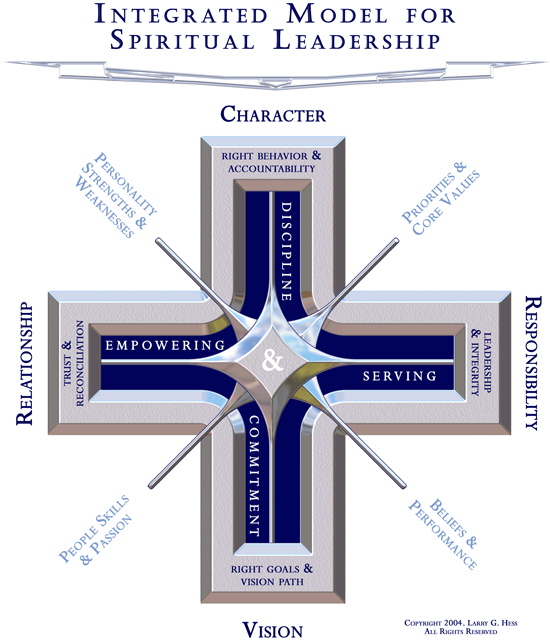
The chart below addresses the major components in an “Integrated Model for Spiritual Leadership.”

1) CHARACTER

A spiritual leader is a person who really wants to reach his/her God-given potential in every area of his/her life.  An integrated model of spiritual leadership is built upon our character, which requires discipline to be faithful to God and true to who we really are inside.

Character gives a sense of dependability to our leadership and enables us to live a life that encourages others to follow.  In an attempt to be a leader, some people have resorted to developing the appearance of a leader rather than developing the character of a leader.

Professional consultants are able to teach “image control” or “reputation management” for aspiring leaders who seek to create the perception that they are authentic and genuinely qualified to lead.  People, with help, can generate a lot of hype, but they are really only pseudo leaders.  They have image, but no character.

Influence is a key word associated today with leadership.  People can seek to gain influence over others in the three following illegitimate ways:

Position:
Achieving a position does not guarantee character.  People who use political or unethical means to acquire positions lack integrity.  Oswald Sanders asked, “Should it not be the office that seeks the man, rather than the man the office?”  Holding a leadership position in a Christian organization does not automatically assure God’s anointing or pleasure.  Some leaders use their position to go further to pursue influence over people by using force and/or manipulation.

Power:
Leaders invite rebellion when they use force to achieve their goals.  The my-way-or-the-highway does not work in the church or in the business world.  Pastors have used many strong-arm tactics to get their way.  Some have volatile tempers.  They are charming and cordial as long as church members submit to their leadership.  But when challenged, they become angry and lambaste anyone who dares to oppose them.  Some have used the pulpit as a platform or soapbox to castigate those who disagree with them.  Some pastors lobby support from influential members as if they were seeking to get a bill passed through Congress.  Some ostracize their detractors or bully people into submission.

Spiritual dictatorships can be the most oppressive form of tyranny.  Such leaders are intolerant of those who would challenge them.

Personality:
People often follow leaders because of their charm and winsome personality.  Popular pastors have used their confident, impressive, persuasive personality to control or dominate people for selfish reasons.  Often pastor-search-committees erroneously look for a striking and charismatic personality whose allure can attract new members.  Charisma is never more important than character.

Spiritual leaders, of all people, ought to be known for their honesty, their integrity, and their character.  Character is manifested in right behavior and in accountability.  Our true purpose in life is a reflection of our character.

Our sense of purpose is derived from the deepest part of our souls.  It is based on ethics, morals, and values that are spiritual principles.  Our purpose shapes our vision and goals.  Our purpose is our highest force that gives us a sense of divine direction.

Our purpose and character shape our relationships.  We can either use people or love them.  If our purpose is holy and unselfish, we will be givers, not takers.  Godly character insures that our actions will be consistent with our words, and we willingly accept the need for accountability to God and those we serve.

2) VISION

Character and vision interact to make the leader disciplined and accountable in order to model commitment to God’s vision.  Leadership is about moving people on to God’s agenda. Vision flows out of a commitment to the mission.  The mission can be achieved through a process of implementing the vision path as we move toward the right goals with commitment and unity.

Visions are exhilarating and must be clear, shared, and compelling.  Visions are about a preferred future that can mobilize people to enthusiastically follow spiritual leadership.

People look to visionary leaders who possess the skills necessary to perform in their role and achieve results.  Churches tend to measure success by focusing on attendance, seats filled in the auditorium, and amount of money in the offerings.  Peter Drucker says that the ultimate measure of leadership is “results.”

According to the expectations of many, successful leaders must be people who get things done.  Leadership should focus on building great teams, building unity, and building healthy churches.

The pastor does not do all of the thinking for the church.  Pastors must involve the right people in leadership and build consensus and commitment to God’s vision and agenda.  Leaders fail when they pursue their goals for achievement but leave people by the wayside, uninvolved and uncommitted to the vision.

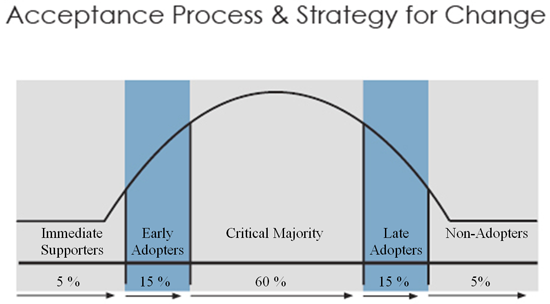
Spiritual leaders seek to achieve acceptance for and commitment to the vision as people align themselves to move forward on a transformational journey.  The journey usually involves change; leaders experience some degree of resistance to change.  A strategy for overcoming resistance and aligning for unity requires the building blocks of unity on the vision path to success.

Managing resistance to change requires an understanding of how people tend to come to a position of acceptance of the vision and to unity of purpose.  In building unity, a spiritual leader looks for more than mere compliance.  They look to achieve acceptance and alignment with the necessary change and transformational process.  The following chart illustrates the path a congregation follows in taking ownership of a projected change or a new vision.

This process is impacted by the personality traits of the group.  Some people are naturally more trusting (immediate supporters and early adopters), while other types tend to be distrusting (late adopters and some are distrustful. Trusting personality traits are:

  • Accommodating
  • Spontaneous
  • Warm and altruistic
  • Trusting and unsuspecting
  • Adaptive
  • Accepting
  • Mature
  • Genuine
  • Emotionally stable
  • Self-assured
  • Cooperative
  • Open to change
  • Deferential
  • Affiliative
  • Restrained and careful
  • Tolerant and flexible
  • Sensitive
  • Patient

Distrusting Personality traits are:

  • Controlling
  • Vigilant and suspicious
  • Directive
  • Skeptical and wary
  • Methodical
  • Private
  • Reserved and impersonal
  • Apprehensive and self-doubting
  • Reactive
  • Self-reliant
  • Emotionally changeable
  • Perfectionist
  • Bold
  • Tense and impatient
3) RELATIONSHIPS

A spiritual leader uses his/her skills in the relationship component to empower and to serve others.  As a leader’s character is expressed in relationships, he/she will be able to earn trust and bring about reconciliation.  Positive relationships and trust are necessary if the vision is to be realized.

A spiritual leader usually works with volunteers and lacks the command authority of a CEO or a general.  The greatest asset of a spiritual leader is the relationships built with people.  No matter how gifted the leaders are or how exciting the vision, leaders will not lead for long if they are not able to build and maintain strong relationships and partnerships.

Trust busters are present in every church and on every ministry team, especially at the higher levels of leadership.

COMMON TRUST BUSTERS

  • Personality factorcharacter flaws and extreme temperament traits/weaknesses
  • Expansive ambitions: always concerned about looking good and being in control
  • Bigger egos and higher stakes: can cause leaders to play on the natural fears and  insecurities of people
  • Insincere: not completely honest, withholding information
  • Controlling nature: want to control all the decisions
  • Defensive: defends own opinions and does not listen to others; moves ahead without adequate facts
  • Distrustful: tends not to show consideration for teammates; leaves them out if they think that they might disagree, even when it is obvious they have a stake in the decision/action

KEY TRUST BUILDERS

  • Honesty and openness:  exhibits integrity and authenticity; share their true feelings without deceit
  • Transparency: does not have private, hidden agenda covered with hypocrisy
  • Genuinely caring: is concerned about the needs of others as evidenced by actions, not just words
  • Listen: listens to people carefully; is not judgmental or overly critical
  • Value other people’s opinions: seeks input from key advisors and trusted partners before making decisions
  • Show empathy: demonstrates compassion by reaching out to give support and help to others

Trust can be built in relationships instead of suspicion and conflict.  Trust is slow to build, yet can come crashing down quickly.  Trust can take years of persistence and character to construct.  Trust is fragile.  It must be handled with care.

A leader must have trust; it is the air that he/she breathes.  There are no perfect models, no flawless characters, or purely selfless leaders.  However, we must remain intensely focused to keep trust and integrity.

4) Responsibility

Integrity is the foundation of leadership responsibility.  Integrity and honesty are essential for sound decisions, mutual trust, and credibility.  Leaders are responsible for truthfulness, fairness, loyalty, good judgment, accountability, clear priorities, and strong values.

Responsible leadership demands that we have the courage and self-confidence to live out integrity in the pressure cooker test of leadership.

Responsibility in spiritual leadership requires emotional stability and maturity.

Characteristics of stable, mature, and responsible leaders:

  • Have ego strength sufficient to overcome frustration or loss with the power of a resilient mindset
  • Are not intimidated by problems and are not overwhelmed
  • Have a good sense of timing and know how to manage priorities
  • Avoid tendency to procrastinate
  • Do not set unreachable goals
  • Do not engage in self-blame and criticism but maintain a positive self-image
  • Are able to anticipate unpleasant events and face them with reinforcing self-talk

Characteristics of leaders who are less emotional stable and mature:

  • Are reactive and emotionally changeable under stress
  • Are impulsive and inconsistent in conflict
  • Excessively criticizes and seek to control people
  • Are angry and tend to reject people, threaten abandonment, or excessively punish people with an emphasis on perfectionism
  • Neglect congruent thinking about realistic consequences of their negative reactions
  • Promote to followers an excessive dependence of their approval as the leader
  • Subject people to double binds or no win situations when in conflict
  • Are apprehensive, guilt prone, self-reproaching, insecure, and worried
  • Are overly driven, tense, and frustrated
  • Are undisciplined, lax, follow their urges, and are careless of social rules

Spiritual leaders should be responsible and remember that people are watching them to see if they walk the talk, if they are consistent and emotionally stable.  Integrity and emotional stability form the bedrock that supports any leadership effort.

The components of responsibility and relationships are linked and essential in achieving the goals of leadership.

Leaders are responsible for their beliefs and for their performance.  Leaders need to be both relationship oriented (possess good people skills) and results oriented (task driven.)

A person’s leadership performance hinges on results and requires that leaders know where they are going and are capable of and committed to take others with them.  A few characteristics of high performance leaders are:

  • Straightforward and direct with clear communications about expectations
  • Have a strong work ethic
  • See the big picture and are visionary and strategic
  • A decisive yet sensitive person who is firm but flexible
  • A good problem solver
  • High expectations of self and of others
  • Focused on the mission, the goals, and necessary tasks
  • Balanced and emotionally adaptable
  • Is proactive to initiate positive actions that are consistent with beliefs
  • Are committed to excellence, pays attention to details, and motivates others to achieve within their capabilities

A leader’s role is to ensure success by communicating the vision, defining the goals, ensuring high standards, resolve problems, make key decisions, hold people accountable, and model integrity.

Often results-oriented leaders place upon themselves or on others unrealistic expectations.

Without a good balance between relationships and responsibility, the frantic pace of a driven workaholic can cause the leader’s emotional engine to shut down and bring him/her to a grinding halt.

The character of Jesus Christ and the grace of God can liberate us from failure in relationships, from self-defeating behaviors, unresolved conflicts, and from the poison of unrealistic expectations.  We should again be comforted by the words of Jesus to those oppressed:

“Come to Me, all you who labor and are heavy laden, and I will give you rest.  Take My yoke upon you and learn from Me, for I am gently and lowly in heart, and you will find rest for your souls.  For My yoke is easy and My burden is light: (Matthew 11:28-30 NKJV).

Successful spiritual leaders work at balancing relationship skills with responsibility skills. They seek to be competent in skills where they tend to be the weakest.  People will not follow weak, tyrannical, or incompetent leaders.

Integrating all of the major components of spiritual leadership is never easy.  However, leaders must:

  • Walk the talk
  • Be accountable and withstand scrutiny
  • Make difficult choices
  • Continue to grow and develop skills and personal strengths
  • Remain flexible and respond appropriately
  • Keep a balance in this integrated model of leadership
  • Interact with peers and mentors who can help leaders stay on the right path

Spiritual leaders need to hear the message that God spoke to Joshua when He said, “Be strong and courageous.  Do not be terrified; do not be discouraged, for the Lord your God will be with you wherever you go” (Joshua 1:9).

CONCLUSION

An integrated model for spiritual leadership looks at four major components of leadership and how they need to balance and compliment each other.

Character requires discipline and accountable behavior to achieve our priorities in keeping with our core values.  Priorities and core values can only be maintained through responsibility based on integrity, which reflect our commitment to beliefs and performance.

Our vision must come from God and must be carefully discerned and articulated to bring about positive change that is clear, shared, and compelling – a vision that is matched with the right goals and vision path.

Commitment is most critical for achieving the right goals and maintaining the vision path necessary to fulfill our true mission.  Commitment recognizes that following God’s path is a never-ending process.

A spiritual leader who has character will seek to build relationships of trust and reconciliation, which empowers people to be part of God’s vision.  Leaders seek to overcome personality weaknesses that can be their dark side.  They build on their personality strength to serve people with integrity and responsibility.

Spiritual leaders seek to be used by God to transform people and the church through disciplined character, visionary commitment, empowering relationships, and serving responsibility.  Through the skills of accountability, integrity, vision, and trust people can come together in unity to achieve the impossible for the glory of God.

The Techniques of Counseling

INTRODUCTION

In this session, we will do more than just look at some specific techniques used in various therapy approaches, we will look at the underlying principles and assumptions accepted in these approaches.

We will look at techniques and concepts that can fit into our Christian counseling philosophy and at some of those that must be totally rejected.  We will place a great emphasis upon a Christian counseling approach that is solution-oriented and designed to be brief, to the point, Biblical, Christ-centered, Holy Spirit directed, and psychologically sound.

We will emphasize the importance of counselors being more than just skilled professionals, but helpers who are themselves committed to spiritual growth, change, development, and maturity.

A variety of counseling techniques are available to the pastoral counselor.  Pastoral counseling still consists of caring, reassuring, exhorting, empathizing, and giving Biblical guidance.  With the present interest in and exposure to psychology, many pastors want to become skilled in counseling and work with troubled people using various counseling techniques.

Counseling is first of all a relationship, not a bundle of techniques or a bag of tricks.  In implementing change through the counseling relationship, the therapist needs to be skillful in a number of techniques.

Since techniques are tied to counseling theory and philosophy, the techniques used reflect the counselor’s theory and philosophy.  Counseling techniques must also be selected to match the needs and personality of the client. The many human variables make counseling a complex task.

Effective counselors adapt their repertoire of techniques to the particular problem and individual involved.  Investigations seem to indicate that many counselors possess or use too few interviewing techniques and a counselor who uses the same basic approach with most people is too limited in his/her mastery of techniques.

It is true that regardless of training, counselors are prone to develop a style of counseling and to adapt particular methods to their way of responding.  Above all, most counselors try to be themselves rather than play a role.  They try to use techniques they trust and feel comfortable using.

A counselor can restrict his/her own flexibility and spontaneity by trying to force himself/herself into a technique that does not fit or blend with his/her style or level of skill.

1) FOCUS ON SOLUTIONS AND STRENGTHS

Before we get into a survey of various techniques and approaches, let’s talk about a new emphasis in counseling known as solution-oriented therapy.

This new trend is an emphasis on strengths and solutions rather than problems and pathology.  When therapy is solution-oriented, assessment techniques become deliberate interventions that often limit counseling to a few sessions.  Counselors watch their language and direct the conversation toward change, encouraging clients to look to the future with an eye to possibilities rather than problems.  Clients learn how to keep the ball rolling and maintain change.  Counseling inevitably becomes brief and purposeful.  It begins by seeking solutions, not attacking problems.  It is a way of thinking that raises up images of what might be — should be — and thereby helps people see potential that otherwise might not be understood.

People often come to counseling so depressed and down that they fail to believe that significant change can take place.  They are often so chained to the present that they can’t seem to hope for anything better.

As Pentecostal ministers, we know and fully believe in the miracle working power of God.  We know that all things are possible.  We know that God answers prayer, that people can change with God’s help, and that God is at work in our lives!  Therefore, solution-oriented brief therapy is very compatible with our approach to spiritual problems and spiritual solutions.

Also, Christian counseling needs to be focused on prevention and on the building of strengths.  God’s Word, through the example of Jesus Christ, gives us a model and example to follow for successful, healthy living.  This shifts our focus away from people’s problems and pathologies to God’s power and purpose, and to people’s strengths and capabilities.  The following is a look at the common assumptions of contemporary therapies and the assumption of a solution-oriented approach.

A) Common Assumptions of Most Contemporary Therapies

1) Deep, Underlying Causes for Symptoms

A common assumption of many psychodynamic approaches and many family approaches is that some underlying dynamic, not readily perceivable to the untrained eye, is creating the problem.  Problems are thus “symptoms” of some deep, underlying cause, formidable as an iceberg.  The very word “symptom” implies that what people complain about when they enter therapy is not the real problem, but always the manifestation of some underlying problem.

2) Awareness or Insight is Necessary for Change or Symptom Resolution

Many models of therapy follow the systemic process from medicine, which advocates that it can be unwise to treat the “symptom” without an understanding of its underlying causes.  Many therapies attempt to resolve problems by providing clients with awareness of both the nature and origin of symptoms.  To change anything, it is argued, one must be aware of the source or true nature of the problem.

In Christian counseling, we know that at the root of peoples’ problems is a spiritual problem, either in the person’s own life or in the lives of those nearest to them.  Attempting to identify, understand, and confront the original source(s) of our problems can be like looking for a needle in a hay stack.  And even when we find it, seldom have we also discovered a cure.

3) The Removal of Symptoms is Useless or Shallow at Best and Dangerous at Worst

The psychoanalytic de-emphasis on solutions follows from the assumption that it is not only impossible to eliminate the real problem by removing the symptom, but could also be dangerous.  Temporary relief might mask the problem and reduce the client’s motivation to seek treatment of “deeper” causes.

4) Symptoms Serve Functions

The assumption that symptoms serve functions is at the heart of even the most disparate current therapy approaches.  Most therapists assume that symptoms occur because they serve some function or purpose in the person’s life.  If they did not serve a purpose, they would not persist.  The theory, then, is that if you remove one symptom without taking care of the function it serves, then another symptom will take its place.

5) Clients are Ambivalent about Change and Resistant to Therapy

There is a fundamental belief in most approaches that people do not really want to change, or at least they are resistant to changing.  Therefore, one has to either wait them out or get around their defenses.

6) Real Change Takes Time; Brief Interventions are Shallow and Do Not Last

Since problems and pathology are often deep-rooted or entrenched, repetitious patterns ingrained in individual or social systems, little can be expected with brief interventions and contacts.  Changes from brief interventions do not last.  Some therapists believe that it will take just as long to get over a problem as it took to develop it.  Most therapies are oriented toward long-term assessment and treatment.

7) A Focus on Identifying and Correcting Pathology (Abnormal Behavior)

Some therapists tend to look for mental illness under every rock.  A person can be given a diagnosis and labeled with certain disorders.  These labels may fit but often do not.  However, a person may struggle for a long time (or even a lifetime) to shake free from the various labels put on them by different therapists.

B) The Assumptions of Solution-Oriented Therapy

The expectations a therapist maintains as a result of previous diagnosis or background information can greatly affect his/her attitude and the approach he/she takes as a counselor/therapist with a client.

Since we you expect influences what we get, solution-oriented counselors maintain those presuppositions that enhance client-therapist’s cooperation, empower clients, and make our work more effective and enjoyable.  We need to hold assumptions that focus on strengths and possibilities.  The solution-oriented therapist will focus on change and shift the conversation away from how things have stayed the same toward how things have changed.

1) The Therapist’s Job is to Identify and Amplify Change

The therapist will guide the client in identifying what is working and what can work in his/her life in order to build on his/her strengths or positive behaviors.  The counselor, in working with people, seeks to see a small change first, realizing that people do get locked into certain behaviors and will only make small changes at first.  People will often repeat past mistakes before lasting changes take place over time.  However, we must never undervalue the importance of small changes.

2) It Is Usually Unnecessary to Know a Great Deal About the Complaint in Order to Resolve It

Typically, solution-oriented therapists do not find it useful to gather extensive historical information about the present problem.  Sometimes only a bare minimum of information is necessary to begin to resolve the complaint.  Sometimes counselors get stuck because they have too much information about the problem(s) and too little about the solution.

In this approach, the counselor/therapist will focus his/her inquiry on what clients are already doing that is working.  The objective is to get people to focus on what does work for them in the times when they are doing well and on what they already know that they could or should do to deal with the problem.

3) It Is Not Necessary to Know the Cause or Function of a Complaint in Order to Resolve It

Solution-oriented therapists do not accept the belief that symptoms (complaints) serve functions for individuals, relationships, or families.  Understanding symptoms only suggest how people become static and stuck, but it does not tell us how people can change.

Before counseling, people usually have already speculated about the causes and reasons for their difficulties.  Seldom does this type of analysis move them toward solutions.  Knowing “why” seldom creates change.  Often people’s idea of “why” is distorted and they will not be able to see truth clearly until they make some right decisions and move away from the self-destructive situation they are plagued with.

4) A Small Change is All That is Necessary to Affect a Significant Change

People go in circles and live in ruts.  They feel unable to take action so they do nothing productive.  Thus, they get more depressed, troubled, or unhappy.

When people are able to make even a small change, they feel (a little, at least) optimistic and more confident or hopeful about tackling further changes.

Small changes can be like a snowball rolling down a mountain increasing and picking up speed.  Also, change is contagious and causes more change.

5) Clients Define the Goal

Solution-oriented therapists do not believe that there is any single “correct” or “valid” way to live one’s life.  Thus the client, not the therapist, identifies the goals to be accomplished in treatment.

NOTE:  As Christian counselors, we will have a serious problem with this assumption if it means in any way that there are no absolutes, no moral laws or clear lines between right and wrong.  We cannot and must not accept a secular assumption that denies God, His Word, or Christian values.  We will allow people to define their goals and make choices, of course.  We will not play God and take responsibility to tell people how they must live their lives except in those Biblical areas where God’s Word makes it clear how we should live.

Christian counselors will sometimes be directive and always uncompromising on God’s Word.  Even in solution-oriented therapy, the counselor is seen as having responsibility to help identify the real problems, issues, and pathological (abnormal) patterns and behaviors.

It is important, in counseling, to allow the client to define the goal(s).  If we, as the counselor, cannot feel good about helping the client meet the goal they stated, then we may have to end the counseling and offer them a referral to someone else.  It is wrong for the counselor to ignore the client’s goal and to press on in counseling with the goal we prefer.

The counselor can certainly make alternate suggestions to people about their goals, problems, and choices.  Sometimes it is necessary to work with people on small problems and goals even though we see what we think to be more significant problems and goals.  We cannot always start at the place we need to be; we have to gently work with people until they are ready to move forward significantly.

6) Rapid Change or Resolution of Problems is Possible

When clients are helped to have faith and hope, they become more optimistic.  In the solution-oriented approach, clients are expected to go home, after the first session, and take some positive action(s).  After each session thereafter, the client is expected to take action to change

In this approach, the average length of treatment is under ten (10) sessions, usually four or five, occasionally one or two.

Other approaches to counseling or psychotherapy expect treatment to last for one year to several years.

Our attitude about change and our approach to resolving problems can be the most significant factor in contributing to client’s expectations of change.

NOTE:  As evangelical and Pentecostal ministers, we know God’s miracle working power to be real.  When we work with people who know God, we should pray for, work for, and expect progress, rapid change, and even miracles.  We can take a Biblical approach to solution-oriented counseling, reject the secular denial of absolutes and holiness, and work with people to see God change their lives.

As Christian counselors, we must constantly work to learn and benefit from psychology and integrate it with Christian faith.  There will be many secular views and approaches we will reject as we learn how to effectively understand people and bring people to God and to right living.

Counseling begins with the way we understand people and how we examine problems.  To end right, we must start right.  We start with faith and direct hurting people to look for God and to build on strengths.  With God’s help, we can start quickly with small steps and move to greater successes and victories.  As Christian counselors, we reject clients’ negative, hopeless view of their problems.  Whenever we look at our problems as unsolvable or unmanageable, we accept the defeat of the devil.  God is a way maker!  God is faithful to make a way of escape.  God answers prayer, He comes through for us.

2) A SURVEY OF THERAPEUTIC TECHNIQUES AND PROCEDURES

A) Psychoanalytic Therapy

Psychoanalytic therapy consists largely of using methods to bring out unconscious material that can be worked through.  This focus is primarily on childhood experiences, which are reconstructed, discussed, interpreted and analyzed.  The assumption is that the exploration of the past, which is typically accomplished by working through the transference relationship with the therapist, is necessary for character change.

Transference manifests itself in the therapeutic process at the point where clients’ “unfinished business” causes them to distort the present and to react to the therapist (analyst) as they did to their mother, father, or other significant person.  In classical analysis, this transference is encouraged and fostered by the analyst’s neutrality, objectivity, anonymity and relative passivity.

The analysis of transference is a central technique in psychoanalysis, for it allows clients to achieve insight into the influence of the past on their present functioning.  This transference allows clients to re-experience a variety of feelings that would otherwise be inaccessible.  The client can express in action what they have buried in their unconscious, and thus change some of their long-standing patterns of behavior.

The most important techniques typically employed in psychoanalysis are free association, interpretation, dream analysis of resistance and analysis of transference.

B) Adlerian Therapy

Along with Sigmund Freud and Carl Jung, Alfred Adler (1870-1937) was a major contributor to the development of the psychodynamic approach to therapy.  Adler was far ahead of his time, and most of the contemporary therapies have incorporated at least some of his ideas.

The basic goal of the Adlerian approach is to help clients identify and change their mistaken beliefs about life and thus participate more fully in a social world.  Clients are not viewed as mentally sick, but as discouraged.  Adlerian therapists are generally eclectic (diverse) in choosing their methods.  Adlerian counselors use a wide range of techniques. The most useful concepts of Adler’s Individual Psychology include:

  • The importance of looking to one’s life goals.
  • A focus on early childhood events, which may be impacting life at the present.
  • The understanding and confronting of basic mistakes.
  • The idea that one’s beliefs and thinking processes influence emotions and behavior.
  • An encouragement for clients to work out an action plan to make changes.
  • The establishment of a collaborative relationship whereby the client and therapist work toward mutually agreed-on goals.
  • Placing a great emphasis on the encouragement process throughout the course of counseling.
C) Existential Therapy

The critical significance of the existential movement in psychotherapy is that it reacts against the tendency to identify therapy with a set of techniques.  Instead, it affirms the basing of counseling practice on an understanding of what makes men and women human beings.

This view projects that mankind is constantly searching for a new significance to our existence.  The theory is that there are no pre-existing designs, no meanings to life that are assigned or given to us, and no purposes in the world outside those we choose.

This approach and its techniques used in counseling are unacceptable to the Christian counselor.  This approach basically denies God, His plan for man, a sinful nature, and also denies eternal life by asserting that after death we are nonbeings.

D) Person-Centered Therapy

The person-centered (client-centered, Carl Rogers) approach can be classified as a humanistic branch of the existential perspective.  Existential humanism creates a third-force perspective on counseling therapy.  This follows the forces of the psychoanalytic and the behavioral approaches.

Thus, existential humanism includes the person-centered and the Gestalt therapy approach.  This view of human nature projects that man is basically good and can be trusted.  The focus here is on the person and not on the person’s presenting problem.  Therapy is seen as a growth process in which the counselor helps the client get in touch with his/her real self. Through this special relationship with the counselor, the client is able to be open, to trust in themselves, to find self-awareness, and to be encouraged.

This concept of the importance of self-actualization is acceptable to the Christian counselor when it is understood that our first and greatest need is to know God and to view reality from the Biblical perspective, not from our own human perspective.  We support the importance of growth, self-awareness, acceptance, respect, congruence, genuineness, and the need in counseling for accurate, empathic understanding.

The existential humanistic concept of man, God, and life must be rejected.  A person-centered approach can work to a certain extent.  For example, it is good to give support and positive regard to clients, but at times they must also be challenged and confronted with truth.  This approach calls for the counselor to be non-directive and client-centered.  At times, we must be directive and allow our own personality and sense of reality to come forth.  Our faith in God and the principles of holiness found in God’s Word must never be compromised, no matter what people may think or say.

There are some valid applications for Gestalt techniques in Christian counseling.  However, the idea of the “here and now” must be limited and not distort the eternal significance of life and God.  People do need to experience the “now”, and not be defeated by the past or live in fear of the future.

Another key concept of Gestalt therapy is that of “unfinished business.”  This involves unexpressed feelings such as resentment, rage, hatred, pain, anxiety, grief, guilt, and so on.  Even though these feelings are unexpressed, they are associated with distinct memories and fantasies.  Unfinished business can persist until it is faced and dealt with effectively.

It is true (and compatible with Christian doctrine) that unacknowledged feelings create unnecessary emotional problems.  Unrepented sin and unhealed hurts cause people great distress.  People use avoidance methods rather than face the pains, sins, and hurts of life.  People live in fantasies and seek to be entertained by all sorts of fantasies (including sexual).

Gestalt therapy (Fritz Pearls, 1893-1970) calls for people to strip off the five layers of neurosis which destroy growth. These layers are (1) the phony, (2) the phobic, (3) the impasse (wall of hopelessness), (4)  the implosive (defensiveness),(5) the explosive (getting free of phoniness and pretense – to become alive and authentic).  The goal of Gestalt therapy is not simply “adjustment” to society, but individual and family growth beyond the narrow limits of adjustment.  We have a choice to be a part of the sickness of man or of becoming healthy.

As Christian counselors, we cannot take the humanistic view that the answer lies at the center within each of us.  We can become totally aware of ourselves and seek to think and behave in healthy ways, and still be lost and dead in sin.  The answer is to have God within and to have a spiritual awareness of a born again relationship with God, through Jesus Christ, by the power of the Holy Spirit.

E) Transactional Analysis

Transactional analysis is basically a description of what people do and say to themselves and to each other.  Communication between people involves a transaction in which messages are sent and a response is expected.  Transactional analysis is based on the assumption that we make current decisions based on past premises.  Transactional analysis teaches clients to recognize three ego states (parent, adult, and child) in which they function.  Underlying transactional analysis is the theory of a life-script, which is similar to Adler’s concept of life-style.  Early in life, each of us fashions a script that we carry out, usually without awareness.

The language of transitional analysis can be very difficult to understand and use in counseling.  One of the dangers is that transitional analysis can primarily be an intellectual experience impacting little change.

F) Behavior Therapy

The major current view in behavior therapy is that the person is the producer and the product of his or her environment.

Goals occupy a place of central importance in behavior therapy.  Some critics characterize the relationship between the behavior therapist and the client as mechanically manipulative and highly impersonal.

Some of the major therapeutic techniques are as follows:

  • relaxation training and related methods
  • systematic desensitization
  • token economics
  • forms of punishment:  time out, overcorrection, response cost
  • modeling methods:  observational learning, imitation, social learning.
  • assertion training
  • self-management programs

Some common criticisms with behavior therapy include:

  • Behavior therapy may change behaviors, but it does not change feelings.
  • The relationship between the counselor and the client is not emphasized.
  • Behavior therapy does not provide enough insight into causes of problem behavior.
  • Behavior therapy ignores the historical causes of present behavior.
  • Behavior therapy involves too much control and manipulation by the therapist.
G) Rational-Emotive Therapy

The basic philosophy in rational-emotive therapy is that humans are born with potentials for rational thinking but also with tendencies toward crooked thinking.  They tend to fall victim to irrational beliefs and to reindoctrinate themselves with these beliefs.  Therapy is cognitive/behavior/action-oriented and stresses thinking, judging, analyzing, doing, and redeciding.  This model is didactic and directive.  The therapy process is one of re-education.

Rational-emotive therapists say that a person’s belief system is the cause of emotional problems.  Also, they say that significant others in our past have contributed to the shaping of our current life-style and philosophy of life.  However, we are the ones who are responsible for maintaining certain self-destructive ideas and attitudes that influence our behavior.  In other words, rational-emotive therapy emphasizes that we are not helpless victims of past unfortunate events.  Rational-emotive therapy is built on the Adlerian notion, that events themselves do not have the power to shape us; rather, it is our interpretation of these events that is crucial.

The Albert Ellis style of rational-emotive therapy is too harsh and humanistic.  It is in conflict with Biblical values.  If the therapist is not a Christian, they will usually call religious devotion unnecessary and irrational behavior.  The values and perspective of the counselor in rational-emotive therapy is of great importance in this approach.  This approach (rational-emotive therapy) can be seen as the therapist beating down the client with persuasion, indoctrination, logic and advice.  They often quickly tell clients what is wrong with them and how they should change.  This style is dangerous even when done by a pastoral counselor.

CONCLUSION

There are many other approaches to counseling with their own unique techniques and procedures.  This study session does not allow time to look at all of them.  What we have done is to look at a few approaches and techniques for the purpose of putting this into the context of pastoral counseling.  First, we talked about the importance of focusing on solutions and strengths.  This lead us to look at the most common assumptions of contemporary therapies compared to the assumptions of a solution-oriented approach.

Christian counseling must never become a science that denies God’s power and help.  It must never put man at the center but keep God at the center.  It must never look at life outside the perspective of eternity.

There are many skills and techniques learned in the various approaches that are not only acceptable in light of Biblical principle, but are also very helpful in counseling with people.  Our responsibility and task as pastoral counselors is to understand both the Bible and psychology, so that we can use a factual understanding of people and God’s Word in effective counseling, teaching, and even in our own personal lives.

Since Christian counselors ask people to take an honest look at themselves and to make Biblical choices concerning how they want to change, it is critical that counselors themselves be searchers who hold their own lives open to the same kind of scrutiny.

Ministering to People in Crisis

INTRODUCTION

We live in a world plagued with crisis situations.  As we read the newspaper, watch television, talk to a friend, or share with a loved one, it is apparent that people are experiencing feelings of anxiety, depression, guilt, helplessness, fear, and exhaustion.

How are we to respond to the crises that surround us?  Are we to become involved, or do we distance ourselves from the problem?  As Christians engaged in ministry, we have a responsibility to care for others.  Even if we should desire to remain detached, our contact with others will demand some level of involvement.  It is incumbent upon us to consider a Christian view of human crisis and to prepare ourselves to be as effective as possible in working with people in crisis.

A crisis can be defined as a period of psychological disequilibrium, experienced as a result of an event or situation that constitutes a significant problem that cannot be remedied by the use of familiar coping strategies.  A crisis occurs when a person’s quality of life is threatened by an obstacle that seems insurmountable through the use of customary habits and coping patterns.  The goal of crisis intervention is to resolve the most pressing problem within a short period of time through focused intervention directed at helping the individual develop new coping methods.

This lecture briefly examines the development of crisis theory and presents a seven-stage model of intervention, which can be applied to individuals experiencing crisis.  The model, developed by Albert Roberts after years of experience and research, expands upon the previously developed systems popularized by well-known theorists such as Caplan, Rapoport, Baldwin, and Golan.  It is an integrated problem-solving approach that can promote effective early crisis resolution.  It is particularly effective as it is utilized by the Christian who relies upon the Holy Spirit for insight and direction.

1) THE MINISTRY OF CRISIS INTERVENTION

A) A Biblical Perspective

1) Acceptance
Jesus always accepted people as they were.  He believed in them and desired to work with them in order for them to realize their full potential.

2) Discernment
Jesus had the ability to see the needs of individuals and directly address those needs.

3) Emphasized Right Behavior
Jesus was very interested in right behavior in the lives of those to whom He ministered.  He said to the woman caught in adultery, “Go and sin no more.”

4) Assisted People in Accepting Responsibility
Responsibility for change was placed upon the individual. When Jesus ministered to a person, He made it very clear that a decision to remain the same or to change had to be made.

5) Hope
Jesus gave hope.  He told people that through Him all things were possible.

6) Encouragement
Jesus encouraged people as He ministered to them.  Encouragement provides individuals with hope and with the desire to change.

7) Peace of Mind
Jesus shared the reality of peace with those to whom He ministered.  People in crisis need peace of mind and Jesus offered that hope.

8) Teaching
Teaching was used by Jesus as a definite part of counseling.  He used a variety of methods for teaching (questions, direct statements, parables, etc.). He taught as One having authority.

These characteristics of Jesus’ approach in counseling help give us direction as we relate to people in crises.  He demonstrated that He cared about people through His warmth, understanding, acceptance, and belief in their ability to change and mature.  As we respond to individuals in crisis, we must do so with acceptance.  We must avoid premature judgments and seek full understanding of the situation.

Obviously, if we are to be used by God to intervene in the lives of others, we must nurture a relationship with Him, live a life of faith, and allow the power of the Holy Spirit to guide us.  Any approach to counseling, any technique, or any theory must be based upon this foundation.

2) CONCEPTUALIZING CRISIS THEORY

Some crisis situations are personal family matters; others are triggered by a tragic occurrence such as an airplane crash, a hostage situation, or a mass murder that can cause widespread crisis for dozens, hundreds or even thousands of people.

The combination of human nature and the hazardous, uncertain and anxiety-ridden world we live in, increases the likelihood that everyone will face some situation that is potentially crisis producing.

A) A Definition of Crisis

A crisis can be defined as a period of psychological disequilibrium, experienced as a result of a hazardous event or situation that constitutes a significant problem that cannot be remedied by using familiar coping strategies.

A crisis occurs when a person faces an obstacle to important life goals that generally seem insurmountable through the use of customary habits and coping patterns.  The goal of crisis intervention is to resolve the most pressing problem within a one- to ten-week period.

Crisis reaction refers to the acute stage, which usually occurs soon after the hazardous event (e.g. sexual assault, battering, or suicide attempt.)  During this phase, the person’s acute reaction may take various forms including helplessness, confusion, anxiety, shock, disbelief, and anger.  Low self-esteem and serious depression are often produced by the crisis state.  The person in crisis may appear to be incoherent, disorganized, agitated, and volatile or calm, subdued, withdrawn and apathetic.  It is during this crisis reaction that the individual is often most willing to seek help.

The word “crisis” is extensively used.  However, it is often misunderstood.  Most people associate crisis with a temporary state that exists while a problem is being solved.  People say such things as, “I had a crisis this morning,” or “Bob is really upset.”  But a true crisis occurs when excessive emotionality prevents individuals from solving a problem by the usual methods.  As a consequence, personal upset increases until it is impossible to function as efficiently as before.  A true crisis is more than a temporary state of upset.  It is an inability to function effectively as a consequence of the emotional turmoil.

There are four major elements in a definition of crisis:

1) Precipitating Event

A specific event in some form almost always precipitates a crisis, even if the individual cannot readily identify the event.  This event usually occurs within two to three weeks of the crisis.  The search for a precipitating event, when it is not obvious, is a very important therapeutic process.

2) Perceived Meaning

A crisis is a subjective state.  It is the personal meaning attributed to the precipitating event that causes the person’s excessive emotional state.  For example, pregnancy may precipitate a crisis for some women, but not for most.

Crisis conditions are subjectively determined.  Therefore, a crisis can only be understood from the frame of reference of the individual experiencing it.

3) Ineffective Problem-Solving Methods

Once a significant event occurs, everyone initially attempts to deal with it by applying their usual methods of problem solving.  The individual who develops a crisis interprets the meaning of the event as lying beyond the capacity of his or her usual coping methods and patterns of adaptation.

As cognitive functioning fails and emotionalism dominates one’s efforts, the individual tends to resort more frequently to inappropriate methods, thus making his or her efforts even more ineffective.

4) Functionally Debilitating Emotional State

A person in crisis typically experiences an emotional reaction so excessive that rational behavior is hampered.  The person is so overwhelmed that reasonable decisions cannot be made.  It is this excessiveness of the response that separates the individual in crisis from the person who is temporarily upset while trying to solve a problem.

B) Theoretical Development

Several models have been developed to guide clinicians who work with people in crisis.  The most widely known models are Caplan’s (1964) four-stage model, Rapoport’s (1967) three-stage model, and Golan’s (1978) three-phase model.

Roberts (1991) has expanded on these systems and has developed a seven-step model that offers an integrated problem-solving approach.  His model is presented below.

3) A CRISIS INTERVENTION MODEL

A) Assess Lethality and Safety Needs

The first step is to carefully determine the individual’s degree of risk for serious injury or death from self-destructive acts or from the violent acts of another.  It is imperative that the individual’s safety be continually kept at the forefront of all crisis intervention procedures.  Is the person’s life being threatened?  Do you need to call the police?  Is medical attention needed?  Assess these issues and assist the individual in exploring the choices he/she has available to himself/herself.

B) Establish Rapport and Communication

It is important to convey willingness and an ability to help.  This is best accomplished by listening in an accepting, concerned, patient and helpful manner.  To assist in this process, share with the individual that he/she has done the right thing by contacting you.

C) Identify the Major Problems

Explore the individual’s problem situations and help him/her to “tell the story.”  Explore and define the problem from the client’s point of view.  Use active listening such as is practiced by Rogerian counselors.  Assist the person to rank order and prioritize the problems.  Help the person focus on the precipitating event or problem that led him/her to seek help.

D) Deal with Feelings and Provide Support

Encourage the individual to express the intense feelings that accompany the crisis.  This process is aided by the use of active listening and communicating through empathic statements.  Some clients may need to be educated about feelings and given permission to express them.

Fear, anxiety, sadness, and guilt are normal reactions to crises, and clients often need to be reassured that they are not “crazy.”  Catharsis of feelings is often very helpful.

E) Explore Possible Alternatives

People in crisis often fail to realize the various alternative ideas, coping methods, and solutions that are available to them.  Their personal reaction to the crisis is so intense that rational thought may be hampered and clear decision-making unlikely.  Coping strategies have not been successful and feelings of helplessness and despair may be present.

Begin this process by encouraging the individual to generate possible alternatives from his/her thinking.  After exhausting this avenue, suggest further alternatives which may be helpful but not realized by the client.  The proposed solutions should be carefully assessed and their usefulness determined.  However, it is important that this assessment not occur until after brainstorming various possibilities.

F) Assist in Formulating an Action Plan

Assist the client in developing a short-term plan that:

  1. Identifies additional persons and groups that may be contacted for immediate support.
  2. Provides coping mechanisms that are concrete and positive for the client to do now.
  3. Is realistic in terms of the client’s coping ability.
  4. May utilize appropriate and available referral sources.
  5. The plan should be specific, measurable and realistic.

Encourage the individual to be committed to positive action.  Encouragement is important because persons in crisis situations are often highly distressed and lethargic because prior attempts to cope have failed.  It is generally good to seek a commitment from the client that he/she will follow through with the agreed upon plan of action.

G) Follow-Up

The final stage in crisis intervention entails an agreement between the counselor and the client to have another meeting in the near future.  Details regarding this meeting (time, place, etc.) should be discussed.  The purpose of this follow-up is to assess the individual’s progress toward crisis resolution.  It can then be determined if further intervention or referral is necessary.

CONCLUSION

This model should not be interpreted as being linear or sequential.  That is, aspects of any certain stage may occur at various times and in no specific order.  For example, establishing rapport is not a single step designated only for the early phases of counseling.  Building rapport is an ongoing process.  Likewise, problem identification may need to be addressed more than once, and at different times as counseling proceeds.  This model provides a planned, yet flexible strategy for dealing with crisis situations.

The responsibility to minister to others is clearly stated in God’s Word.  Dealing with persons in crisis situations is an obvious part of this work.  Therefore, it is incumbent upon each of us to be informed and knowledgeable regarding the characteristics of crisis, and to be acquainted with various strategies which can be useful in our intervention efforts.

REFERENCES

Caplan, Gerald.  1964.  Principles of Preventive Psychiatry.  New York:  Grune & Stratton.

Golan, Naomi.  1978.  Treatment in Crisis Situation.  New York:  Free Press.

Rapoport, Lydia.  1967.  “The State of Crisis:  Some Theoretical Considerations.”  Social Service Review 36, 211-217.

Roberts, Albert R.  1991.  Contemporary Perspectives on Crisis Intervention and Prevention.  Englewood Cliffs:  Prentice Hall.

Wright, Norman.  1985.  Crisis Intervention.  San Bernardino:  Here’s Life Publishers, Inc.

SUGGESTED BIBLIOGRAPHY

Baldwin, Bruce A.  “Styles of Crisis Intervention:  Toward a Convergent Model.”  Journal of Professional Psychology 11: 113-120.

Dixon, Samuel L.  Working with People in Crisis.  Columbus:  Merrill Publishing Company, 1987.

Gilliland, Burl E. & Richard K. James.  Crisis Intervention Strategies.  Pacific Grove, California:  Brooks/Cole Publishing, 1988.

Hunt, Skip.  How Can I Help.  Shippensburg, PA:  Companion Press, 1990.

Kennedy, Eugene.  Crisis Counseling:  An Essential Guide for the Nonprofessional.  New York:  Continuum, 1981.

Oden, Thomas.  Crisis Ministries.  New York:  Crossroad, 1986.

Switzer, David K.  The Minister as Crisis Counselor.  Nashville:  Abingdon Press, 1974.

Purity and Accountability

INTRODUCTION

God is very serious and clear concerning His command for holiness of life, which includes both purity and accountability. Every aspect of our walk of life is to be pleasing to God and obedient to His commandments for purity, sanctification, holiness, and accountability.

1) Moral Purity

God’s will is that we live pure lives before Him. Purity involves abstaining from any kind of sexual immorality and manifesting the dynamic virtues of love and loyalty. “For this is the will of God, even you sanctification” (I Thessalonians 4:3a). God’s will is that we know how to control our lives (mind and body) in sanctification and in honor. Sanctification is achieved through a personal consecration to moral purity. Impurity dishonors God, is a sin against God, and will be revenged by God.

Sanctification means resisting the enslaving passion of immoral lust. Immoral lust is of the sinful world, not of God. “But each one is tempted when he is drawn away by his own desires and enticed. Then, when desire has conceived, it gives birth to sin; and sin, when it is full-grown, brings forth death” (James 1:14,15, NKJV).

Immorality defrauds and cheats, it destroys trust and love, and it steals innocence and affection. “For the wrath of God is revealed from heaven against all ungodliness and unrighteousness of men, who suppress the truth in unrighteousness” (Romans 1:18).

God has called us to holiness and purity because immorality destroys:

  • love of self and others
  • trustworthiness
  • discipline and self-control
  • true concern for others
  • self-esteem
  • confidence in self and others
  • justice and fairness
  • honesty
  • family and nation

Moral purity and holiness of life are possible and expected in believers because of God’s redemptive grace through salvation in Jesus Christ. “Having therefore these promises, dearly beloved, let us cleanse ourselves from all filthiness of the flesh and spirit, perfecting holiness in the fear of God” (2 Corinthians 7:1).

The love of God demands purity and a turning away from sin. Sin is always some form of disobedience, rebellion, or denial to following after purity and holiness. Without Jesus Christ and the new birth we are all unrighteous, impure sinners.

Sin has produced in mankind spiritual death and eternal damnation, but the sacrificial death of Jesus Christ has delivered us from the penalty of sin and death.

Purity demands that we as believers be filled with the fruits of righteousness and that we deny ungodliness. We are to live soberly, righteously, and godly in this present world (Titus 2:12).

The call to perfection demands of us a life which is ever on the watch against sin, always fights the battle for goodness, and does not surrendered to sin, but demands a life which is always quick to repent and abide in obedience to God’s Word. As we walk in the light of purity, the blood of Jesus Christ cleanses us from all sin and enables us to overcome the world through faith.

Purity requires “guarding yourself in your spirit” (Malachi 2:15). Aristotle said, “Character is that which reveals moral purpose, exposing the class of things a man chooses or avoids.”

Henry Ward Beecher said, “Expedients are for the hour, but principles are for the ages…” Purity is a principle for the ages. Recently the word purity has made a great comeback when we consider the prevalence of sexual immorality around the world. Purity has a great payoff when we consider the wages of sin in child abuse, diseases, guilt, or broken destructive relationships.

It is time to be pragmatic and honest in dealing with sexual immorality and all violation of purity of life. It is time for the church to cry out over America’s degeneration and violations of the basic principles of purity and morality.

2) Accountability Through Submission

Accountability is complex because it refers to the many Biblical principles of leadership, responsibility, and holiness. There are hundreds of specific commands to be and to do placed upon those who name the name of Jesus as Lord and Savior.

Our life with God depends upon our obedience to walking in the power and anointing of the Holy Spirit. We are accountable to all of these spiritual principles.

The big question is – How can we be accountable to God and one another in a way that assures our anointing and fruitfulness in the Holy Spirit?

The secret is in living out the Redemptive Call to Submission. Submission produces:

  • diligence – The diligent shall be filled with the Spirit (Proverbs 13:4).
  • trust – He who trust in the Lord shall prosper (Proverbs 28:25).
  • responsibility – God said, I will send you a man, anoint him over my people  (I Samuel 9:16).
  • righteousness – Those who love righteousness and hate iniquity will be anointed with the oil of gladness (Psalms 45:7).
  • courage – God will not fail you (Deuteronomy 31:6).
  • obedience – Obedience is the ability to do all the Lord commands (Joshua 11:15).
  • unity – The goal of unity is to bring in the measure of the stature of the fullness of Christ (Ephesians 4:13).
  • joy – Joy is the oil of gladness (Isaiah 61:3).
  • humility and brokenness  Micah 6:8 says that we are to do justly, to love mercy, and to walk humbly with God.

All followers of Jesus Christ are called to accountability, submission, faith, and love, which are available because of God’s redemptive grace.

Redemption brings into our lives God’s process of reconciliation (healing, forgiveness, deliverance) under the Lordship of Jesus Christ. This process is an act of submission – to Christ and to one another. Submission to the Lordship of Christ causes us to – “shine as lights in the world” (Philippians 2:15b).

Submission is inward surrender governing outward action. Without submission there is no church and no reconciliation. “Fulfill ye my joy that ye be like-minded, having the same love, being of one accord, of one mind” (Philippians 2:2). In Philippians chapter 2, Paul describes the fruit of submission and unity.

A) We Avoid Conflict and Contentious Controversy

Philippians 2:3 – “Let nothing be done through strife…”

Strife is disputes, quarrels, contentions.Paul told Titus (3:9) – “Avoid foolish controversies…”

In Colossians Paul said, “…forgive whatever grievances you have against one another. Forgive as the Lord forgave you” (3:13). Paul told Timothy that the servants of God must not quarrel nor be resentful. Submission requires that we develop the mind of Christ for obedient accountability. Submission is an act of worship guided by a heart for the Lord and A Passion to be Like Jesus!

B) We Follow the Example of Jesus Christ

Philippians 2:8 – He humbled Himself

From His entry to His exit, Jesus walked in humility and submission in order to be obedient. Isaiah described the Messiah as “…despised and rejected by man, a man of sorrows, and familiar with suffering. Like one from whom men hide their faces, He was despised, and we esteemed Him not…oppressed and afflicted, yet He did not open His mouth…” (53:3-9).

From the Incarnation to the Crucifixion of Christ, it is a story of scandalous shame and abuse reflected in the passion of Christ! Peter reminds us that we too shall suffer for Christ.

Paul said we will have to, “Work out our own salvation with fear and trembling” (Philippians 2:12). Therefore, we are to “Do all things without murmurings and disputing…be blameless and harmless…” (14, 15). This is how we are to live here on earth in the midst of a wicked and perverse world. We therefore “Shine as lights in the world” (15).

C) We are Committed to an Unconditional Obedience to God and His Word

Submission is about our attitude and a matter of the heart. Obedience is action, a matter of faith. Obedience is our response to truth as we put our faith and trust in God. For example in the book of Daniel, Shadrach, Meshach, and Abed-Nego disobey Nebuchadnezzar’s order to bow down and worship the image of gold, and Daniel disobeyed the king’s decree by praying to the God of Israel. In the New Testament, Peter and the apostles disobeyed the order of the Sanhedrin to stop preaching the Gospel. Their response was, “We must obey God rather than man!” (Acts 5:29).

D) We Live in the Light and Confront the Darkness

Ephesians 5:8-11 says, “For you were once darkness, but now you are light…live as children of light…have nothing to do with the fruitless deeds of darkness, but rather expose them.” Light is a symbol of obedience, faith, and spiritual purity. Darkness represents spiritual depravity and corruption. Paul said that we are saved out of darkness to be “children of light,” who live in the light; therefore, we expose sin and darkness, realizing that sin is not a private issue! We do not control sin; sin seeks to control or possess us!

Only in the light can we live holy, pure, authentic lives. Accountability demands submission to the light of God’s holiness. Paul said we are to “Have nothing to do with the fruitless deeds of darkness.” We are to be reconciled to God. We are to be restored, made perfect, and made like new!

We are to recover what has been lost! When darkness creeps in, a light must be restored if joy is to return. You cannot restore unity to a church that has not had unity. Many churches never achieved a vibrant life and unity where people are joined heart and mind under the Lordship of Jesus with a pure vision and love.

Some Christians do not understand the normal spirit-filled life of unity produced by accountability and submission. Darkness keeps up conflicts and destroys or deprives us of power with God.

Accountability calls for authentic communication (“speaking the truth in love”), which must be present within the community (koinonia) of the church. Leaders are admonished to correct, rebuke, and encourage. Speaking the truth often requires confrontation calling for honest responses. In the Greek the word for truth literally means “nonconcealment.” We are held accountable by God to cause truth to shine in the light for all to see.

Truth is the attributes of mind and character that are free from falsification, pretense, simulation, concealment, or deceit. Again, truth is living in the light; living in a new reality without concealment, or pretense, or any deceit.

Jesus said concerning Himself, “I am the Way, the Truth, and the Life. No one comes to the Father but by me” (John 1:14; 14:6). Truth and Love work together. Truth sanctifies; Love sacrifices.

Truth Sanctifies:  Jesus said, “Sanctify them by the Truth; your word is truth” (John 17:17).

Love Sacrifices:  “Not that we loved God, but that God loved us and sent His Son as an atoning sacrifice for sins” (I John 4:10,11).

Accountability involves our responsibility to confront in love:

  • We are not responsible for the sinner’s response.
  • We are not responsible for justice or vindication.
  • But we are responsible to model accountability and submission to God.

Living in the light requires personal examination and corporate confrontation marked by humility and submission. Church conflicts usually come from personal sin or bad theology. We must confess our sins and change our theology or we will self-destruct.

Confession of our sins and failure glorifies God, builds character, and creates unity. Confession brings forgiveness because if we refuse to forgive others, God will refuse to forgive us. Jesus taught us that forgiveness is the power to love. Also, that he who has been forgiven little loves little! Why do some people not love others?

Forgiveness brings freedom and the power to worship God in the Spirit. Revelation 3:19says, “Those whom I love I rebuke and discipline. So be earnest and repent.

Conclusion

David cried out in prayer, “Create in me a pure heart, O God, and renew a steadfast spirit within me. Do not cast me from your presence or take your Holy Spirit from me. Restore to me the joy of your salvation and grant me a willing spirit, to sustain me” (Psalm 51:12-13).

David turned from the darkness to the light and was restored. The redemptive call to submission and to purity can set us free, forgive us, and restore in us the peace of God and the glory of the Lord.

Let us truly become a people transformed by the power and wisdom of the Resurrected Christ. People of a pure heart are fully submitted to Christ and obedient to God’s demands of love and holiness.

We started in the Spirit; let us go on in the power of the Holy Spirit and shine as bright lights in a dark world.

Pastors Cannot Do It Alone

INTRODUCTION

One of the highest goals of the Christian church is to prepare God’s people for works of service so that the body of Christ may be built up and matured spiritually (Ephesians 4:11-13).

Pastoral care of the flock of God needs to be a partnership between clergy and laity.  Lay people can pastor others.  Works of service which build up the body of Christ include the pastoral care of believers.  People must first of all be won to Christ and then cared for in various ways.  Christians need to be fed from the Word of God through preaching and teaching from the pastor.  They need to be taught and motivated by other lay persons.  They need lay role models, friends, prayer partners, fellow laborers, etc.

Pastors cannot care for all of the needs of the flock.  They cannot be the friend, role model, partner, advisor, helper, or teacher that is needed by everyone in any size congregation.

Pastors need lay ministers in their churches who will reach out to the lost, visit the sick, and nurture fellow Christians.  There are lay people in every church who are gifted and can be used of God to care for the various needs of others.

The Scriptures do not restrict pastoring or ministering to the clergy.  This is what is meant by the “Priesthood of Believers.”

1) LAITY CAN HELP CARRY A PASTOR’S LOAD

Some laity can pastor, disciple, minister, teach, etc.  Other laity gladly accept care and nurturing from spiritual lay leaders within their congregation.

Every pastor needs dedicated, mature, and spiritual lay leaders who will faithfully support their pastor, be an example to others, share the vision, and assume personal responsibility to help make certain aspects of the ministry a success.  Pastors need to be mentors and build a strong relationship with key lay leaders who will obey God and become active in ministry.

Lay leaders can make great spiritual counselors.  They often possess great empathy, positive warmth, and a genuine concern for others.

A) The Pastorhood/Priesthood of Believers

Laity are capable of ministering to people pastorally.  Pastoral care is not to be viewed simply from the framework of professionalism.  Pastoral care is a helping relationship founded upon the integrity of the one providing the care.  Laity can often relate to and confide in each other better than they can with a clergy person.

The skills necessary to minister to people’s spiritual needs are the result of the call of God and the gifts of the Holy Spirit.  These skills, combined with quality training and spiritual discipline, can help all of us to be more effective for God.

It is not necessary for a person to be seminary trained in order to show empathy, warmth, concern, genuineness, integrity, or the love of Christ.  Laity can and do minister effectively in the kingdom of Christ.  One of the biggest mistakes clergy have made in the past is to try to do everything themselves.  Some people refer to their denomination as a “preacher’s church” because they have been made to feel that the only leaders or ministers are the credentialed clergy.

Church members want and need fellow laity who are in roles of spiritual leadership whom they can admire, trust, and follow.

B) What is Lay Pastoring?

Pastoring can be defined as caring for another by giving one’s self in Christian love to a relationship in times of weakness and times of strength.  Everyone needs people who care for them and who will bring into the relationship the love of God and the power of the Holy Spirit.

Preachers and laity are both shepherds over the flock according to their individual call.  All spiritual leaders are called by God to comfort His people.  Many Christians today cry out, as did the writer in Psalm 142:4, “There is none who takes notice of me…no man cares for me.”  People have been neglected because laity have not been allowed to obey the call of God and help care for people’s needs.

Lay ministry provides a method of involving many people in God’s work so that sheep do not fall through the cracks and get forgotten or neglected.

C) Moses Learned About Lay Ministry

Moses, the great leader that he was, was not adequately caring for God’s people.  When his father-in-law, Jethro, observed that Moses was exhausting himself in trying to hear and help all the people, he told Moses, “What you are doing is not good” (Exodus 18:17).  From the model developed by Moses we see the following principles.

  1. A wise leader disciples/mentors others to help carry the load.
  2. People will not know what to do unless they are equipped and discipled.
  3. God will raise up trustworthy men and women with a passion to do His will.
  4. In the work of God there are certain responsibilities only entrusted to the pastor.  However, there are many ministry roles available to lay leaders.
  5. Pastors and lay leaders can share the burden of ministry and together reap a far greater harvest.

We should and must depend upon the anointing of the Holy Spirit to make us effective for God.  The promise in Acts 1:8 says, “You shall receive power when the Holy Spirit has come upon you.”  The power of Pentecost is for all believers. The Holy Spirit wants to equip all of us for ministry.

2) THE BIBLICAL OBJECTIVES OF LAY MINISTRY

From Ephesians chapter 4, we see some specific objectives of lay ministry.  Lay ministry allows gifted believers to equip other believers for the ministry, imparting to them stability in doctrine and practice.  There are several clear objectives or purposes of lay ministry.

A) Build Up the Body of Christ

The purpose of gifted believers is to perfect and equip God’s people for works of service, so that the body of Christ may be built up (Ephesians 4:12).  This shows that all believers and not just a few leaders should be involved in the ministry.  We are all to serve each other spiritually

B) Attain the Unity of the Faith

We are in this race together.  We are not alone.  We are to be in unity with others as we serve together and seek our common destination.

C) Assist People in Maturity

There is a place of knowledge and maturity for all believers and leaders.  It is “unto the measure of the stature of the fullness of Christ” (Ephesians 4:13). As each believer functions in accord with the gifts Christ has given him/her, the body as a whole enjoys unity and becomes spiritually mature, more like Jesus Christ in all His fullness.

D) Speak the Truth in Love

By maintaining truth in love in both speech and life, believers may grow up unto Him with reference to all things. Christ is the source, the aim, and the goal of our growth and maturity.  Each member of the body is carefully fitted together and held strong.  We are a support and encouragement to each other. We must fulfill God’s call upon our lives and use our gifts to minister in love to others.

E) The Preservation of Unity is the Responsibility of All Believers

We are each one responsible for the unity of the body.  We are to respect our differences and the variety of our functions.  Paul emphasized body-growth, not only self-growth.  We are to walk in holiness and in unity.

3) THE ROLE OF A LAY LEADER/MINISTER

Spiritual lay leaders are the key to ministry success in the future.  It is impossible for pastors to carry the full load of pastoral care, evangelism, counseling, and administration.

The man or woman of God who stands before the local congregation as being responsible for the overall care of the congregation must have help.  There must be lay leaders who are actively involved doing the work of ministry on a daily basis with the focus of a small group of people or specific area of focus.

Successful churches in the twenty-first century will be those churches who focus on the involvement and training of lay leaders.  God has called laity to be involved in a leadership role in ministry.  These lay leaders, under the guidance of their pastor, provide spiritual care to people who fit into the lay leaders’ area of responsibility.  Regardless of what area of specialized ministry a lay leader selects, they all are involved in four major areas.

These areas of ministry leadership can be remembered by using the acrostic PACE.

  1. P – Pray
  2. A – Be available
  3. C – Make contact with people
  4. E – Provide an example
P – Pray

Some people may not want a visit but everyone accepts prayer.  Lay leaders should pray daily for the people in their care.  What happens when a lay leader prays regularly for people?

  • Prayer builds a deep concern.
  • Prayer builds strong relationships.
  • Prayer deepens our sense of responsibility.
  • Prayer opens the door for God to direct and inspire us to do great things for Him.
A – Available

Leaders must make themselves available and approachable.  If people have to try too many times to reach you, they give up.  If they feel uncomfortable approaching you with a need, they will avoid you and act as if everything is fine.

C – Contact

Lay leaders must see themselves as ministers and servants of God.  This servant attitude impresses us to make contact often with those we serve. In many churches today, lay leaders are becoming “Lay Pastors.”  These under-shepherds accept responsibility for the pastoral care of a certain group within the church.  The lay pastor then stays in close contact with his/her small group.

E – Example

The Apostle Paul called on Timothy to “set the believers an example” (1 Timothy 4:12).  This is the call of God upon all who will be spiritual leaders.  We are to be examples, role models, leaders in the things of God.  We are to demonstrate the character of Christ in our lives.  This means manifesting maturity, integrity, humility, faithfulness, and wisdom.

It is essential that all lay leaders be totally committed to God, to their own family, and to the area(s) of ministry in which God has called them.  Leaders must be committed to continuing education and training.  They must be accountable and loyal to those over them in the Lord.

When lay leaders fail to function effectively, when they procrastinate or behave disrespectfully reflecting a negative attitude, they should be confronted and helped.  Leadership is a serious responsibility and people need to understand from the very beginning that they will be held accountable.

Pastors should guide the congregation in showing appreciation to all lay leaders.  People need recognition and they need to know when they are doing well.  They should be affirmed for their work as well as being held accountable.

4) MENTORING PASTORS PROVIDE SUPERVISION FOR LAY LEADERS

A vital part of Lay Leadership Development is the process of supervision and mentoring.  Lay leaders need and deserve support, encouragement, and direction from their pastor.

It is the job of mentors supervising the ministry work of lay leaders, to guide laity and help them have the resources needed to accomplish goals.

The mentoring pastor’s job is not to do all the work or to sit back and wait for the lay leader to mess up, but to roll up his sleeves and help them win.  If the laity win, pastors win!

As mentoring pastors to different lay leaders, we will relate to each one individually as a situational leader.  This demands three (3) skills.

  1. Flexibility skills
  2. Diagnostic skills
  3. Contractual skills
1) Flexibility skills

A mentor must be flexible and able to use different styles of leadership with different people.  There are four basic styles of leadership needed in mentoring lay leaders.  Lay leaders then need to learn these styles so they can effectively use them in working with people.  The four basic leadership styles are as follows:

A) DIRECTING
The mentor provides specific instruction and closely supervises task accomplishment.  Directing behavior tends to be autocratic.  The mentor tells the person what, when, where, and how to do something and then closely supervises the person on the problem or task.  In this style, the mentor makes the decision and the lay leader carries out the plan.

B) COACHING
The mentor continues to direct and closely supervises the task.  The leader also explains decisions, solicits suggestions, and supports the progress.  This style combines both directive and supportive behavior from the mentor.  There will be more communication and sharing of ideas.  The mentor still makes decisions and stays in control of the task or goal.  In coaching, there is more consultation but still high levels of both direction and support.

C) SUPPORTIVE
The mentor facilitates and supports workers’ efforts toward accomplishment and shares responsibility for decision-making with them.  This style involves listening to people, providing support and encouragement for their efforts.  The behavior of the mentor in this style would be high supportive and low directive behavior.

D) DELEGATING
The mentor turns over responsibility for decision-making and problem-solving to lay leaders and tends to be low in both supportive and directive behavior. Delegation is used with people who are high in competence and high in commitment.  They are able to direct their own behavior and have the confidence and skill to achieve. Our strategy as mentors is to help people grow so that our style with them moves from directing to coaching to supporting to delegating as they develop.

2) Diagnostic skills

As mentors, we must become good at diagnosing the development level of our workers.  When we examine and evaluate a person, we look at two key ingredients that determine a person’s performance or achievement:  competence and commitment.

Competence is a function of knowledge and skills, which can be gained from education, training, and/or experience.  It is not something we are born with. It’s something we develop.

Commitment is a combination of confidence and motivation.  Confidence is a measure of a person’s self-assuredness and faith in God.  Motivation is a person’s interest in and enthusiasm for doing a task well.

Any person can range from a level of:

  • Low competence and low commitment to
  • High competence and high commitment.

Highly developed leaders (competent and committed) are hard to find.  They don’t just grow on trees.  In fact, we have to train people to be good leaders or performers and that involves good diagnostic skills.

All of us have potential that can be developed.  The mentor needs to be able to diagnose the level of development of each lay leader and know how to guide them forward.  Thus the mentor is doing for the lay leader in development what he/she cannot do for themselves at the present moment.

3) Contracting skills

Contracting is the third skill necessary for situational leadership in mentoring.  Mentoring is not something we do to people but something we do with people.

Contracting has to do with the relationship and commitment between the lay leader and the mentor.  It is about the day-to-day coaching and counseling that will take place between them.  In contracting, the mentor says to the leader, “I want you to win to achieve.  I will be available to you and help you develop.  I will see to it that you know what is expected of you and what it takes to accomplish your goals.  We will even work together to set the goals and determine the objectives which must be reached in the process.”

Contracting says, “I (the mentor) will be specific with you (the lay leader).  The goals will be measurable — and attainable.  It also means that as your mentor I will consistently evaluate my own levels of development and seek to grow along with you as you come to the place of delegated leadership responsibility.”

CONCLUSION

The pastor cannot do God’s work alone and lay leaders cannot be expected to carry a load of responsibility without being mentored.  The mentor must match the appropriate leadership style with the needs of each person (lay leader).  Lay leaders cannot be expected to assume leadership responsibility and achieve peak performance without the right kind of direction and support.  Every lay person is a potential high performer for God.  Some people just need a little more development than others along the way.

The pastor must learn how to develop people effectively if he/she wants quality help in God’s work.  The pastor cannot do it alone and laity cannot do it without the support and direction of the pastor.

When developing lay leaders, mentors need the skills of flexibility, diagnosis, and contracting.  Mentors and lay leaders can put together powerful ministry teams who can accomplish great things through the power of the Holy Spirit.

Never in human history has the church been more needed than now!  We desperately need lay leaders with a deep personal faith in God and commitment to Christian service and leadership.

Spirituality and Holiness

INTRODUCTION

In Christ we have been sanctified through the work of the Holy Spirit and begotten unto a lively hope by the Resurrection of Jesus Christ from the dead to an inheritance, which is in corruptible and undefiled that fadeth not away (I Peter 1:2-4).

The hallmark of maturity in Christ is a boldness of faith and a peace of mind.  As believers, we pray that our lives will be vibrant witnesses to the love of God and a life of holiness.  Humility and sensitivity to the Holy Spirit keep us pure and free from condemnation.  We must guard our hearts and keep them with all diligence in order to maintain both spirituality and holiness.

1) SPIRITUAL STRENGTH AND ANOINTING

Paul said, “Live by the Spirit, and you will not gratify the desires of your sinful nature” (Galatians 5:16).  Holiness requires that we remain dependent on the Holy Spirit through prayer, humility, and feeding on the Word of God. Holiness of life cannot be attained without the enabling power of the Holy Spirit.  Under the New Covenant, God has put His Spirit within His people.  The baptism of Jesus and the Spirit of God descending on Jesus like a dove modeled for future disciples that God’s plan is for all who are called to ministry to be filled with the Holy Spirit.

In His last promise to His disciples, Jesus tells them, “Ye shall receive power when the Holy Spirit is come upon you; and you shall be My witnesses” (Acts 1:8).  The outpouring of the Holy Spirit on the Day of Pentecost demonstrated to the disciples in supernatural terms the truth of Christ’s promise.

The indwelling power of the Holy Spirit bears witness that we are children of God and that we are called to live holy and reflect like mirrors the glory of the Lord.  The Baptism of the Holy Spirit upon the early church was an answer to Christ’s prayer for the sanctification of His followers/disciples.

Pentecost thus represents the full manifestation of the presence of the Trinity in the lives of believers under the New Covenant.  God’s presence and glory revealed throughout the Old Testament was but only a foreshadowing of the full manifestation of God’s presence. The full manifestation of God’s personal presence in the world was first revealed in the coming of Jesus in the incarnation and then in the outpouring of the Holy Spirit at Pentecost.

The call of God is for His people to follow after righteousness and holiness of life. We are called to “seek good and not evil…to establish justice” (Amos 5:14).  God desires of us righteousness not ritual, commitment not complacency.  In the Old Testament, God used the Law to show people their sinfulness and then to drive them to God for His glorious salvation.

The Law had attached to it the penalty of death (Galatians 3:10); and to break one command was to be guilty of all (James 2:10).  Since people had broken the Law, they were under the curse of death.  God’s righteousness and holiness demanded that the penalty be paid.  It was for this reason that Jesus came into the world to pay the penalty by His death.  Though sinless, Jesus gave His life for the guilty.  By trusting in the redemptive work of Jesus Christ, we are free from the penalty of death. 

2) The Higher Righteousness

The righteousness demanded by the Law is fulfilled in those “who do not walk according to the flesh but according to the Spirit” (Romans 8:4).  The teachings of Jesus set an even higher standard of righteousness than that set by the Law.  The Law commanded, “Do not murder;” but Jesus said, “Do not even hate.”  Jesus also taught that our righteousness must surpass the righteousness of the Scribes and Pharisees.

The higher righteousness of Jesus is seen in His command that we love our enemies and pray for those who persecute us.  Jesus even commanded that we return good for evil (Matthew 5:43-48).

The words of Jesus are very practical concerning righteousness in our lives.  We are warned in Matthew 6 not to perform charitable deeds for the purpose of being seen by others because God will not reward hypocrisy.  Hypocrites noisily attract attention to themselves; their charitable deeds should have been done for God, not to gain notoriety.

Jesus also warned that we should not use public prayer as a means to impress people of our piety.  We should pray with sincerity and humility (Matthew 6:5-8), not with vain repetitions.  In prayer, let us communicate with God and acknowledge our dependence upon Him.

In Matthew 6:9-15, Jesus taught the righteous how to pray.

  • Our Father in Heaven— Prayer begins by acknowledging the sovereignty of God in our lives.
  • Hallowed be Your Name— We begin prayer with true worship and praise.
  • Your Kingdom come The righteous seek to fulfill God’s agenda and not their own personal agenda.
  • Your will be done— The righteous acknowledges that God knows what is best and they surrender their will to His will.
  • On earth as it is in Heaven— This statement acknowledges that we should seek to allow things on earth to be as they are in Heaven.
  • Give us this day our daily bread— The righteous depend upon God for basic existence.
  • And forgive us our debts as we forgive our debtors— Righteousness demands our ability to forgive the wrongdoings of others.
  • And do not lead us into temptation— The righteous recognize their own ability to be tempted and to fail; therefore, they seek God’s preservations in order to walk holy.
  • But deliver us from evil— The righteous cry out daily to be kept from sin by the power of the Holy Spirit.
  • For Yours is the kingdom and the power and the glory forever— The righteous recognize that God alone is our foundation for holiness and that our prayer must be to walk in the Spirit and in the glory of God.

The righteousness demanded by God in the Old Testament is fulfilled in converted believers who thus walk according to the Spirit (Romans 8:4).

3) The way of Righteousness

The Lord warns that the gate of Christian discipleship is narrow and difficult (Matthew 7:13, 14).  But those whose life is built on the solid rock and who follow His way find the abundant life.  The Bible says that the wide gate and the broad way lead to destruction (Proverbs 16:25), and that the narrow gate and difficult way lead to life.  Jesus Christ is both the gate and the way to righteousness and eternal life (John 14:6).

Whenever a person lives according to the words of Jesus, the world calls him a fool but God calls him wise.  People have always been astonished by the teaching of Jesus.  Jesus appeals to us for a new morality and a holy walk.

The apostle Paul describes the way of the unrighteous in Ephesians 4:

  • They walked aimless in the futility of their minds (v. 17).
  • Their understanding was darkened (blind) and they could not understand the things of the Spirit (v. 18).
  • They were shameless and sordid. They were past feeling the pain of sin and  descended to unparalleled depths of depravity (v. 19).
  • They grew corrupt through deceitful lusts (v. 22).

But the way of the righteous is to put off the old man and to put on the new man by the renewing of the spirit in our minds (Ephesians 4:24).  The new man created according to God is manifested in true righteousness and holiness.  The righteous person seeks to put away bitterness, wrath, anger, clamor, evil speaking, and malice.  The way of the righteous is to manifest kindness, tenderheartedness, humility, forgiveness, and love (Ephesians 4:32).

The way of the righteous is to forsake all forms of sexual immorality (Ephesians 5:3).  The righteous understand that these sins bring the wrath of God upon the disobedient; therefore, let us not walk in darkness, but let us walk as the children of light (Ephesians 5:8).  For those who walk in the light have no fellowship with the unfruitful works of darkness.

Paul urged in Ephesians 5:15-21 to:

  • Walk not as fools but as wise
  • Not be drunk with wine but be filled with the Spirit
  • Encourage one another and submit to one another in the fear of God

When the righteous walk in the power of the Holy Spirit they will:

  • Be bold in rebuking sin and in testifying for the Lord
  • Have power with God for service
  • Not be selfish
  • Seek to exalt Christ, rather than to exalt themselves
  • Do the will of God from the heart

Paul also described the way of the righteous as a warfare (Ephesians 6:10-20).  On our own we are no match for the devil; therefore, we should be continually strengthened in the Lord and in the boundless resources of His might.  We thus put on the divine armor of God:

  • the belt of truth
  • the breastplate of righteousness
  • the shield of faith
  • the helmet of salvation
  • the sword of the Spirit

The divine armor of God assures us of victory knowing that “If God is for us, who can be against us?” (Romans 8:31).

4) THE CALL TO HOLINESS

God has made full provision for us to live a life of holiness.  This provision is evidence that His divine power enables us to live holy and godly lives.

The power to live a holy life comes through the knowledge of Him who has called us.  The divine power of God at work in the believer is our source of holiness.  Peter said that we have been called:

To those who live a life of holiness, God has promised:

The promises of God are precious and great as we, through faith in God, develop godliness.  Godliness is characterized by virtue, knowledge, self-control, perseverance, brotherly kindness, and love.  These all represent practical holiness.

Failure to persevere in the development of Christian character (holiness) leads to:

  • Barrenness: The guidance of the Holy Spirit eliminates barrenness.
  • Unfruitfulness: Disobedience to the Word of God causes unfruitfulness.
  • Shortsightedness: Living for self or for the present produces spiritual blindness.
  • Forgetfulness: We must never forget that we were dead in our sins when God’s great grace redeemed our lives from destruction.

The apostle Peter exhorts us to make our calling and election sure.  Living a holy life will keep us from stumbling and backsliding.  The peril lies in disobedience, stubbornness, and blindness.  Happy is the person who submits to the Lord, who delights in His commandments, and proves it by obeying them.  A lifestyle of practical godliness, honesty, diligence, and frugality assures the blessing of God.

Holiness of life produces people who are gracious, full of compassion, generous, trustworthy, and discreet.  These are people whose lives are built on a stable foundation and walk in confidence.

5) SPIRITUAL POWER FOR HOLINESS

In light of the holiness of God, we are commanded to walk in the Spirit and not in the flesh.  The Spirit and the flesh are in constant conflict, a perpetual war, which will continue until we are taken home to Heaven.  Our part in this conflict is to yield to the Holy Spirit.  Paul said that those who are Christ’s have crucified the flesh (Galatians 5:24).

Spiritual experiences must be kept fresh, alive, and renewed.  The sanctifying work of the Holy Spirit must not become static but remain perpetual.  Holiness of life is a life of separation and consecration.  Total commitment to God is reasonable and possible.  Holiness demands that we be separated from the world and transformed by the renewing of our mind.  This transformation enables us to follow after God’s good, acceptable, and perfect will (Romans 12:1-2).

The grace of God “teaches us to say no to ungodliness and worldly passions” (Titus 2:11-12).  Those who sin are described in Scripture as lawless (1 John 3:4).  Lawlessness refers to a state of the heart that is rejecting the law, that is, the will of God.

Spiritual power for holiness of life is imparted by the divine guidance of the Holy Spirit.  “Because those who are led by the spirit of God are the sons of God” (Romans 8:14).

The indwelling life of the Holy Spirit brings us out of the old life of sin into divine sonship with God.  This awakens in us a spirit of faith and hope.  Because of this powerful work of the Holy Spirit, holiness is not just a theory but a personal hope of unspeakable sweetness and power.  The power of the Holy Spirit influences our thinking, controls our passions, and lifts us above our trials and temptations.

The Holy Spirit is preparing us as the holy people of God to be ready for the coming of the Lord and the gathering of His saints.

As holy people, we are able to pray in the Spirit because we have an advocate with the Father, Jesus Christ, who prays for us.  The Holy Spirit is also our advocate within, who prays in us, inspiring our petitions through Christ to God.  “Likewise the Spirit also helps in our weaknesses.  For we do not know what we should pray for as we ought, but the Spirit Himself makes intercession for us with groanings which cannot be uttered.  Now He who searches the hearts knows what the mind of the Spirit is, because He makes intercession for the saints according to the will of God” (Romans 8:26-27).

We need this powerful work of the Holy Spirit because we know not what to pray for, but He breathes in the holy heart the desires of the Spirit even though we may not comprehend.

The Holy Spirit is at work in our lives in response to our consecration to God.  Paul urged that we present our bodies as living sacrifices to God (Romans 12:1a).  We desire to do this, not because of the fear of punishment but because we remember the mercies of God and we are glad to respond in holiness of life.  Our total being is to be yielded to the Spirit.  This offering is “holy and pleasing (acceptable) to God” (Romans 12:1).

The effects of our consecration on the life of holiness are:

  • Separation: Our consecration sets us apart and separates us for God’s use.  “And do not be conformed to this world, but be transformed by the renewing of your mind” (Romans 12:2a).  True separation from the world transforms and renews our minds.  Jesus Christ had no affinity for the world or for sin.  In the New Testament, the supreme example of consecration is Christ Himself.  The Spirit of God in our hearts draws us to God and away from the unholy things of the world. 
  • Knowing the will of God: Coming into the will of God is a result of our consecration to the life of holiness.  We are to test and to clarify God’s good, pleasing, and perfect will.  A life of holiness is possible as we remain consecrated to a life of obedience to God’s Word and His will.  Samuel emphasized that God’s pleasure was not in sacrifice but in obedience(1 Samuel 15:22). Obedience to the will of God brings grace, peace, and righteousness (Romans 5:12-21). 
  • Self-renunciation: “For I say, through the grace given to me, to everyone who is among you, not to think of himself more highly than he ought to think, but to think soberly, as God has dealt to each one a measure of faith” (Romans 12:3).  The highest spiritual life is the humble life of dependence on God, self-renunciation, and self-forgetting.  Commitment to a life of self-denial, humility, and holiness produces in us the character of God and the mind of Christ. 
  • True individuality: “For as we have many members in one body, but all the members do not have the same function, so we, being many, are one body in Christ, and individually members of one another.  Having then gifts differing according to the grace that is given to us, let us use them” (Romans 12:4-6).  Consecration leads to true individuality.  We seek to clarify our calling and gifts while receiving our strength and sufficiency from Christ.  The power of the Holy Spirit at work in us individually, enables us to function out of our unique gifts. 
  • Fellowship and cooperation: The secret of true fellowship and cooperation is to see God’s grace at work in one another and to focus on the divine love of God.  “We are all members of one body” (Ephesians 4:25).  “Iron sharpens iron“ (Psalm 27:17). We impact each other because we love, forgive, and even reprove one another in the spirit of love.  If we live consecrated, holy lives we will work for and pray for unity and cooperation. 
  • Commitment to ministry: Consecration to holiness of life motivates us to see life as an opportunity to do ministry for Christ, whether as a lay minister or as a clergy.  We understand that every ministry is important and reflects a divine call from God.  Living holy and maintaining our commitment to ministry will always be intellectually, emotionally, and spiritually demanding.  We may even experience betrayal from our fellow Christians.  Our commitment to ministry will be a reflection of our consecration. 
  • Practical theology: Consecration to be holy demands that our theology is one of practice and demonstration.  “Let love be without hypocrisy.  Abhor what is evil.  Cling to what is good.  Be kindly affectionate to one another with brotherly love, in honor giving preference to one another; not lagging in diligence, fervent in spirit, serving the Lord; rejoicing in hope, patient in tribulation, continuing steadfastly in prayer; distributing to the needs of the saints, given to hospitality.  Bless those who prosecute you; bless and do not curse.  Rejoice with those who rejoice, and weep with those who weep.  Be of the same mind toward one another.  Do not set your mind on high things, but associate with the humble.  Do not be wise in your own opinion” (Romans 12: 9-21).

A consecrated believer will be:

  • sincere (v. 9)
  • devoted to one another in brotherly love (v. 10)
  • joyful in hope (v. 12)
  • patient in affliction (v. 12)
  • faithful in prayer (v. 12)
  • sensitive to the joys and sorrows of others (v. 15)
  • considerate and humble (v. 16)
  • honest in all relationships (v. 17, 18)
  • an over-comer of evil with good (v. 21)
6) The Authority of the Ministry

The apostle Paul explained that ministers are trustees or stewards of the treasures of the Lord. We are invested with great responsibility and stand under tremendous accountability.

Because of the anointing and the seal of the Holy Spirit upon our ministry, we should be successful and fruitful.  We are to minister through the gifts of the Holy Spirit.  We must never reduce Christianity to a form of human culture.  The church and the Christian must function in the gifts of the Spirit.  The Holy Spirit is the source of these gifts and the divine agent who exercises them in the church and through its members (1 Corinthians 12:11).

We know that we are on forbidden ground when we see the Spirit on self-display, human exaltation, the advertising of men, and the glorifying of self.  A Supernatural enduement of the Spirit is not an exclusive privilege of a favored few.  To each of us is given the Holy Spirit in His fullness.  We should eagerly desire the greatest gifts (1 Corinthians 12:31).

A ministry empowered by the Holy Spirit will demonstrate the love of God.

The qualities of the love of God manifested in a holy life are clarified in 1 Corinthians 13, which says that love:

  • Does not envy
  • Does not boast
  • Is not puffed up
  • Is not rude
  • Is not self-seeking
  • Is not easily angered
  • Keeps no record of wrongs
  • Does not delight in evil
  • Is kind
  • Rejoices with the truth
  • Trusts
  • Always hopes

Ministry has no authority or integrity outside of the love of God.  Love is preeminent above other gifts.  It is not recorded in Scripture that God is faith, or power, or wisdom, or even holiness.  God has all of these attributes, but it is said that “God is love” (1 John 4:16).  Therefore, Christian character is love.  Without love, the apostle says, “I am nothing” (1 Corinthians 13:2).

We follow the way of love and also desire spiritual gifts, especially the gift of prophecy (1 Corinthians 14:1).  This gift is specifically designed that we may speak words of strengthening, encouragement, and comfort.  We edify, exhort, and bind up the broken hearted as obedient servants of God.

Another important enduement of the Spirit is the gift of tongues.  Tongues are for our personal edification as a prayer language for worship and intercession.  When interpreted they are for the edification of the Church.  God’s object in everything He does is to benefit the Church in practical ways.

7) Holiness of Life - A Triumphal Procession in Christ

“But thanks be to God, who always leads us in triumphal procession in Christ…” (2 Corinthians 2:14).

The life of the follower of Jesus Christ is sometimes filled with conflicts, ordeals, and struggles.  However, we know that in Christ we have victory over sorrow, fear, anger, enemies, and satan.

“Therefore, since we have this ministry, as we have received mercy, we do not lose heart.  But we have renounced the hidden things of shame, not walking in craftiness nor handling the word of God deceitfully, but by manifestation of the truth commending ourselves to every man’s conscience in the sight of God.  But even if our gospel is veiled, it is veiled to those who are perishing” (2 Corinthians 4:1-3).

Holiness and victory demand that we understand that our competency comes from God and not ourselves (2 Corinthians 3:5).  We see in Jesus Christ our resources and gifts come from the graces of the Holy Spirit.  It is God who has made us competent as ministers of a new covenant (v. 6).

The life of practical holiness and victory means:

Conclusion

Holiness of life demands that we seek to be strong in the Lord and in the power of His might.  Also, that we put on the full armor of God so that we can take our stand against the devil’s schemes (Ephesians 6:10).

We are in a struggle against principalities, powers, rulers of darkness, evil spiritual forces, and satan himself.  Our only true defense is to be strong in the Holy Spirit, to hide God’s Word in our hearts, to walk in truth, and to have complete faith in God and His holy Word.  Thus shall this “mind be in [us] which was also in Christ Jesus” (Philippians 2:5).

The Amsterdam Declaration was a “Charter for Evangelism in the twenty-first century,” agreed upon by thousands of evangelical leaders gathered in 2000 in Amsterdam.  Concerning holiness and evangelism the Charter stated:

“The servant of God must adorn the Gospel through a holy life . . . We should be held accountable for our lives, our doctrine, and our ministry.  The Church should ensure that those whose lives dishonor God and the Gospel will not be permitted to serve as its evangelists.  The holiness and humility of evangelists give credibility to their ministry and leads to genuine power from God and lasting fruit.”

Todays Women

INTRODUCTION

Many women are profoundly aware of the world of change in which they are living out their lives. The many changes which have taken place since 1940 show two distinct faces to contemporary women, with the faces looking in opposite directions.

One face of change is negative and could be called “the destroyer.”  In this aspect, change brings loss, grief, depression, and anxiety. The other side of change is positive and could be called “the transformer.”  In this aspect, change brings the hope of new beginnings and the excitement and challenge of new opportunity and new experience.

Most women find themselves confronted by both aspects of change, often simultaneously. In many life experiences – having babies, sending the last child to school, passing a fortieth birthday, entering or leaving the labor force, or becoming a grandmother – women often feel strongly both the loss of the familiar and the anticipation or anxiety of the new.

These times of transition are the best times for some and the worst times for others. Therefore, the impact of change upon the mental health of women is varied. It is a time of exodus in which women must select what to keep and what to leave behind. In such a time of change, deciding what is significant is sometimes confusing. The emotional cost of living in these times of transition is very high for women.­ Women face tension and dilemma from several issues of change and transition. These issues cluster around work, education, and family.

There is much in our lives over which we seem to have little or no control—the family into which we were born, the way we were reared as children, the lives and choices of those nearest us, the inevitable advance of age and death. The Biblical promise “We shall all be changed” sometimes sounds more like a threat than a promise!

First, we will look at the predictable transitions and the pains of progress, then we will look at the prescription for the pain of overloaded lives and the prognosis of a new paradigm for Christian women.

1) The Predictable Transitions

Nothing in our lives ever really remains the same. We seem always to be enmeshed in a process of change, sometimes traumatic or unexpected, sometimes welcome and refreshing. With alarming regularity, our lives shift purely by the passing of time, but the increasing pressures of modern-day life make it difficult to find stability anywhere we look.

Picking up the pieces of our shattered dreams and painful memories is difficult. It is predictable that as we live out our “life scripts” and move through the passages of various stages of life, we will be confronted with all sorts of change.

As children, we are able to see life as full of wonderful opportunities for growth and change. As adults, we need a faith in God that will enable us to face the coming changes with hope and encouragement. Life is a mixture of the old and the new; the stable and the dynamic; the changing and the changeless.

Unless we prepare ourselves spiritually and emotionally for the transitions of life and ministry, we will become stuck in pain, disappointment, and depression. I am convinced that it is God’s desire to “do infinitely more (for us) than we can ask or think…” (Ephesians 3:20).

Certain events or situations in life are predictable based on our choices. Our daily lives revolve around making choices. Many of these choices may seem insignificant even though they are far-reaching. We need to take care that the choices we make change our lives for the better.

There are three (3) typical or predictable responses to change. Our response can be to resist (a resister); to tolerate (an adaptor); or to embrace change (an innovator).

  • A Resister
    We dig in our heels and refuse to accept change. There is a time and place to be a resister and never compromise principles or support some changes.
     
  • An Adaptor
    We must know when it is right to tolerate and even adapt to change. The changes we accept and adapt to must never be changes which will violate our conscience or destroy our purpose in life.
     
  • An Innovator
    An adaptor will embrace change and seek to be transformed for the better. An innovator will bring about positive change and leadership to encourage others to follow.

Emotional maturity and resilience is necessary in order to adjust to the transitions of life that are difficult but necessary for our growth. People are living longer, facing more career changes, and modifying their expectations of what it means to live a productive life.

Typical Times of Transitions

We bring more away from high school than our senior yearbook. We carry into our adult lives many of the patterns and beliefs we gain between the teen years and young adult life. High school reunions may cause us great anxiety. Flora Wuellner wrote, “Only the very rich and very thin actually want to attend their school reunions.”

Each decade of life tends to generate in people a different sense of purpose. For example:

  • Young Adults – Questioning and challenging the status quo
  • Thirties & Forties – Building for the future
  • Fifties & Sixties – Preserving tradition

Morris Massey says that what we are is where we were when we became an adult. He says that the way we relate to change is influenced by what decade we turned twenty years old. If we reached adulthood in the:

  • 1950s – “The Suspicious Decade”

You were taught to be suspicious of change.

  • 1960s – “The Angry Decade”

The sedate world of the fifties was turned upside down by civil rights, Vietnam, flower power, and the Beatles. The philosophy of nonconformity and “do your own thing” turned many people away from churches and religion. For those now in their forties, change means looking for stability in life.

  • 1970s & 1980s – “The Money Decade”

These decades brought a return to materialistic values. The seventies saw young adults seeking money to fill the emptiness brought about in the sixties. People lost confidence in what change could do and they became filled with apathy and greed. The seventies led to the “Me Decade” of the eighties when Americans complacently pursued self-centered goals of pleasure, immorality, and materialism while the world was radically changing.

  • 1990s – “The Electronic Decade”

For young adults, the nineties brought perhaps the most dramatic changes ever with the internet, cell phones, examples of great financial successes such as Bill Gates, Sam Walton, Oprah Winfrey. The nineties raised the level of moral issues by the examples of people like Madonna, Howard Stern, Ellen DeGeneres, and Bill Clinton.

In the 1990s, young adults were looking for some way to establish and maintain meaningful relationships as evidenced by the most popular television shows of the nineties: Cheers, Seinfeld, Friends, ER, Frasier, and Home Improvement.

By the end of the nineties, in the United States, violence had become a key issue for young adults. By the year 2000, in the USA each day an average of fifty-three died by homicide, eighty-four committed suicide, three hundred attempted suicide, and 18,000 are assaulted.

The United States has ten times the number of homicides each year than the combined total of France, Canada, Germany, Spain, the Netherlands, Switzerland, Finland, and the United Kingdom.

Developmental research has clearly identified the following three (3) typical times of transition:

  • Young Adults (17-24 years of age)

During young adult years, people begin to seriously explore and define values like commitment, fidelity, intimacy, and integrity. These qualities begin to influence their lives more and more. 

  • Adults (24-40 years of age)

It is during this stage of life when the multiple challenges of having children and managing the many changes and complications of parenthood are experienced. Parenthood increases conflict, stress, anxiety as well as increased financial pressure.

For a woman the stresses of this stage of life usually come primarily from the responsibility of motherhood along the possible career changes or interruptions. A woman’s stresses are sometimes increased because of marital conflict and possibly divorce. Divorce puts the mother into the role of single parent often with the unfair burden of the primary financial support of a child or children.

During the early adult years, men often put their work before the needs of their family and women often put their children above their marriage.  Therefore, the husband/wife relationship becomes sick and couples grow apart.

Husbands and wives must seek to:

  1. cling to love after reality strikes
  2. childproof their marriage
  3. recognize failures and unrealistic expectations
  4. renew their marriage contract
  5. maintain reasonable expectations
  6. commit to never give up trying
  7. maintain an individual identity along with the marriage identity
  8. overcome the now-or-never syndrome
  9. practice true forgiveness
  10. maintain a loving and intimate relationship
  • Midlife (40s & 50s)

At this point in life, we look at what we have achieved and begin to reflect on its meaning, both for the present and for the future. Part of the task of midlife is to discover that we can change the self-destructive patterns of behavior, rather than simply resign ourselves to the negative consequences of the these behaviors.

The classic example of midlife crisis is the middle-aged married man who tries to make up for the lost romantic opportunities of his youth by pursuing intimacy with a much younger woman. Women often take a second look at their options as well. Many assert their independence and creativity much more strongly during this time of transition.

Midlife can destroy all a person has lived for up to that point or it can help define the success which lies ahead. A person close to, or in, his/her forties needs to realize the following important idea about adult development.

The greatest time of productivity and impact begins at about forty-five years of age.

A person under forty-five, is in a time of preparation and training for his/her greatest years of productivity.

  • Late adult years (60s)

These late adult years are a time of reflection and consolidation of experiences and planning for a life of quality in one’s elder years. Transitions will continue to take place in our adult lives regardless of age, education, or background. And don’t expect smooth sailing! Be prepared for white water rapids, all the way!

2) The Pains of Progress

America has been a place where men and women have enjoyed the best of everything available in the world. Yet our failures are also many. We have the highest rate of divorce, teenage pregnancy, illicit drug abuse, crime, homicides, AIDS, immorality, and more garbage than anyone else.

If progress is so wonderful, why are we so plagued with problems? Forty years ago, the discipline problems in school were talking, chewing gum, etc. Today it is rape, robbery, assault, and drug abuse. Some forty years of progress!

Eighty years ago we had no national debt. Today, we have a 7.4 trillion dollar debt (September 04) that is out of control. Our modern world finds itself tumbling from crisis to crisis.

Progress has not brought us fewer crises but more crises. Each day we awake to a world that appears more confused and disordered than the one we left the night before. It seems that our solutions create even greater problems.

Many Christian women today feel overwhelmed with the pains of progress. Many are depressed, stressed and exhausted. Some are desperate for help! Their jobs are insecure, their finances are in crises. They are over their heads in debt (2004 average card debt per household is $8,400). Their marriages are in trouble (forty-three percent of marriages will end in divorce). Their sons are using drugs, and their daughters are getting pregnant. These women don’t know what to do or where to turn. The promise of progress has soured into epidemic pain.

To lay all the blame for our woes on progress is unfair. Most of the blame belongs on us humans. If progress gave us the gun, we pulled the trigger. Perhaps the question is “Are we building a better world – or simply nourishing evil?”

Progress has given us new ways to express our hostility; our cynicism; our greed; our decadence; our discontent; our lust; our pride. Trying to solve humans’ problems by giving them more power is like trying to tame a wolf by letting it play with a lamb.

The biggest failure of progress has been its inability to nurture and protect right relationships. Progress has brought wealth, technology, knowledge, and materialism to the world. But our pains result from our relationships, our emotions, and our spiritual needs.

The problems facing Christian women today are real, systemic, serious, and unprecedented. Without the power of the Holy Spirit at work in our lives, we have no hope of dealing with the pain we face.

Christian women who are in ministry or whose spouse is a clergyman need to be aware of how some leaders are more a part of the problem and pain than the solution. Some leaders quickly grow impatient with the talk of stress, burnout, and depression. Instead of helping, they challenge the weak to quit the whining and get with the program. They love stress and seem to thrive by living on the edge. They eat, breathe, and sleep adrenaline. Productivity and numerical growth are the goals, not living. Even these driven leaders have their limits, as they will eventually learn.

3) The Prescription for the Pain of Overloaded Lives

One of the common things that happens to us human beings is that we try to avoid pain and we are drawn toward pleasure. We need a sense of purpose at all times. If we have purpose, we are able to put pain and pleasure into proper perspective. We will be able to see the profit in pain, and at the same time, not feel guilty about enjoying pleasure. Perspective gives us that balance. But we can’t have perspective without a clear and positive purpose or reason for living.

James 1:2-4 tells us that we should develop a positive view to the trials and test which come into our lives. These very trials and tests produce in us stability and maturity. Pain can have a positive benefit and produce something in us that pleasure never can.

There is no painless entrance into a new phase of life. Each transition in life can be to some degree an upsetting or traumatic experience. The prescription for the pain of overloaded lives in these times of transition is to increase our margin and balance in life. Increasing our margin means to increase our spiritual and emotional reserves. Also, it is learning to always hold in reserve strength, time, energy, and patience for unexpected contingencies or situations. This requires developing the power of resilience and optimism.

It has now become urgent and essential that Christian women create a margin between themselves and their limits. We can’t keep living in a state of overload. If we were equipped with a flashing light to indicate “100 percent full,” we could better gauge our capacities. The problem is that we usually don’t know how overextended we are until we feel the pain. It is rare to see a life prescheduled to only eighty percent, leaving a margin for responding to the unexpected.

A) Power Minus Load

We have, probably, all heard of the “Peter Principle” which says that a person can be promoted to a position beyond their strengths and abilities.

Power is made up of factors such as skills, time, emotional strength, physical strength, spiritual vitality, finances, social supports, and education. Load combines internal factors such as personal expectations and emotional weaknesses and external factors such as work, relational problems and responsibilities, financial obligations, and community/family involvement.

When our load is greater than our power, we enter into negative margin status and we are overloaded. When these stresses are endured long term, we might experience burnout.

B) Margins Needed in Four Areas

1) Margin in Emotional Energy

When we are emotionally resilient, we can confront our problems with a sense of hope and power. Emotional overload saps our strength, paralyzes our resolve, and maximizes our vulnerability, leaving the door open for even further stress related complications.

We begin each day with a certain measure of emotional energy. For some, this energy reservoir is huge, while for others it stays near empty. One thing is certain, the amount of emotional energy within us is finite. No one has an infinite capacity for emotional stress/pain. When our reserves are depleted, they are depleted. This is why a life of faith and trust in God is so important. However, if we fail to turn to Him in the moments of weakness and distress, we will pay the consequences.

It is our responsibility to trust God and to keep a margin in our lives so we will not experience failures of self-control during times of emotional distress. The use of tranquilizers has become so prevalent that for decades they have been near the top of the list of most widely prescribed drugs. As one observer commented, “Millions of suburbanites seems to find that, ‘the good life’ is only endurable under sedation.”

When major tranquilizers appeared on the scene in the 1960s, there was great hope. Finally, there was a prescription to soothe our frazzled nerves. The disillusionment came when we realized that while these drugs did assist in controlling symptoms, they did not cure the underlying problems.

What can a woman do when she finds that her emotional energy is gone? How can she get it back? The following are prescriptions that work; take as needed.

Rx 1) Cultivate a network of social support
Cultivate an interpersonal network of support within a loving church and within our families.

Rx 2) Reconcile relationships
True reconciliation is one of the most powerful of all human interactions. For the child of God, there is access to the healing power of the Spirit. Through our brokenness, emptiness, and humility, God comes ever close to us as we yield to him and confess our wrongs.

Rx 3) Serve one another
Doing nothing for others is the undoing of one’s self.  If we are not by nature kind and generous, we miss out on the best part of life. Altruistic behavior improves the quality of our lives.

Rx 4) Rest
Be with people and serve them, but be sure to get away from them occasionally. Escape; relax; sleep in; take a nap; unplug the phone; enjoy a walk and don’t take your beeper.
When we feel emotionally exhausted, we need to find a quiet solitude and time to rest. These times are just as important as productive times.  Remember, rest restores.

Rx 5) Laugh
Humor is a medicine. It tastes better than pills, it works, and it costs less. Four year old children laugh on an average of ever four minutes. Try laughing every four minutes, we need it.

Rx 6)  Cry
Sometimes we laugh so hard we cry. Other times we just cry. Crying can be a form of healing and emotional release. According to some studies, those who cry more often get sick less often. A good cry usually lasts six or seven minutes and releases a burdensome load of emotional pollution.

Rx 7) Create appropriate boundaries
The inability to say no and to protect our privacy robs us of our margin. It is wise to understand that some people simply are not sensitive to boundaries. There can be an absence of malice but a presence of self-centeredness. To be able to say no without guilt is to be freed from one of the biggest monsters in our overburdened lives. Boundary deficits are disabling. People with unclear boundaries can find themselves making commitments under pressure that they would never make with a clear head. If we do not learn to say no, we will never regain proper margins.

Rx 8) Envision a better future
We must have a transcendent vision: a hopeful, spiritually valid expectation of what the future holds. We all must have a purpose bigger than ourselves for which we can live. Today, so many people have lost a sense of vision and tend to live aimlessly in a black hole.

Rx 9) Offer thanks
We have much for which to be thankful because we have a loving God watching over us. If we really look around, we can see a lot of beauty, love, kindness, and nobility. Remember, gratitude fills and discontent drains. The choice is truly ours.

Rx 10) Be rich in faith
The faith of Godly fathers and mothers that has successfully withstood many great trials is the same faith that leads us safely through contemporary dangers, toils, and snares. Faith in God can withstand anything. When the hammers of doubt have rusted, the anvil of faith will yet endure. When all else fails, faith remains. Perhaps the most vital ingredient of resilience is faith!
 

2) Margins in Physical Energy

A large percentage of Americans are sadly out of shape and have diminished physical energy reserves because of poor health. Many mothers suffer from chronic sleep-deprivation due to children and jobs. Others are in poor health due to obesity, injuries, or disease.

The Center for Disease Control estimates that more than fifty percent of all deaths are related to lifestyle choices. Self-destructive lifestyle pathologies (such as severe stress, sexually transmitted diseases, drug abuse, smoking, or alcohol abuse) makes medicine a secure profession.

Some prescriptions to help us take steps to reverse our self-induced body deterioration include the following:

Rx 1) Take personal responsibility for health

Rx 2)  Change our habits

Rx 3)  Choose to get enough rest/sleep

Rx 4)  Don’t oversleep

Rx 5)  Take naps

Rx 6)  Decrease intake of fat and sugars and maintain a healthy diet

Rx 7) Avoid overeating and drink a lot of water

Rx 8) Exercise wisely and often

Rx 9) Get a complete physical

Rx 10)  Seek to know our body

We need to give our bodies a chance! Be patient and persistent in exercise, weight loss, and diet.

3) Margins in Time

Thirty years ago, futurists peering into their crystal balls predicted that one of the biggest problems for coming generations would be deciding what to do with their abundant spare time. Some time back, they stopped talking about this idea. According to a Harris Survey, the amount of leisure time enjoyed by the average American has decreased thirty-seven percent since 1973. Progress was believed to be leisure-permitting and time-gifting. The opposite has been true. The spontaneous flow of progress is toward decreasing stress complexity and overload. It is to consume more and more of our time, not less; to consume more of our margin, not less.

The marginless lifestyles and their resultant chronic time pressures are particularly devastating to our relationships – even our relationship with God. We jump at the alarm of a clock, but we sleep through the call of the Almighty. Progress tricked us into trusting it—then it exhausted us. But we are not helpless. Time margin can be built into our lives if we take the following steps to restore sanity to our schedules.

Rx 1) Expect the unexpected
Nearly everything takes longer than anticipated.

Rx 2) Learn to say no

Rx 3) Turn off the television
The average adult watches up to thirty hours of television per week.

Rx 4) Prune some activities off our schedule

Rx 5) Practice simplicity and contentment

Rx 6) Develop long-term vision
Living from week-to-week is like a dot-to-dot life. Make some long-term goals and plans.

Rx 7) Get less done, but do the right things

Rx 8) Build and relish positive memories

Rx 9) Don’t rush wisdom
We do need to be wise and decisive. However, the more important the decision, the slower it should be make along with deliberations.

Rx 10) Create buffer zones, and plan for free time
Remember, life is a journey not a race. God never intended for time to oppress us, dictating our every move. Regaining margins in our use of time is one way of restoring freedom from overloaded lives.

4) Margins in Finances

There is a serious financial crisis in our world today. The federal government, state governments, and families are all swimming in the same red ink. Median family income (adjusted for inflation) has been stalled for three decades, according to the United States Department of Commerce. It is little wonder that the lack of money is the leading stressor among families.

What has happened is that income has stagnated while expenses kept rising. The financial margin of many families has vanished, along with many dreams.

Many people see no way out. They have been treading water so long that they can’t remember what it was like to have money left at the end of the month. With God’s help and wise actions there is hope. Here are some prescriptions to help restore margins to our finances.

Rx #1 – Put first things first
We must first of all settle the issue of Lordship by putting God first in our lives.

Rx #2 – Determine to live within our income
We must learn to live within our boundaries and find contentment with what God sends our way rather than pining for greener grass on the other side of the of the fence.

Rx #3 – Discipline desires and re-define needs
Our true needs are few and basic. Much of what we call needs are really desires. God is generous and gracious to give us many of our desires. We need to focus on godly priorities.

Rx #4 – Decrease spending
One of the wisest and quickest ways we can increase our financial margin is to reduce our spending, especially on excessive finance charges of credit cards.

Rx #5 – Increase income
Increasing our income usually requires working longer hours or a second job. This may be necessary for a time, but remember it will be at a high price of any discretionary time you now have for family and yourself.

Rx:6 – Increase savings
Most people fail God by not saving and keeping a cash reserve for times of need. Probably only a few are guilty of hoarding money. God does want us to be channels of blessings with a giving spirit. Without question, it is a fact that too many people have large debts and little, if any, savings.

Rx:7 – Make a budget and stick to it

Rx:8 – Don’t abuse credit cards
Only use credit cards if the balance can be paid in full each month, in order to avoid paying high interest.

Rx:9 – Don’t mortgage the future
Most people have a house payment and car payments; the key is to be careful to buy and finance only what you can afford.

Rx:10 – Resist impulses and fashion games
Resist impulsive buying and getting caught in trying to keep up with what others have obtained. Learn to shop less, use what is in the freezer, and wear out what you have in the closet. A plaque on Grandma’s wall said, “Use it up. Wear it out. Make it do. Do without.”

5) The Prognosis of a New Paradigm for Christian Women

In the midst of this changing and complex world, Christian women must find a lifestyle of faith, contentment, and spiritual strength. These require that we live by a new paradigm—one that creates a margin in all areas.

Discontent is a destructive driving force that will bankrupt us eventually. Contentment is not only a good idea, it is our duty. God commands us to be content and says that contentment with godliness is great gain.

Often our quest has not been for contentment but for more material possessions. This carnal, materialistic quest causes us to covet and lust for things. What we all need is what so few ever find and that is “godliness with contentment.” Contentment is not complacency, but peace.

CONCLUSION

There are those predictable transitions in a woman’s life and deep pains of overloaded burdens. God has given us prescriptions for the pain and a pattern for stability and contentment. He calls us to live out a new paradigm designed to bring satisfaction and peace.

You may ask, “How do I achieve this contentment and implement these prescriptions?” Start with making these actions a matter of priority. Priority thinking requires balancing our lives and our use of time. Insist on the cooperation of your spouse in making the necessary changes.

Ration time wisely. Learn to say no and avoid overloads. Get control of life and place God at the center of all things. Find balance in life and allow those around the freedom to achieve God-honoring balance and margins in their own lives.

Balance is necessary and attainable, but not easy. We will work hard to please the Master, resting confidently knowing that He understands our condition and our needs.